In this article
TL;DR
The best focus group questions ask participants to describe what happened, then follow up on why.
Ask specifically for a "last time" episode before any opinion ("Tell me about the last time you dealt with this problem"), because a recalled event from daily life carries detail a preference lacks.
Plan follow-up questions for every prompt, since the reason behind a short answer appears only when asked.
Tie every question to a decision, such as go or no-go, pricing, or which message ships in the marketing campaign.
Cut questions that feed no decision first, before trimming any that explain behavior.
By the time the moderator reaches the question that matters, the clock is usually gone, because most guides order focus group questions by the brief's topic list. Guides try to cover all the things the brief lists, so each topic gets a few minutes. With no follow-up questions planned, the most confident group members fill whatever time is left.
The result: hesitation, objections, and "last time" behavior never surface, and the transcript records opinions without explanation. A go-or-no-go call built on that weaker qualitative data is expensive to unwind once you commit to a marketing campaign or launch.
This article helps you pick the right questions, with sample focus group questions grouped by the decision they inform, plus the order that protects the ones that matter most. If you're new to the method, start with what a focus group is.
What makes focus group questions qualitative research rather than opinion polling
Like other qualitative research questions, focus group questions are open-ended prompts that surface the reasons behind behavior.
Two common prompts fail for different reasons:
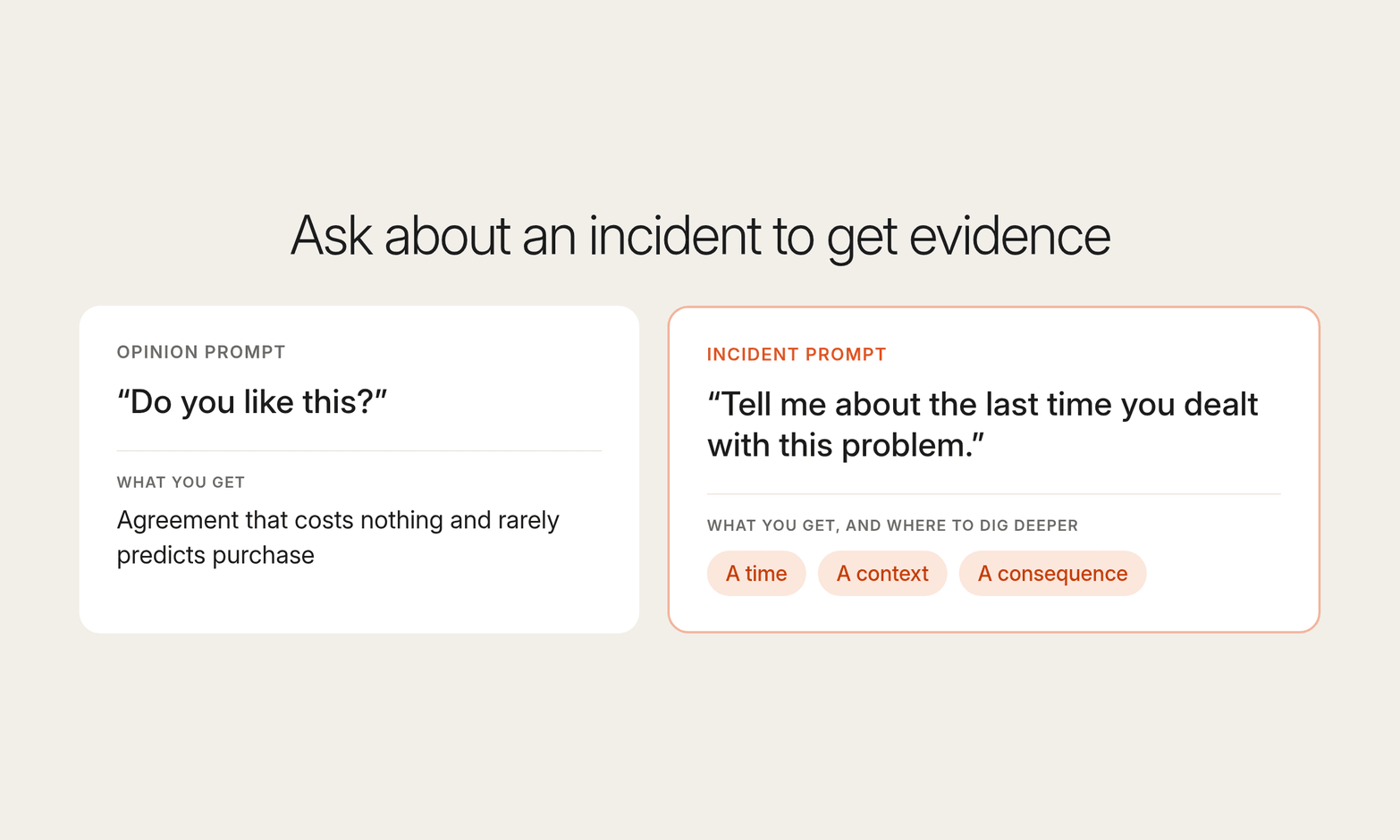
"Do you like this?" produces false positives because liking costs nothing and rarely predicts purchase. In a group, participants also align with whoever spoke first.
"Describe this in three words" returns adjectives with no event attached, which is feedback no team can act on.
| Avoid | Use |
|---|---|
| "Do you like this?" | "Tell me about the last time you dealt with this problem." |
| "Describe this in three words" | "Tell me about a moment this delivered or didn't." |
The principle is incident-based questioning. An incident has a time, a context, and a consequence, and each one gives the moderator a place to dig deeper. Conveo's screener questions apply the same principle: they set qualifying answers on direct experience with the task and run with every recruitment source.
If participants can answer a question without recalling a real moment from their daily routine, it will produce opinion rather than evidence.
Sample focus group questions by decision type
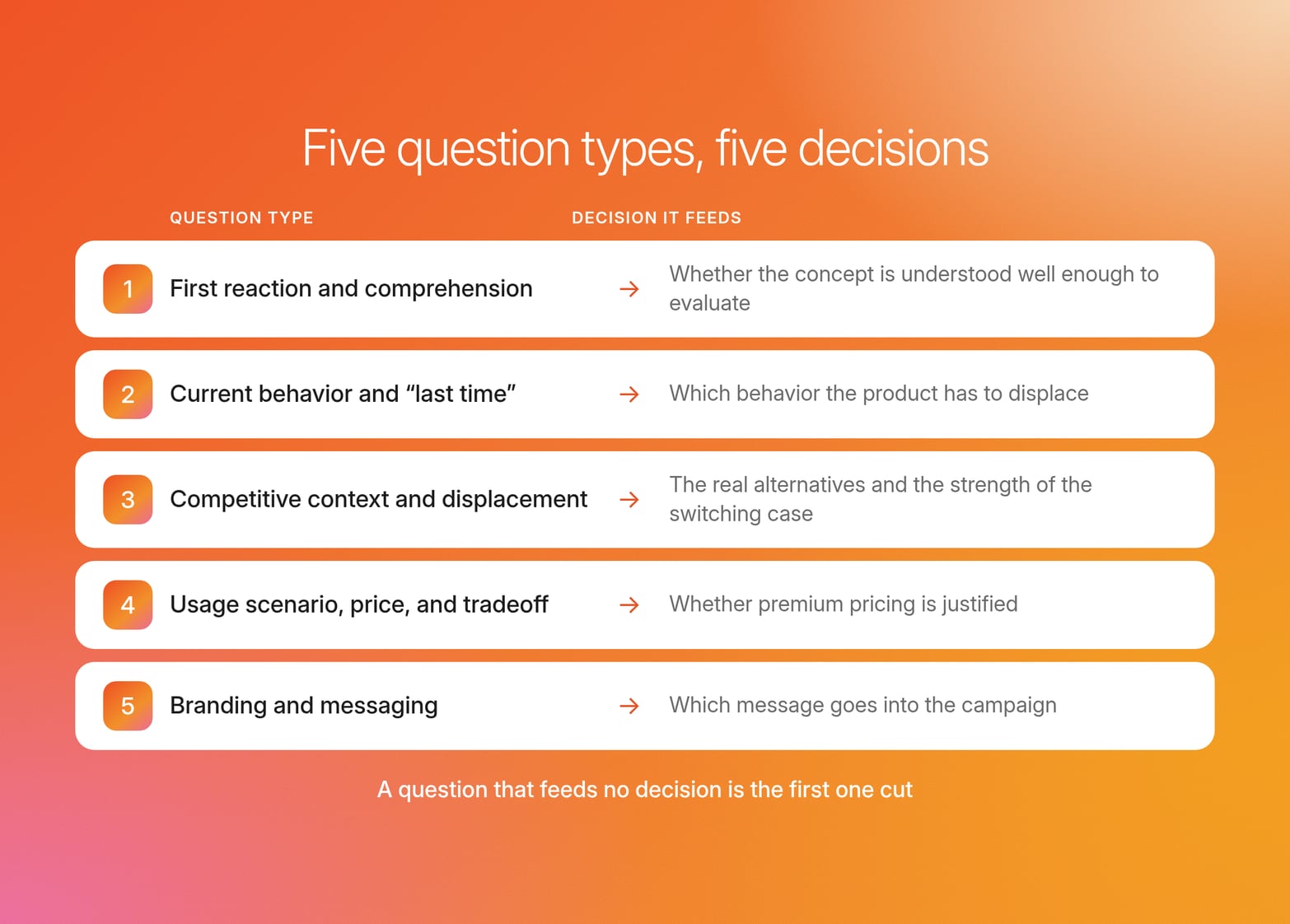
The most useful focus group question examples are organized by the decision they inform, because different kinds of questions feed different stakeholder documents.
1. First reaction and comprehension questions
These focus group discussion questions show whether participants grasp the concept and which aspects stand out, before anyone debates its merits. Capture first reactions before any probing.
"In your own words, what is this?"
"What is the first thing you notice?"
"What, if anything, is unclear?"
"Who do you think this is for?"
Skip comprehension, and you end up measuring reactions to confusion rather than perceptions of the concept. For a fuller set, see our concept testing questions.
Decision it feeds: whether the concept is understood well enough to evaluate.
2. Current behavior and "last time" questions
Customer focus group questions about current behavior set the baseline against which every later answer is judged. Ask them before showing any stimulus, or you lose the baseline needed to judge switching friction.
"Tell me about the last time you [did the task]."
"What do you use now to solve this?"
"What happened next?"
"Where does this task sit in your daily routine?"
Decision it feeds: which behavior the product has to displace.
3. Competitive context and displacement questions
Displacement questions test whether a product or service is strong enough to change habits. They also show which similar products participants compare you against and what advantages those alternatives have. These are the questions for focus groups most often cut for time.
"What would make you choose this instead of what you use now?"
"What would you stop using, or stop doing, to make room for this?"
"What would have to be true for you to switch this month?"
"Who else in your household would weigh in?"
Decision it feeds: the real alternatives in consumers' minds and the strength of the switching case.
4. Usage scenario, price, and tradeoff questions
Scenario questions explore whether a concept that sounds good in the room maps to a recurring need, which makes them the earliest read on product fit.
"Walk me through a situation where you would use this."
"How often does that situation come up?"
"What would you expect to pay?"
"What would you have to give up or change?"
Read each price answer against the scenario and the specific features participants named. A high number attached to a rare situation does not justify a premium. Conveo's price testing, live in research preview, runs Van Westendorp or Gabor-Granger inside the interview, with follow-ups on why each person chose their price.
Decision it feeds: whether premium pricing is justified.
5. Branding and messaging questions
Branding questions for focus groups show which claims your target audience would repeat when they talk to friends.
"Which of these statements would you repeat to a friend, and why?"
"What does this brand make you assume about the company behind it?"
"Which statement would you doubt, and what would make it believable?"
Ask participants to restate the chosen claim in their own words. The paraphrase shows what landed and what expectations it set.
Decision it feeds: which message goes into the campaign and shapes the marketing strategies built on it.
Any question that feeds no decision artifact is the first one cut.
How to sequence a focus group question guide before time runs out
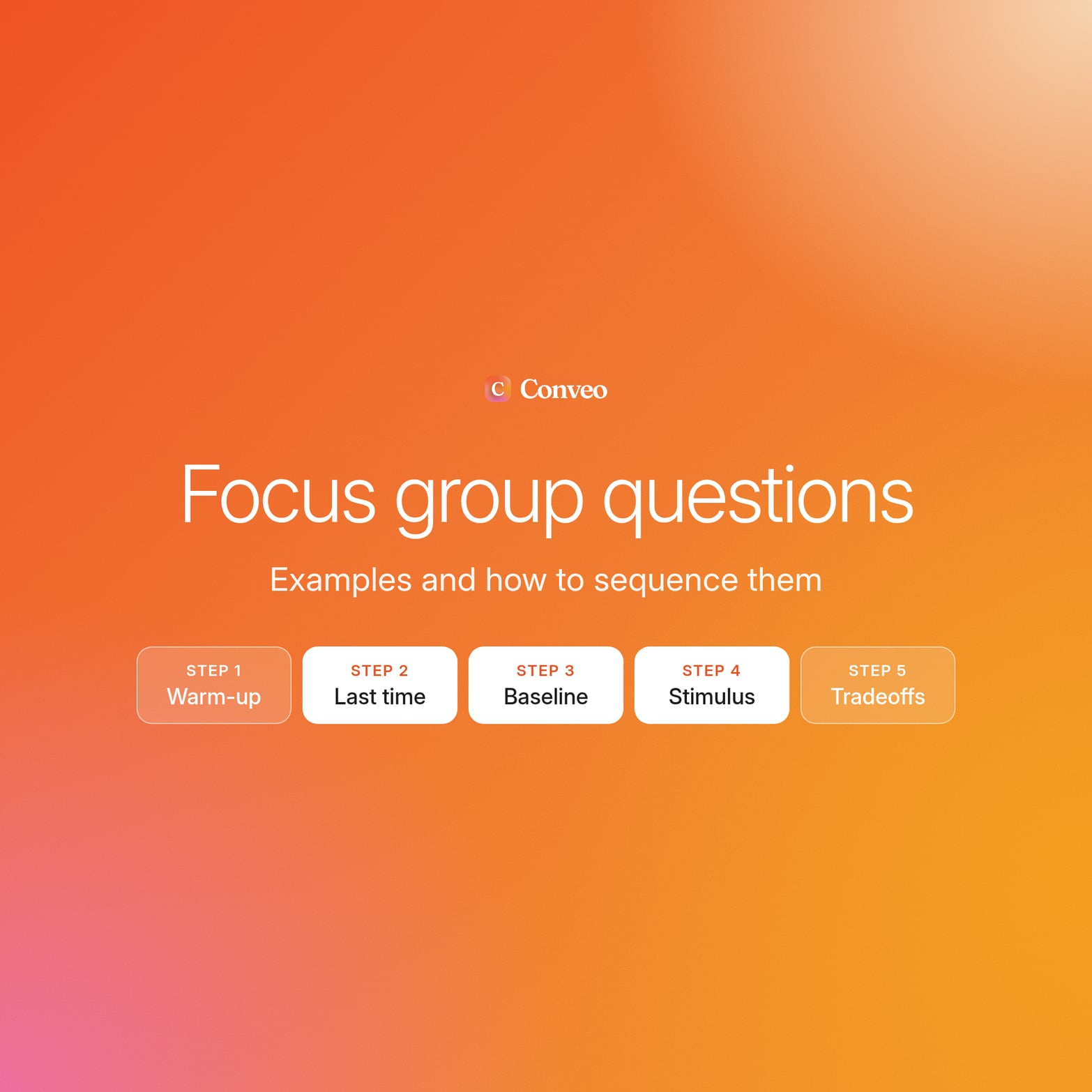
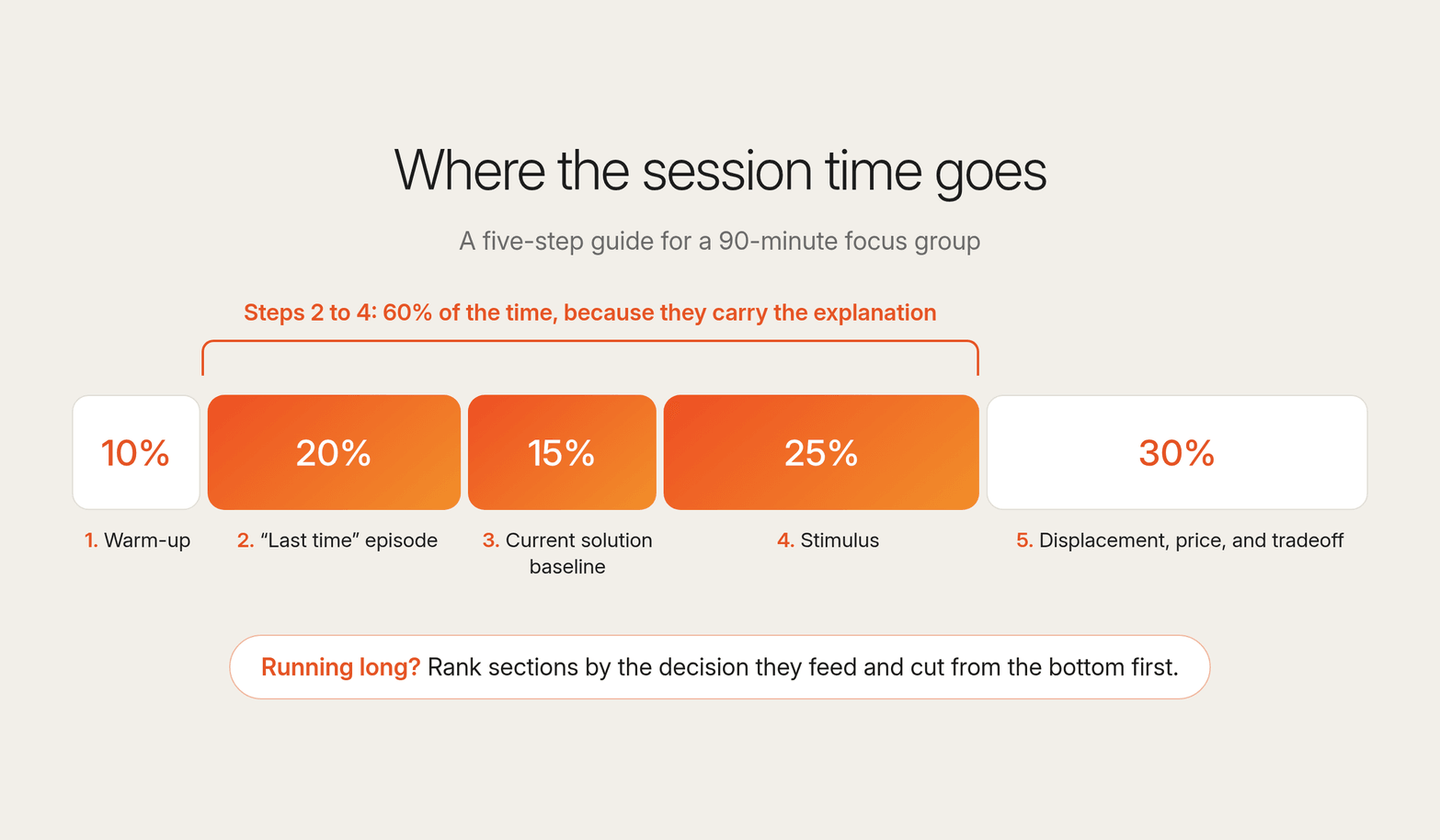
Sequencing a focus group question guide means protecting behavior-explaining questions from the warm-ups that eat up the session. In a successful focus group, order does more work than wording. When designing focus group questions, determine the decision first, then fix the order around it.
| Step | What it covers | Time |
|---|---|---|
| 1. Warm-up | Two introductory questions at most, beginning with a light opening question about how they use the category | About 10% |
| 2. "Last time" episode | Exploratory questions about a recent event | About 20% |
| 3. Current solution baseline | What participants use now, before any stimulus | About 15% |
| 4. Stimulus | First reaction captured before probing | About 25% |
| 5. Displacement, price, and tradeoff | Ends on one or two closing questions | About 30% |
Steps two through four hold 60% of the time because they carry the explanation. Before fieldwork, rank every section by the decision it feeds and cut from the bottom first.
Skip the generic request for final thoughts. Two exit questions worth keeping, because they often surface a concern no earlier prompt reached:
"Is there anything we haven't discussed that you expected to?"
"Before we wrap up, tell me about one more time [the task] didn't go the way you expected."
1. Write the probes into the guide
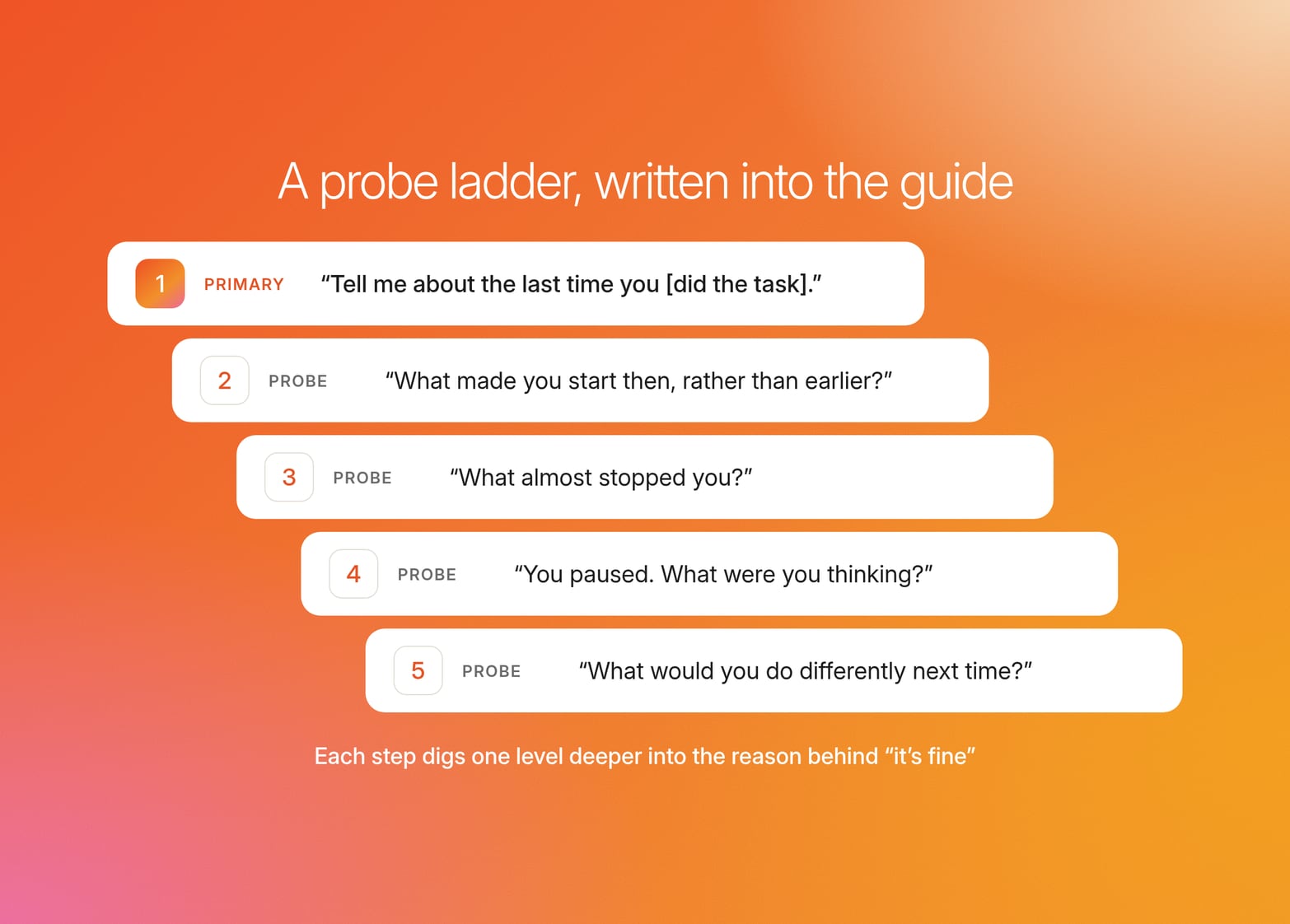
Developing focus-group questions means writing the follow-up beside each question, because the follow-up is where the reason behind "it's fine" shows up. A moderator under time pressure tends to skip it. A sample probing ladder, with each probe built to dig deeper:
Primary: "Tell me about the last time you [did the task]."
Probe: "What made you start then, rather than earlier?"
Probe: "What almost stopped you?"
Probe: "You paused. What were you thinking?"
Probe: "What would you do differently next time?"
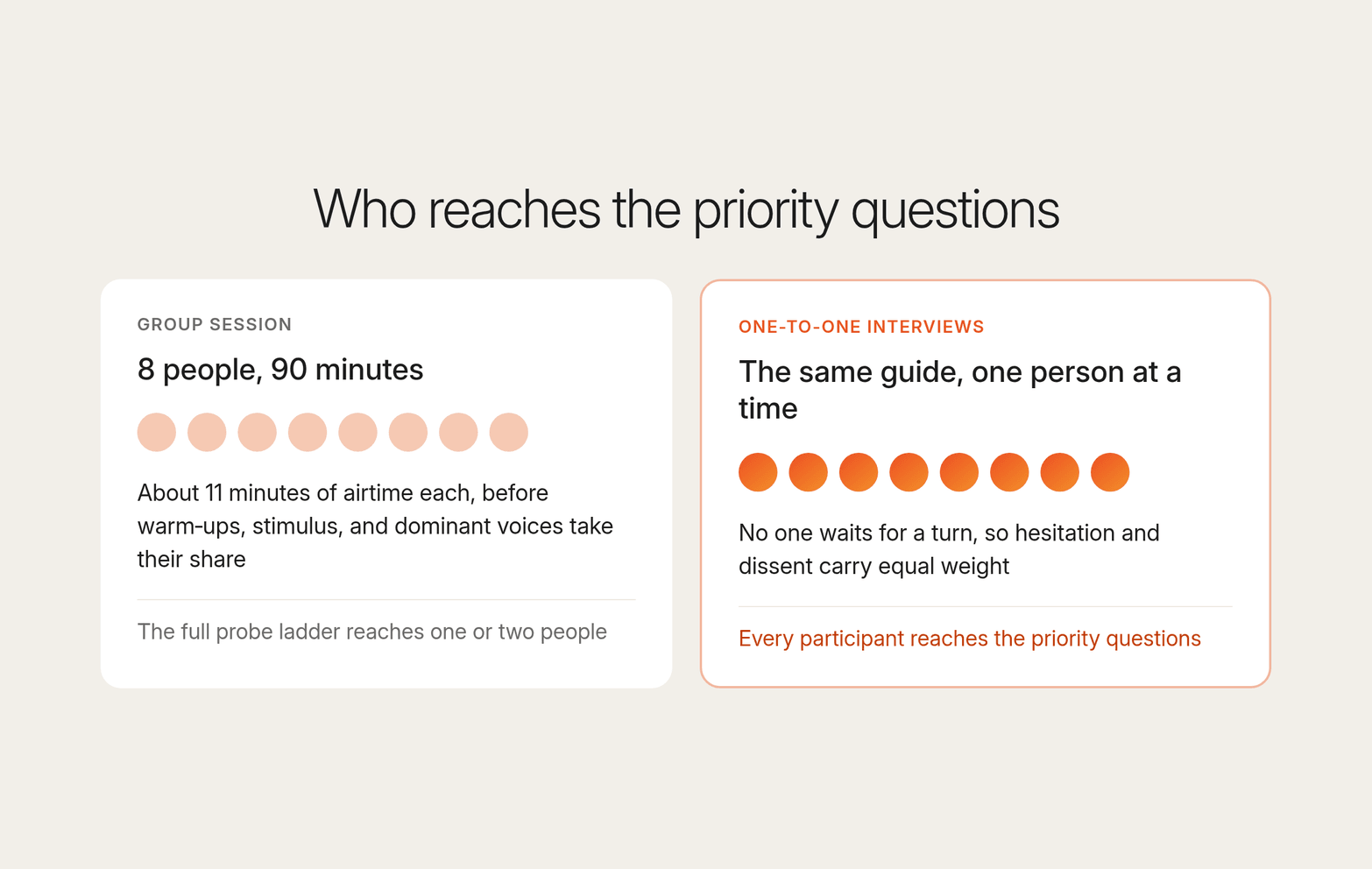
The group format puts this ladder at risk. With eight group members and 90 minutes, each person gets roughly 11 minutes of airtime before warm-ups, stimulus, and dominant voices take their share. In practice, the full ladder reaches one or two people.
2. Recruit for the "last time" step
The "last time" step fails when participants lack relevant experience. Write screening survey questions on three factors: category use in the last 3 months, purchase frequency, and who in the household buys. Participants who are only interested in the topic lack the firsthand knowledge the episode needs. For segmentation work, plan 5 to 15 participants per behaviorally defined segment of your target audience.
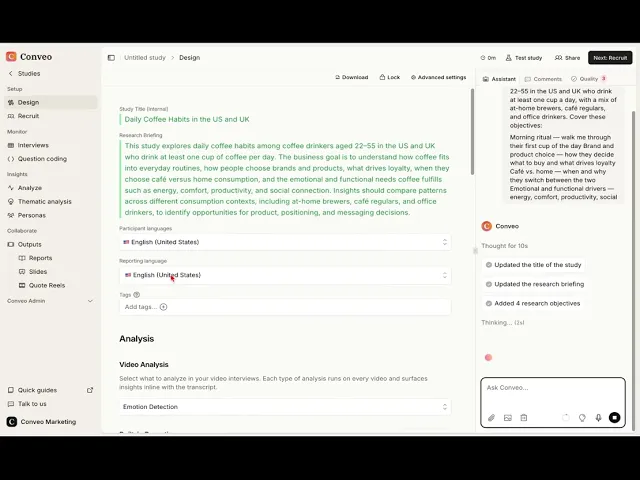
With Conveo, every participant reaches the priority questions: the same guide runs one-to-one with each person, so answers compare across the full sample.
Watch the walkthrough: Building a Study on Conveo From Scratch
Where one-to-one interviews answer what group sessions cannot
Conventional focus group questions often fail: the moderator runs out of time, and the questions that explain behavior never get asked. That makes format a choice to make around the priority questions.
| Group session | One-to-one interview | |
|---|---|---|
| Airtime | About 11 minutes each for eight people in 90 minutes | Every participant reaches the priority questions |
| Dominant voices | One or two confident group members steer the discussion | No one waits for a turn, so dissent carries equal weight |
| Objections | Rarely raised in front of others | Hesitation probes surface what people would not volunteer |
| Evidence | Field notes and paraphrase | Themes link to the participants behind them, with video clips and verbatim quotes |
| Best suited to | Watching a community build on each other's reactions to create new ideas | The questions a decision rests on |
Group sessions still serve co-creation, such as watching a community build on each other's reactions. For priority questions, in-depth interviews let researchers hear objections people would not raise in front of other group members.
Video-based interviews also keep the tone and expression around skepticism, price, and trust that group notes and surveys miss. In Conveo's video interviews, emotions are tagged from face, voice, and words across every session. A participant who calls the price fine while showing hesitation gives the researcher two data points to reconcile.
"You see them physically doing it. Testing the product for the first time, being probed right there. That unfiltered, in-the-moment reaction is possibly the most powerful thing you can see as a researcher."
Dafydd Jones, Associate Director, Ninth Seat
Traceability matters because stakeholders challenge findings they can't trace. Themes that link back to the participants behind them, with video clips and verbatim quotes, help a research team feel confident presenting insights to the wider organization. Because AI-moderated interviews run in parallel, teams can complete 100 interviews in 3 days, so findings arrive while the campaign decision is still open. The researcher still designs the guide and interprets the findings.
For questions that drive a decision, one-to-one qualitative research gives every participant the airtime a group can give only a few.
Multi-market focus group question design: translation and equivalence
Multi-market question design standardizes each question's intent while allowing the wording to change by language.
Translate for meaning, since a literal translation can turn an open question into a leading one.
Test idioms and examples for local equivalence, so a scenario familiar in one market does not read as foreign in another.
Keep priority questions identical in intent across markets, so answers remain comparable.
Back-translate the priority questions before fieldwork, because drift in intent costs more there than anywhere else in the guide.
Conveo runs interviews in 50+ languages, so the same guide can be fielded across markets without a separate vendor per country.
Considerations for European fieldwork:
Avoid US-centric analogies, such as Thanksgiving shopping or 401(k) plans, because participants end up answering the analogy instead of the question.
State consent, recording, and data handling in the guide itself. Conveo gives that language infrastructure to point to: SOC 2 Type II and ISO 27001:2022 certified, GDPR compliant, EU hosting (Belgium).
Comparable answers to the same focus group questions across markets come from shared intent.
Where Conveo fits into your question guide
A strong question guide still depends on the format it runs in. With Conveo, the guide in this article runs one-to-one with every participant:
The sequencing and probing ladder reach every participant in the sample.
Screener questions set qualifying answers on direct experience with the task, across every recruitment source.
Each theme links to the participants behind it, with video clips and verbatim quotes stakeholders can audit.
Compliance is in place for European fieldwork: SOC 2 Type II and ISO 27001:2022 certified, GDPR compliant, EU hosting (Belgium).
Findings arrive while the campaign decision is still open. Teams at Google, Unilever, and Canva use Conveo for research like this.
Frequently asked questions
What are examples of good focus group questions?
Strong focus group questions ask about real events and tie to a decision. Examples include "Tell me about the last time you [did the task]," "What do you use now to solve this?", "What would make you choose this instead of what you use now?", and "Which of these statements would you repeat to a friend, and why?"
Do focus group questions need to be different for one-to-one interviews versus group sessions?
The questions can stay the same. What changes is probing depth: in one-to-one, every participant gets the full probing ladder and follow-up questions, whereas in a group, you reach one or two people in the time available.
How many focus group questions should a guide include?
Fewer than most teams plan for: roughly 10 to 12 main questions for a 90-minute session, each with planned probes. A successful focus group guide built around five steps (warm-up, "last time" episode, current solution baseline, stimulus, and tradeoffs), with a capped two-question warm-up and short closing questions, protects time for the "last time" episode and the tradeoff questions that carry the decision.
What's the difference between a focus group question and a survey question?
A focus group question is open-ended and built to surface the reason behind behavior through a follow-up. A survey question is built to produce a rating or a rank.
How do you adapt focus group questions for multi-market research?
Translate for intent rather than literal wording, test examples for local equivalence, and back-translate the priority questions before fieldwork.
How many participants do you need per segment in a behaviorally defined study?
Plan for 5 to 15 participants per segment, recruited on category use in the last 3 months, purchase frequency, and who in the household buys. See [sampling methods in qualitative research](/insights/sampling-methods-in-qualitative-research) for how to set segments.

About the author
Meg Gerli
Research Impact Lead
Meg is a Research Impact Lead at Conveo, working with insights and research teams on the studies they run with Conveo.
Meet Meg on film →Qualitative insights at the speed of your business.
Conveo runs AI-moderated video interviews and structures everything they say.