In this article
TL;DR
Pricing research is the structured study of what consumers will pay, what they compare a price against, and why they react as they do.
Single-method pricing studies (a survey, a range, a curve) return a number without the reasoning that produced it.
Combining Van Westendorp, Gabor-Granger, MaxDiff, and open conversation, as Conveo does in one session, lets teams present a price with documented reasoning stakeholders can inspect.
The decision (a launch price, a pack-size change, a premium sub-line) should set the method choice.
A pricing decision closes on a date, whether or not the pricing research behind it is ready. Once it closes, the reasoning that should have shaped it either exists on record, or it doesn't. If it doesn't, the next price challenge gets argued from memory.
Most teams know what consumers will say they are willing to pay. Few can say why. Pricing surveys capture price ranges, but they miss reactions and objections when the price is revealed. Without that reasoning attached to each number, the next price change gets defended with data that cannot explain it. The next study then inherits the same problem.
This article covers the core pricing research methods, when each one fits, and how to run them so every number arrives with the reasoning attached.
What pricing research is and why one method is not enough
Pricing research is the structured study of what consumers will pay, what they compare prices against, and why they react the way they do. Price sensitivity analysis is one part of it: measuring how demand changes as price moves. Together, they determine customers' willingness to pay and the logic behind it.
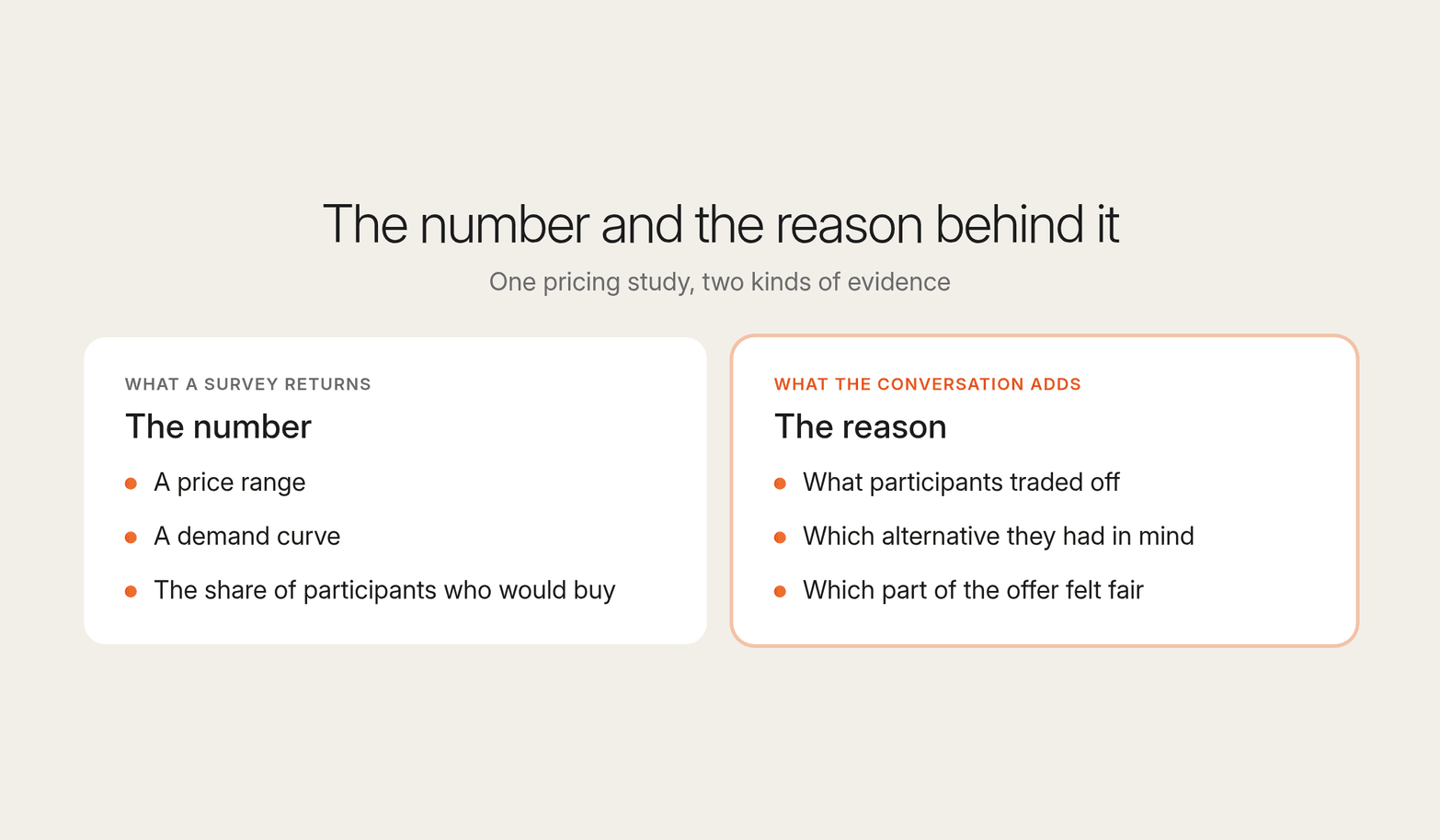
In practice, market research on pricing often collapses into one method, usually a survey. Surveys collect data quickly and produce clean pricing data: a range, a curve, or the share of participants who would buy. It does not record what participants traded off, which alternative they had in mind, or which part of the offer felt fair. The team ends up with a number and no account of how target customers arrived at it.
Missing reasoning costs you the moment the price is challenged. A brand director asks why demand breaks at a certain point, or a category team asks whether the threshold holds for lapsed buyers. The study has no answer, so the debate over the right price turns on opinion. The team that commissioned the research loses the argument it paid to win.
Pricing research helps build an effective pricing strategy only when it explains its own findings. A pricing study needs both the number and the reason attached to it. Conveo's view is that both should come from the same participant in the same session, so neither has to be reconstructed later.
Pricing research methods: when to use each
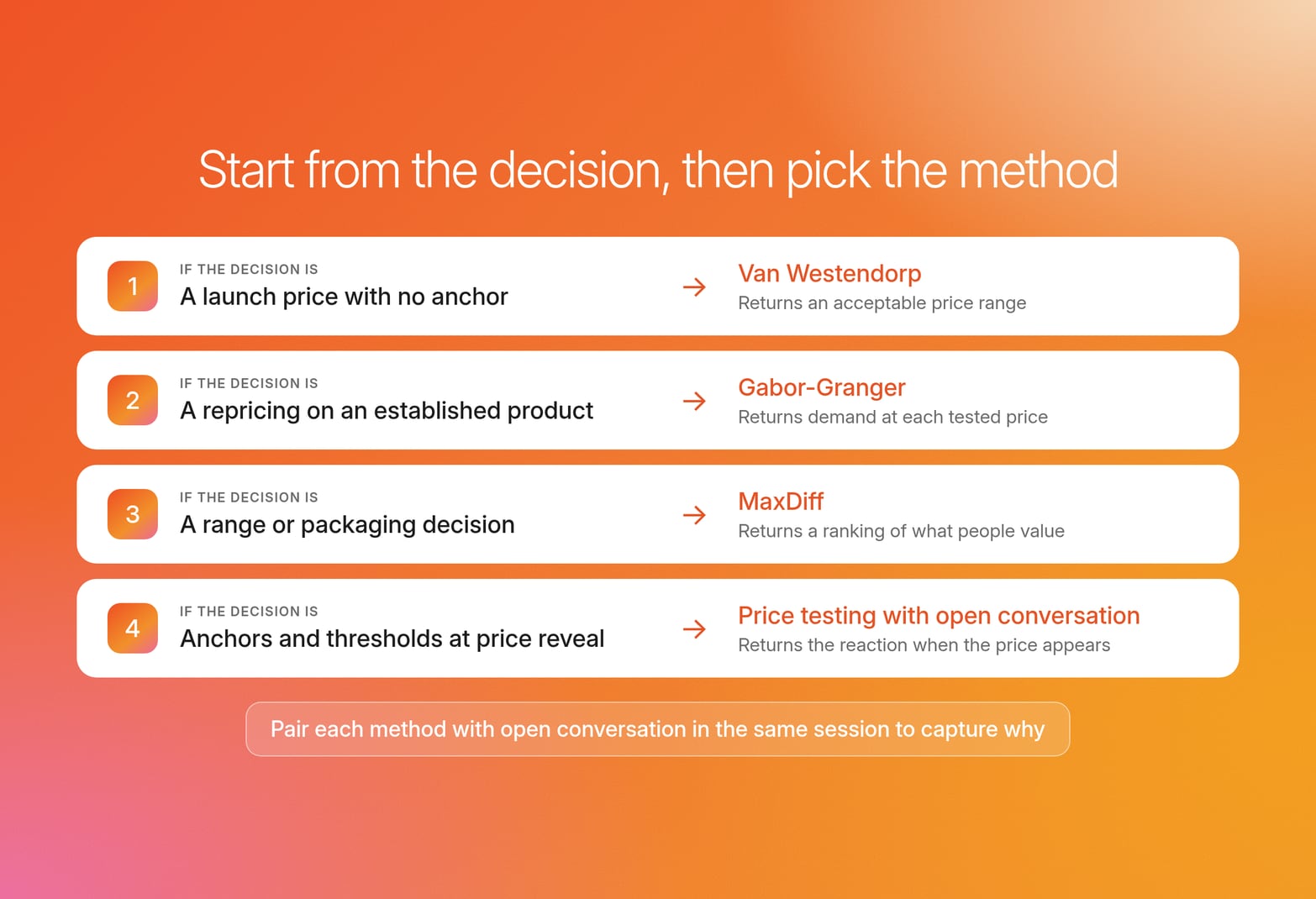
This section covers the four core pricing research methods and the decision each one answers. Every method below follows the same order: what it measures, the decision it fits, what it cannot tell you, and how to read the result. The closing table sets all four pricing techniques side by side for quick selection.
Conjoint analysis and its close relative, discrete choice modeling, sit one level up from these four. They test price as one attribute among several product features, which suits complex portfolio decisions but adds design time.
1. Van Westendorp price sensitivity meter
The Van Westendorp price sensitivity meter asks participants four questions (too cheap, cheap, expensive, and too expensive) to map an acceptable price range.
Among pricing research techniques, it fits early-stage products and new categories where no price anchor or pricing norms exist yet. Its limit is explanation: the range shows where price feels wrong and leaves the reason unrecorded. Low prices, for example, can erode perceived value, and the meter cannot say why.
Read the intersection points as the bounds of the ideal price range, with the indifference price point marking where "cheap" and "expensive" responses cross. Treat them as boundaries for the recommended price.
2. Gabor-Granger
The Gabor-Granger pricing method asks participants to respond to a sequence of different price points, and their answers produce a demand curve.
It fits setting or adjusting the price of an existing product or range, where the team already has a realistic set of prices to test. It helps determine demand at each tested price point. Its limit: a curve shows where demand falls and leaves the driver of the drop unexplained.
To read it, multiply stated demand by price at each point to find the optimal price point for maximum revenue. Then check that point against the reasons participants gave before committing to it. Once margin enters the model, the profit-maximizing price can differ from the revenue-maximizing price.
3. MaxDiff
In MaxDiff, participants repeatedly choose the most and least valued item from a set, producing a preference ranking. Of the pricing research methodologies here, it fits the packaging decision: which product features or benefits justify a premium price or sub-line.
MaxDiff shows what people prefer. On Conveo, the AI research assistant asks why each participant picked their best and worst options, in the same session.
Use the ranking to decide what to bundle and what to fence. Use the follow-up conversation to find the perceived value signal that supports the price.
4. Price testing with open conversation
Price testing shows participants a product and its price together and records their reaction. In monadic price testing, each participant sees one price, so reactions to different prices stay uncontaminated by comparison. In an AI-moderated video conversation, that reaction includes the pause, tone shift, or facial expression at the moment of exposure, signals that rating scales and transcripts erase.
"You see them physically doing it. Testing the product for the first time, being probed right there. That unfiltered, in-the-moment reaction is possibly the most powerful thing you can see as a researcher."
Dafydd Jones, Associate Director, Ninth Seat
In conversation, participants also name the competitor prices they are benchmarking against and say whether the price feels fair, expensive, or suspiciously cheap.
Read the result as three findings:
The default comparison anchor participants use to measure the price.
The price threshold where intent drops.
The stated reason for the drop.
Comparing pricing research methods
| Method | Question it answers | Best fit | What it cannot explain |
|---|---|---|---|
| Van Westendorp | Ideal price range? | New categories | Why price feels wrong |
| Gabor-Granger | Demand at each price? | Repricing existing products | What drove the drop |
| MaxDiff | Which features matter most? | Range and pack architecture | Why items rank |
| Price testing with open conversation | Reaction at price reveal? | Anchors and thresholds | Demand estimates |
How to conduct pricing research with the reasoning attached
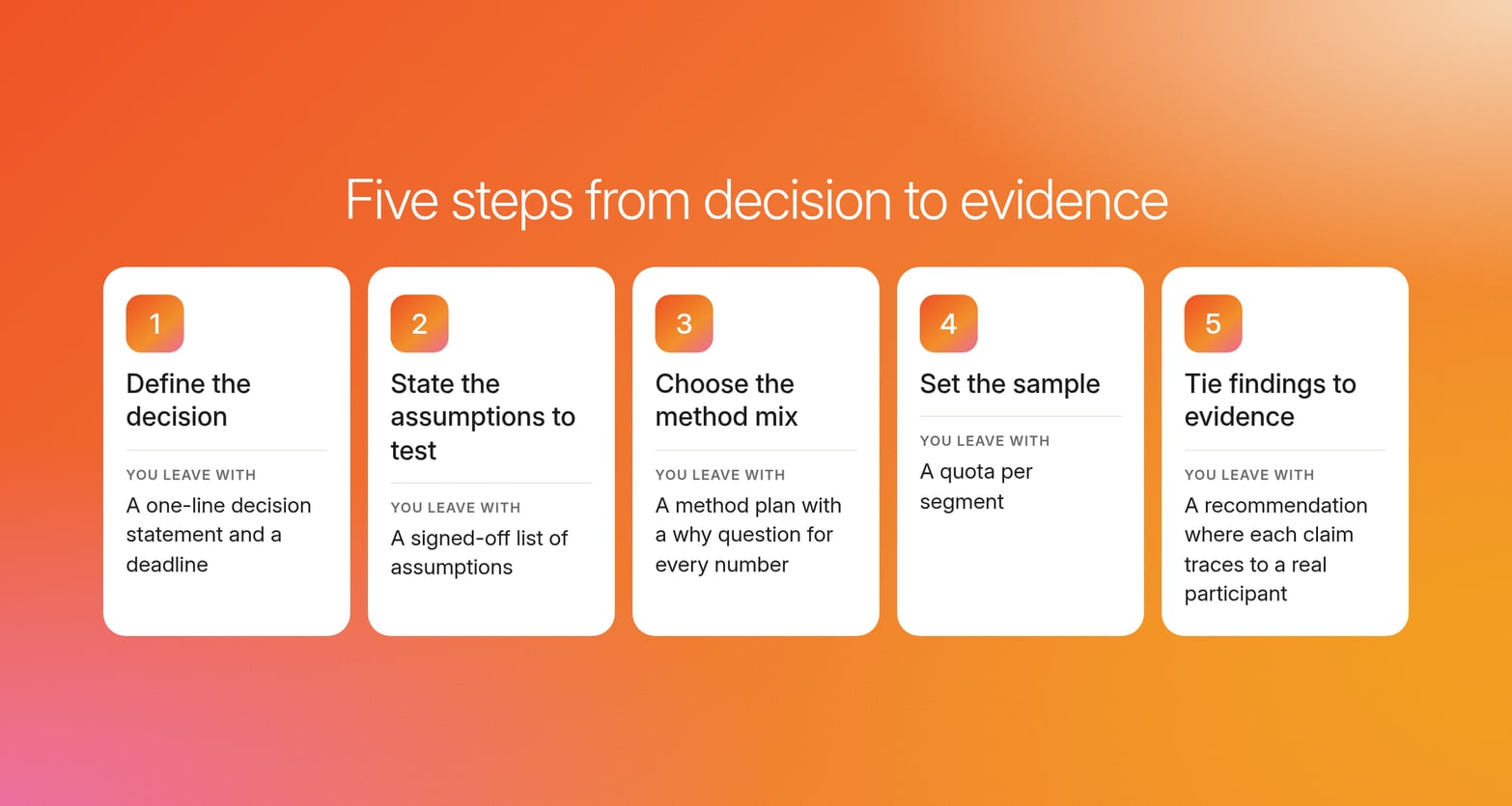
This section shows how to conduct pricing research so each number has a clear reason. The same five steps apply to product pricing research for a launch price and to a mid-cycle pack-size change, and they turn pricing market research into data-driven pricing decisions.
Define the decision. Name the price change, pack-size change, or launch window the study must inform, and set the date the decision closes. State whether the goal is to maximize profit, protect volume, or hold share against a private-label anchor. The team leaves this step with a one-line decision statement and a deadline.
State the assumptions to test. List the comparison anchor, the expected threshold, and the objection the team expects to hear. Agree these with stakeholders before fielding, so nobody reframes the brief once results arrive. The result is a signed-off list of assumptions.
Choose the method mix. Match each pricing method to the decision type, then pair every quantitative method with open conversation in the same session. Pairing each quantitative method with open conversation is mixed methods research inside a single session. For a repricing, that might mean Gabor-Granger with probing at each threshold; for a new concept, monadic price testing across multiple price points. The team ends with a method plan where every number has a matching question about why.
Set the sample. Recruit by segment, and cover existing customers, prospects in the target market, and lapsed buyers when retention is the concern. Recruit from Conveo's 8 integrated panel providers or the team's own list. The result is a quota per segment.
Tie findings to evidence. Link every recommendation to the video clips and verbatim quotes behind it so stakeholders can inspect it. On Conveo, you can open the interviews behind any price tier or outlier. The team ends with a recommendation where each claim traces to a real participant.
Watch the walkthrough: price testing in Conveo, from choosing a method to opening the interviews behind the curve.
In pricing strategy research, timing decides whether any of this reaches the decision. With interviews running in parallel across markets and time zones, findings arrive while the pricing decision is still open, and the team can compare pricing scenarios before the price is set.
Test structure as well as level. A fixed monthly price for a streaming plan or subscription box can trigger fairness objections from irregular users even when the absolute price is acceptable, and a price sensitivity analysis on the monthly fee alone misses this. When "paying full price for a quiet month" is the core objection, pricing research should test different pricing strategies and pricing models, such as pause options or usage-scaled pricing, against the common pricing strategies in the category.
The decision date and the assumptions set the method.
Competitor pricing research without false precision
This section covers what to collect on rival offers and how to connect it to consumer value language. Competitor pricing research examines what rivals charge and which prices consumers actually compare.
Collect competitive pricing data: list prices, packaging, and billing units for each rival offer, alongside your own prices.
Avoid treating a competitor's list price as the real comparison set.
Ask participants which prices they name.
In open conversation, participants explicitly name the competitor prices they benchmark against. Those names often differ from the set the team tracks, revealing the real competitive context shaping willingness to pay. In practice, pricing research that skips this step optimizes against the wrong reference point. A brand price trade-off exercise, a lighter form of conjoint analysis where participants choose between brands at varying prices, can quantify that frame, and open conversation explains it.
When shoppers anchor a premium sub-line to the core range, or to a private-label pack on the same shelf, the price gap makes the offer read as inflated. Positioning, packaging, or messaging then becomes the fix.
In that case, lowering the price tends to give away margin without changing the comparison, and any market share it wins comes at a discount.
Teams find the value signal behind a premium price, such as pack size, a premium ingredient, or a sustainability claim, because Conveo's AI research assistant probes the comparison moment. Value-based pricing depends on that signal, and competitive pricing data alone cannot supply it.
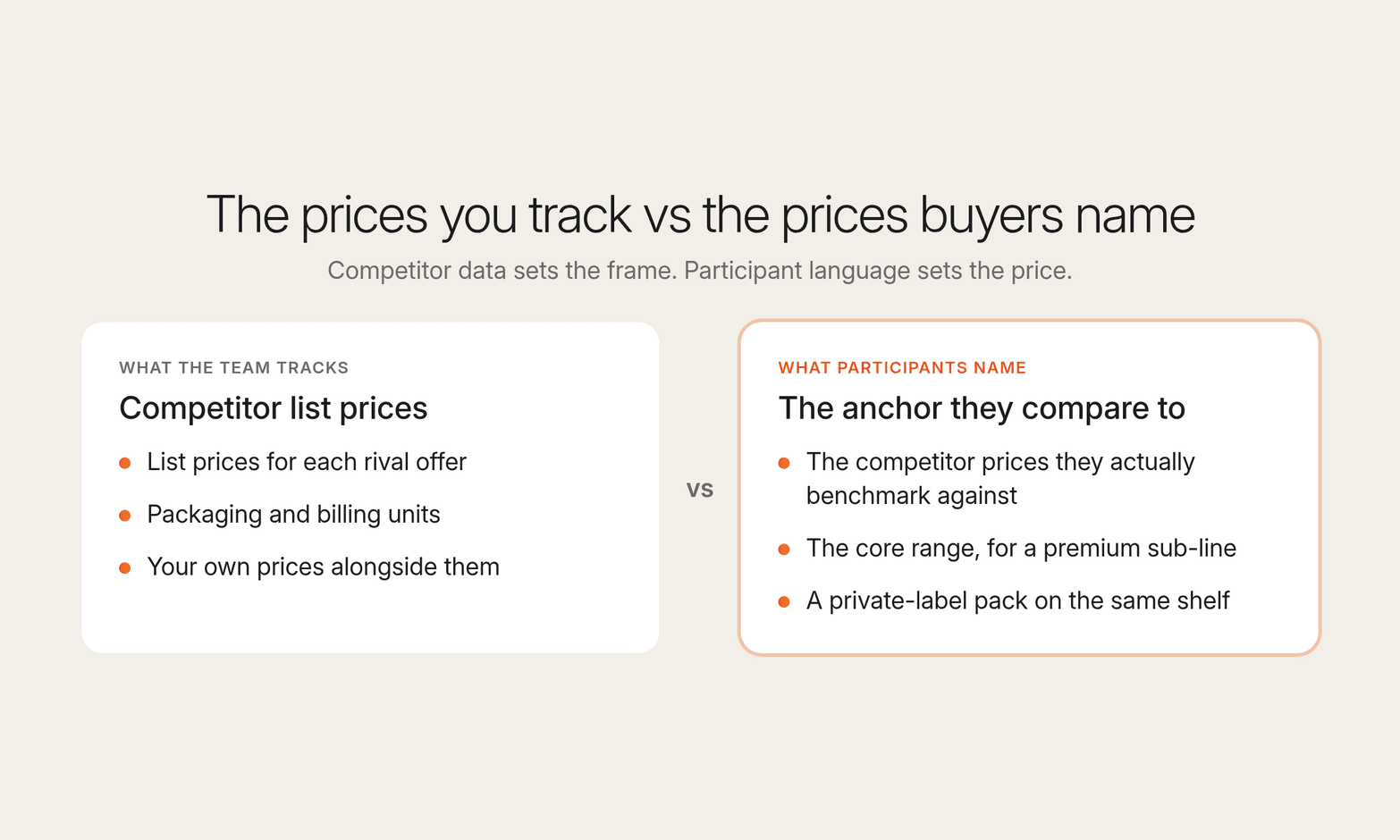
Competitor data sets the frame. Participant language sets the price.
Where survey-only pricing research falls short
A survey returns a number, but the team cannot say what consumers traded off to reach it, so the next price change goes undefended. This is one of quantitative research's core limitations: the number arrives without its reason. Surveys, agency-led qual, and Conveo each handle that gap differently, and each remains a valid choice for some decisions. Four criteria separate them.
| Criterion | Surveys | Agency-led qual | Conveo |
|---|---|---|---|
| Cost at scale | Cheapest directional range | Moderation cost per study | Adds session design and moderation |
| Reaction at price reveal | Stated answer after processing price | Live, probed by skilled moderator | Captured on video in priced interview |
| Speed to decision window | Days | Multi-week cycles | 100 interviews in 3 days |
| Evidence traceability | Aggregate tables | Moderator synthesis, selected clips | Themes linked to participants, clips, quotes |
Pricing surveys remain the cheapest route to a directional range, and agency-led qual's longer cycle suits strategic studies with long horizons.
Teams get the number and the reasoning from the same priced interview, because Conveo runs Van Westendorp, Gabor-Granger, and MaxDiff alongside open conversation. The research team shapes the design and interprets the findings, while Conveo handles the operational work and extends the team's existing practice. Price testing is in research preview: add a Van Westendorp or Gabor-Granger question to the topic guide, and the AI research assistant asks why on the price answers you choose.
Pricing techniques that measure willingness to pay and record its reasons together produce a price a team can present with its reasons on record.
Proof: a Gabor-Granger study with the reasoning attached
This section shows a pricing research study where interviews explained the number. Conveo ran this Gabor-Granger price sensitivity testing study with 399 streaming non-subscribers, comparing YouTube Premium on its own with YouTube Premium bundled with Peacock. The bundle shifted results at each price point tested:
| Result | Premium | Premium + Peacock |
|---|---|---|
| Rejection at $5.99 | 40% | 28% |
| Stated demand at $15.99 | 8% | 15% |
| Revenue-maximizing price | Baseline | +33% |
| Modeled revenue per 1,000 | Baseline | +22% |
The curve showed where demand moved across both pricing scenarios. Interviews showed the lift at $15.99 came from subscription consolidation more than content interest.
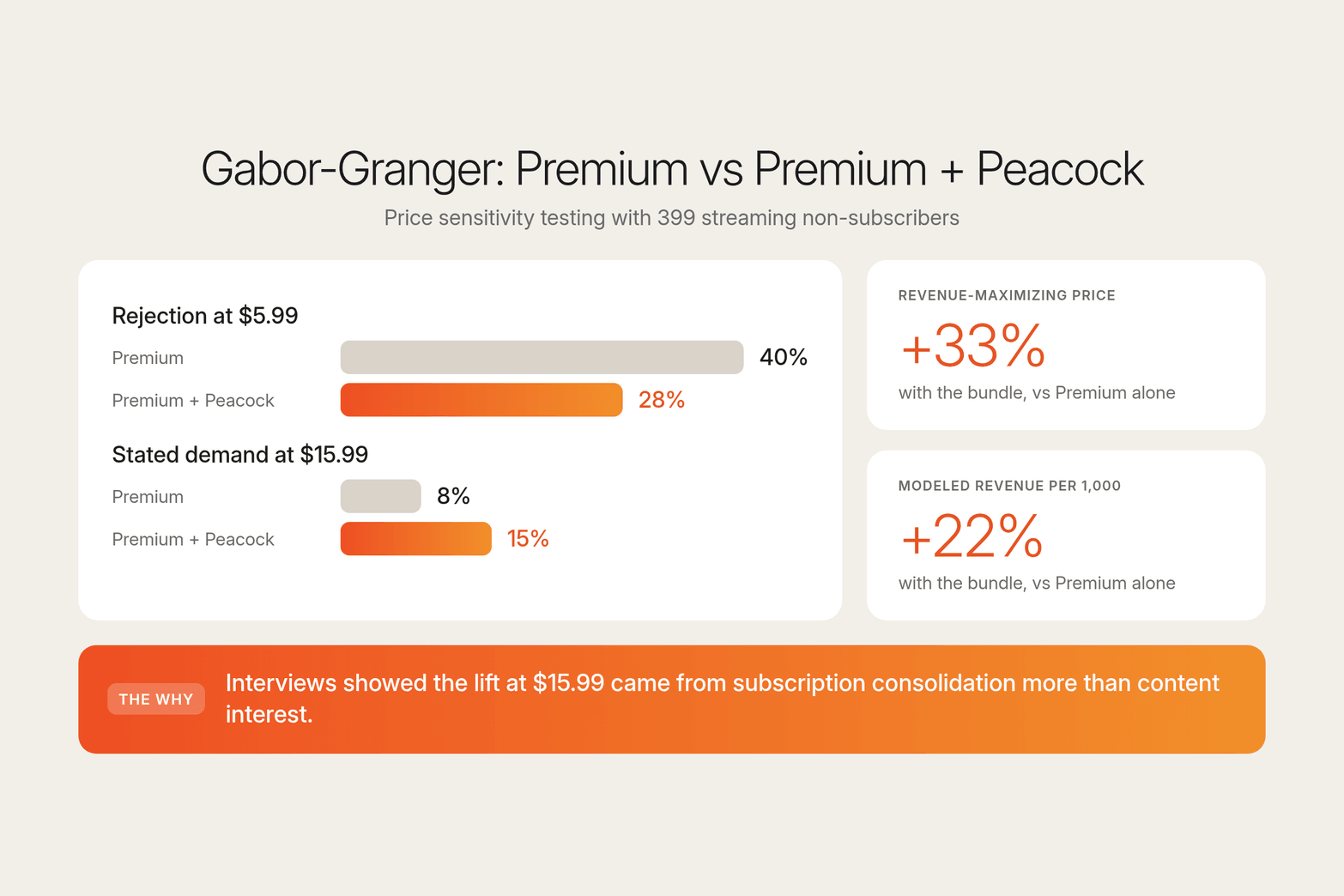
A survey alone would have shown the demand lift at $15.99. The interviews showed that consolidation drove it. That distinction shapes what the team does next, and it is why teams on Conveo capture the reason in the same session as the number.
Stated demand in a test also differs from market demand, so the reasons help the team judge how far the curve will hold after launch.
Reading the curve alone, a team might credit the bundle's content and position it that way. The consolidation finding gives the team a testable message and a rationale stakeholders can inspect.
The number set the price. The reasons told the team how to sell it.
Why connect pricing research to Conveo
Pricing decisions follow their own schedule, so always-on access to consumer reasoning keeps a team ahead of the next price challenge and supports an effective pricing strategy over time. The research team designs the study and interprets the findings, and Conveo supports that work in three ways.
Methods and reasons in one session. Conveo runs Van Westendorp, Gabor-Granger, and MaxDiff alongside open conversation in the same session, so every number already carries a documented reason.
Findings that compound. Recurring themes and facets are recognized across studies in a searchable insight library, so the next wave starts from what earlier ones established and teams have the context to make informed pricing decisions.
Review-ready governance. Conveo is SOC 2 Type II and ISO 27001:2022 certified, GDPR compliant, with EU hosting (Belgium).
Who this fits. Teams facing a specific, dated pricing decision (a launch, a pack-size change, or a premium sub-line priced next to the core range) where the reasoning behind the right price needs to hold up to stakeholder scrutiny.
Who it doesn't fit. A low-stakes, low-visibility price check with little at stake and no need to defend the number later is often served fine by a standalone survey.
Frequently asked questions
What's the difference between pricing research and price sensitivity analysis?
Pricing research is the broader study of what consumers are willing to pay and why. Price sensitivity analysis, using methods like the Van Westendorp pricing model and the Gabor-Granger pricing method, measures how demand changes as price moves, and is one part of pricing research.
Which pricing research method should I start with?
Start from the decision. A launch price with no anchor: Van Westendorp. A repricing on an established product: Gabor-Granger, to find the optimal price point. A range or packaging decision: MaxDiff, usually alongside one of the other two.
Where do conjoint analysis and discrete choice modeling fit?
Use them when price is one of several attributes in play, such as product features, brand, and pricing models. A brand price trade-off study is a lighter variant focused on brand and price together. Each benefits from the same follow-up conversation that explains why participants chose as they did. For packaging decisions, compare [MaxDiff vs conjoint](/insights/maxdiff-vs-conjoint) before choosing.
Can one study combine multiple pricing research methods?
Yes. Pairing a quantitative method (Van Westendorp, Gabor-Granger, or MaxDiff) with open conversation in the same session attaches a number and its reasoning to the same participant. It is the most reliable way to determine optimal pricing with evidence stakeholders can check.
How many participants does a pricing study need?
Sample size depends on the segments being tested. Existing customers, prospects, and lapsed buyers each need their own quota when retention is a concern, so recruit by segment of your target customers. Conveo marks pricing results with a caution below 30 valid respondents, so plan at least that many for each segment you want to read on its own.
Why does price testing with open conversation matter if I already have quantitative data?
A curve or range shows where demand changes. Open conversation in the same session shows what consumers compared the price against and why a given threshold felt fair or unfair, which attaches the reason to the number and helps teams optimize pricing with the right context.

About the author
Florian Hendrickx
Head of Growth
Florian is Conveo’s Chief Growth Officer, leading growth strategy and go-to-market execution as the company scales. He’s held growth leadership roles at companies like Deliverect, Robovision, and Aikido Security, and brings hands-on experience across marketing, sales, and product.
More by Florian →Qualitative insights at the speed of your business.
Conveo runs AI-moderated video interviews and structures everything they say.