In this article
TL;DR
Qualitative research methods help answer questions about why people think and act the way they do.
Each method gives you a different type of evidence. Interviews reveal individual motivations, while diary studies capture how behavior changes over time.
Choosing a method that can't capture the evidence you need leaves you with findings that don't explain the problem you're trying to solve.
This guide compares the main qualitative methods for research and insights teams and how to choose the best one for your project.
When a new research question comes up, it's tempting to reach for the method your team always uses. A survey or a round of focus groups can feel like the safe choice, even when the question calls for something else.
The findings then answer a narrower question than the one stakeholders asked. Fixing that means running a second study, and by the time those answers arrive, the decision they were meant to inform may already have been made.
This guide walks insights teams through the main qualitative research methods, including when to use each one and how to defend the choice to stakeholders.
What qualitative research methods are (and aren't)
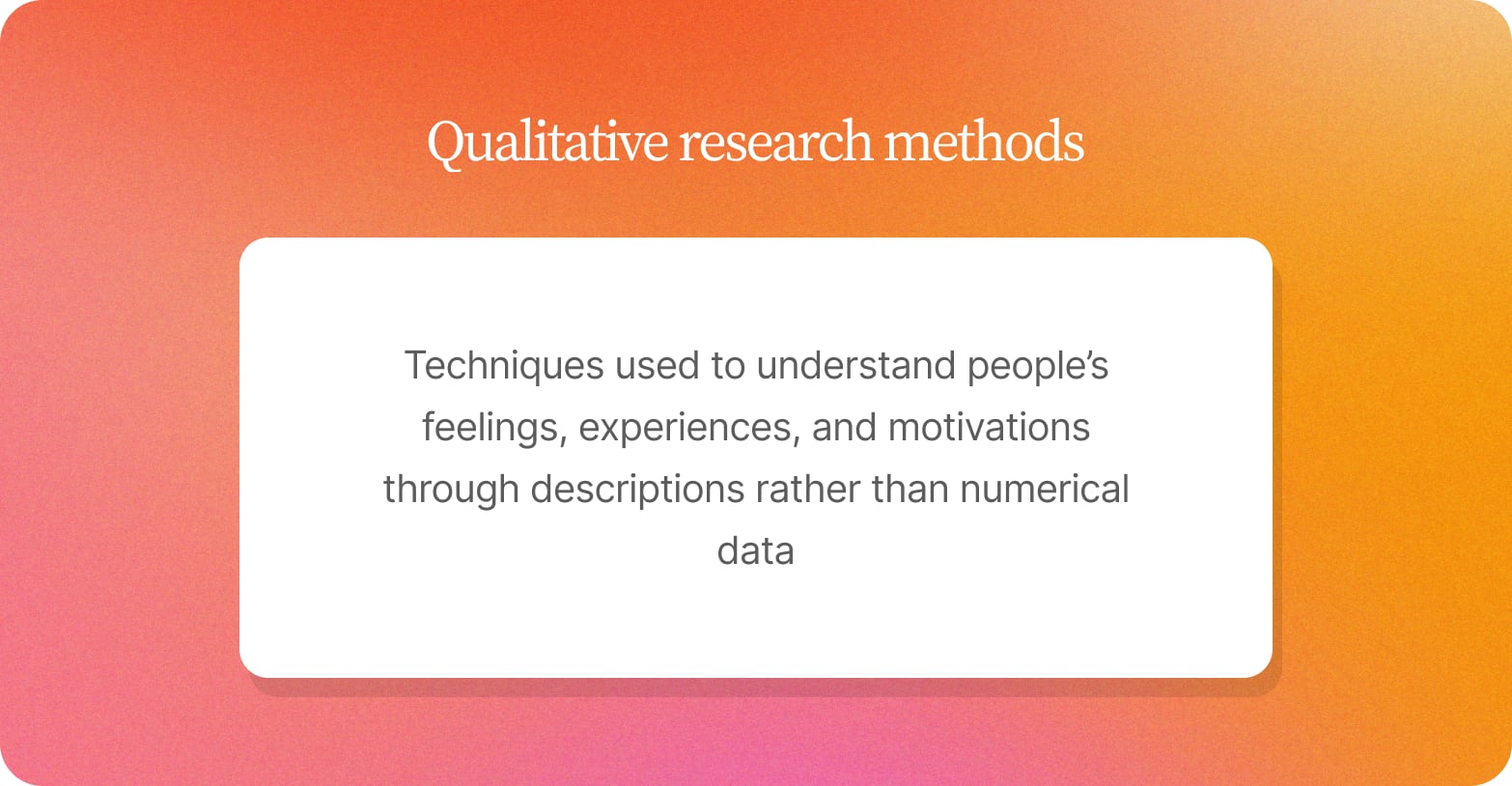
Qualitative research methods are techniques used to understand people's feelings, experiences, and motivations through descriptions rather than numerical data. Researchers collect those descriptions in a structured way, through data collection methods like interviews and observation, and analyze them for patterns in what people say and do.
Qualitative research answers "why" and "how," while quantitative research answers "how many" and "how much." For example, a survey might show that 40% of shoppers stopped buying a snack brand after its pack changed: that's quantitative. Qualitative interviews with some of those shoppers can show why, such as the new pack being harder to reseal.
Teams often use the two together, with the numbers showing the size of a change and the interviews explaining what's behind it.
Why method choice matters more than most teams realize
The type of qualitative research method you choose decides whether your research can answer the question you're asking, and how much detail you get back. But teams often default to what's familiar. For example, surveys are a common starting point because they're quick to set up and cheap to run at scale, even when the question is about why people behave the way they do.
When the method doesn't fit the question, a few things can happen:
Findings that miss the point. The results answer a narrower question than the one the team asked, like how many shoppers switched brands without showing why.
Stakeholders lose confidence. When they ask what's behind a finding and the study can't say, the results can end up set aside.
Budget spent on answers nobody uses. The time and money go into data that can't inform the decision.
A second study to fix it. Rerunning the research with a better-fitting method pushes the answer further from the decision it was meant to inform.
Knowing how to match your research objectives to the best qualitative method gets you findings that answer the question the first time.
How to choose a qualitative research method
Choosing a qualitative method for custom research starts with the kind of question you're asking, then narrows based on the practical limits of the study. Working through both steps gives you a reason for the choice that you can explain to stakeholders.
Most research questions fall into one of three types:
| Question type | What you're trying to learn | Example | Best-fit methods |
|---|---|---|---|
| Explore | What's going on in an area you don't understand well yet | How do parents decide which snacks to pack for school? | In-depth interviews or ethnography. Diary studies if the behavior plays out over time. Focus groups for the language people use about a category. |
| Diagnose | Why something you've already measured is happening | Why did repeat purchases drop after the pack change? | In-depth interviews. Usability testing if the problem sits in a product or website. |
| Test | How people react to a specific concept, product or design | Do shoppers understand the refill instructions on the new pack? | Usability testing, or in-depth interviews with the concept shown during the session |
Next, check the study's practical limits:
If the timeline is short, interviews and usability tests fit better than diary studies or ethnographic research, which follow behavior over days or weeks by design.
For personal topics like health or money, use one-to-one interviews, since focus group participants tend to hold back in front of others.
If the study covers several markets, remote interviews and diary studies are easier to run than ethnography or focus groups, which need a researcher or moderator in each location.
Before you commit to a single method, check what it involves in practice, from the number of participants you'll need to the output you'll hand to stakeholders.
Qualitative research methods comparison table
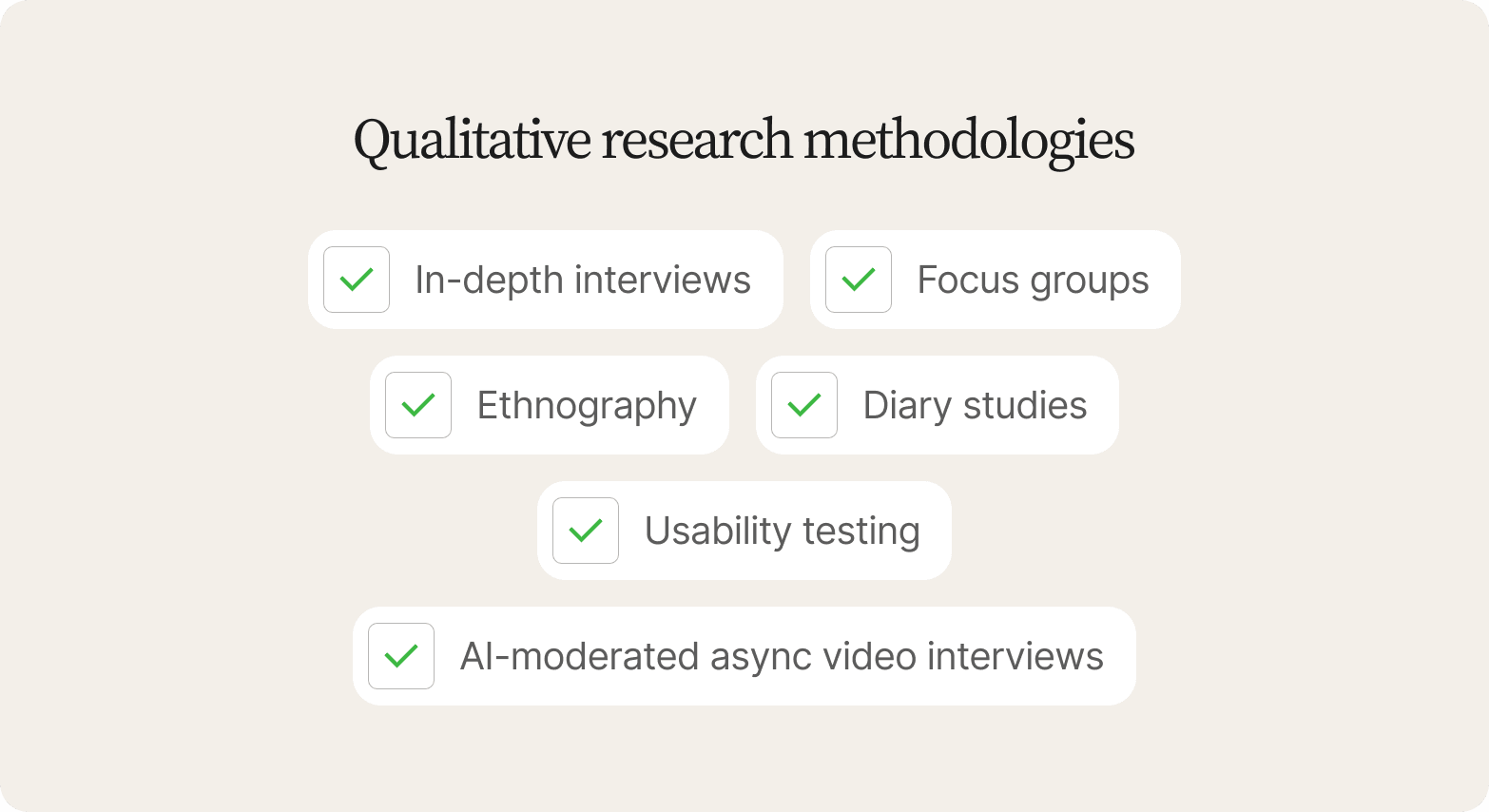
Here's an overview of how the main qualitative research methods compare:
| Method | Best for | Sample size | Session length | Bias risks | Deliverable |
|---|---|---|---|---|---|
| In-depth interviews (IDIs) | Individual motivations and sensitive topics | 8 to 15 per segment | 45 to 90 minutes | Interviewer effect, social desirability | Themes table with quotes and participant IDs |
| Focus groups | Social norms and the language people use about a category | 6 to 8 per group, several groups per segment | 90 to 120 minutes | Groupthink, dominant voices | Consensus themes with dissenting views flagged |
| Ethnography | Behavior in context, including workarounds people wouldn't mention in an interview | Small, often 6 to 12 households or sites | Several hours to a few days per visit | Participants acting differently when observed | Annotated photos or video and behavior maps |
| Diary studies | Behavior that unfolds over time or happens infrequently | 10 to 20 participants | One to four weeks of entries | Drop-off and shorter entries as the study goes on | Timeline of how behavior changed, with dated entries |
| Usability testing | Where people struggle with a product, website, or app | 5 to 8 per round | 30 to 60 minutes | Thinking aloud can change how people behave | Annotated task flows with friction points ranked by severity |
| AI-moderated async video interviews | Interview depth across many participants or markets at once | Dozens to hundreds | Taken in the participant's own time | Unclear core questions repeat in every interview, so pilot the guide first | Themes linked to video clips and quotes |
Explore each method in more detail below.
In-depth interviews (IDIs)
An in-depth interview (IDI) is a semi-structured conversation carried out with one participant at a time. The interviewer works from a set of core questions, with room to follow up on what individual participants say.
IDIs are best suited to understanding individual motivations, for example, choosing a baby formula. They're especially useful for sensitive topics where a group would change what people are willing to say.
However, the interviewer is still an audience, and participants can shape their answers around them. Some pick up on the interviewer's tone or wording and give the answer they think is wanted, known as the interviewer effect. Others give the answer that makes them look good, like overstating how often they buy organic food, known as social desirability bias.
Neutral wording helps with both, and so does asking about a specific recent purchase, since a concrete memory is harder to polish.
What an IDI deliverable includes
An IDI deliverable is often a written report or deck built around a themes table. Here's an illustrative themes table from a study on how parents choose school snacks:
| Theme | What it means | Example quote | Participants |
|---|---|---|---|
| Lunchbox judgment | Parents choose snacks they'd be comfortable with other parents seeing | "I don't want to be the one sending chips in." | P03, P07, P11 |
| Kid veto | Snacks that come home uneaten get dropped after one or two tries | "If it comes back in the bag twice, I stop buying it." | P01, P04, P09, P12 |
Researchers provide the clips from each interview tagged with the relevant theme, with the participant ID and timestamp. When the next study on the same category starts, those themes and excerpts give the team evidence to build on, so the new research begins from what participants have already said.
Focus groups
A focus group is a discussion among a small group of people, in person or online, guided by a moderator. Groups usually include six to eight participants and run for 90 to 120 minutes.
Focus groups are best suited to research where the conversation itself tells you something, like how people talk about a category or how opinions form as they hear each other. For example, a snack brand might run groups to hear which words parents use for "healthy" before it writes new pack claims.
However, group dynamics can also change what people say. One or two confident voices can steer the discussion, and quieter participants may go along with the majority, known as groupthink. On sensitive topics, participants tend to hold back in front of strangers, which makes IDIs the better choice there.
A moderator can limit these effects by asking participants to write down their view before the group discusses it, and by inviting quieter participants in by name. Many teams use both methods: focus groups to hear how people talk about a category, and IDIs to follow up on individual motivations.
What a focus group deliverable includes
A focus group deliverable is usually a topline summary soon after the sessions, then a full report presented to stakeholders. The report shows what the group agreed on and how it got there, including:
Common themes, supported by quotes from participants
Different views, including minority opinions
Changes in opinion, such as someone changing their answer after hearing others
Video clips, where available, to show reactions such as laughter or hesitation
Ethnography and contextual inquiry
Ethnography and contextual inquiry involve observing and talking to people in real-world environments like their home or workplace as they carry out relevant activities. Ethnography takes a broader view of everyday behavior, like observing how someone manages their household shopping over several days. Contextual inquiry focuses on a specific task or activity, like watching someone use a banking app while asking questions.
Both are best suited to behavior people can't describe accurately in an interview, because they've stopped noticing it. For example, while observing someone's household shopping, a researcher might see them check the cupboards before leaving and never look at their list, even though they'd say in an interview that they always shop from one.
Observation also shows the limits of the setting, like a small kitchen with no room for bulk packs, and the workarounds people have built around them, such as buying smaller packs more often.
However, people can act differently when they know they're being watched. Longer or repeat visits help, since people tend to settle back into their usual habits over time.
What an ethnography deliverable includes
An ethnography deliverable tends to be built around visuals from the visits, like a short edited film or a photo-led report, often shared in a workshop with stakeholders. It typically includes:
Annotated photos or video showing relevant behaviors and observations
Behavior maps showing how an activity unfolds across different settings or stages
Contextual constraints that affect how people behave
Participant quotes explaining their choices and workarounds
Diary studies and longitudinal methods
Diary and longitudinal studies involve following participants over time. Both are best suited to behavior that develops across days or weeks, or happens too rarely to catch in a single session.
For example, in a diary study, a brand launching a refill pack might ask participants to log every refill over four weeks to see whether the habit sticks or fades after the first few uses. Longitudinal studies work the same way over longer gaps, like interviewing the same new parents when their baby is three months old and again at a year.
Best practices include giving participants a short, structured prompt for each entry, like "What did you refill today, and did anything nearly stop you?" Letting them add photos or short videos captures details they'd leave out of a written note.
However, entries tend to get shorter as the study goes on, and some participants drop out. Keeping each entry to a few minutes and sending reminders helps keep people engaged through to the end.
What a diary study deliverable includes
Diary study findings are easiest to follow as a timeline, so the report is built around one and walked through with stakeholders in a debrief. Alongside the timeline, it includes:
Behavior changes tracked over the course of the study
Participant entries with dates and times
Themes identified across entries
Photos or videos from participant entries, where available
Qualitative usability testing
Qualitative usability testing is where researchers observe users interacting with a product. The tasks are set in advance, like signing up for a subscription on a brand's website. Participants often think aloud as they work through them, and the researcher asks follow-up questions during or after each task.
For example, a participant might pause at the delivery frequency options and say they can't tell how often they'd be charged. The researcher can then ask what they expected to see, which shows whether the problem is the pricing itself or the way the page explains it.
Quantitative usability testing also exists, and it measures things like how many people complete each task and how long it takes. Teams often run the qualitative version first to find the problems, then the quantitative version to track how often they happen.
Five to eight participants per round is usually enough, since most major problems show up within the first few sessions. Many teams run several short rounds and fix issues between each one.
However, thinking aloud can change how people behave, because explaining each step slows them down and makes them more careful than usual. Keep prompts neutral, like "What are you thinking now?", and watch what participants do as closely as what they say.
What a usability testing deliverable includes
Usability findings need to reach the people who'll fix them, so the deliverable is often a ranked list of problems, shared with the product team or logged straight into their issue tracker. It includes:
Friction points ranked by severity, from problems that stop people finishing a task to minor annoyances
Annotated task flows showing where each problem happens
Video clips of the moments participants hesitated or got stuck
Quotes where participants describe what confused them
How asynchronous qualitative interviews work and when to use them
Remote and asynchronous interviews extend the depth of traditional qualitative research to participants who can't take part in a live session. AI makes this possible: an AI research assistant can run the interview, so the researcher and participant don't need to be online at the same time.
The research team still designs the study, setting the core questions and deciding which topics need a closer look. During each interview, the AI research assistant asks follow-up questions based on what participants say. Once the interviews are in, research automation links each theme back to the participants behind it, with the video clip and quote.
See it in action: how an AI-moderated interview probes a concept reaction.
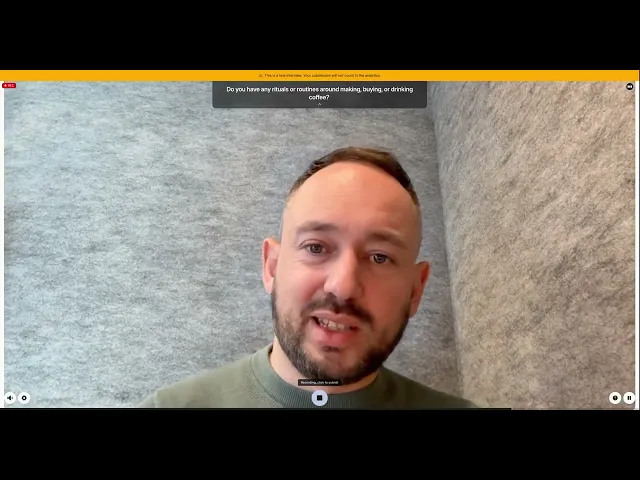
Asynchronous interviews work well when participants need time to reflect before they answer, or when the topic is sensitive and people may share more without someone watching live. They also suit studies across several markets, since participants in every time zone can answer during their own day. They're less suited to research that depends on participants building ideas together.
A checklist for defending qualitative findings to stakeholders
Qualitative findings hold up with stakeholders when you can show how you reached them. Work through these checks when you plan each study, and again before you present the research findings:
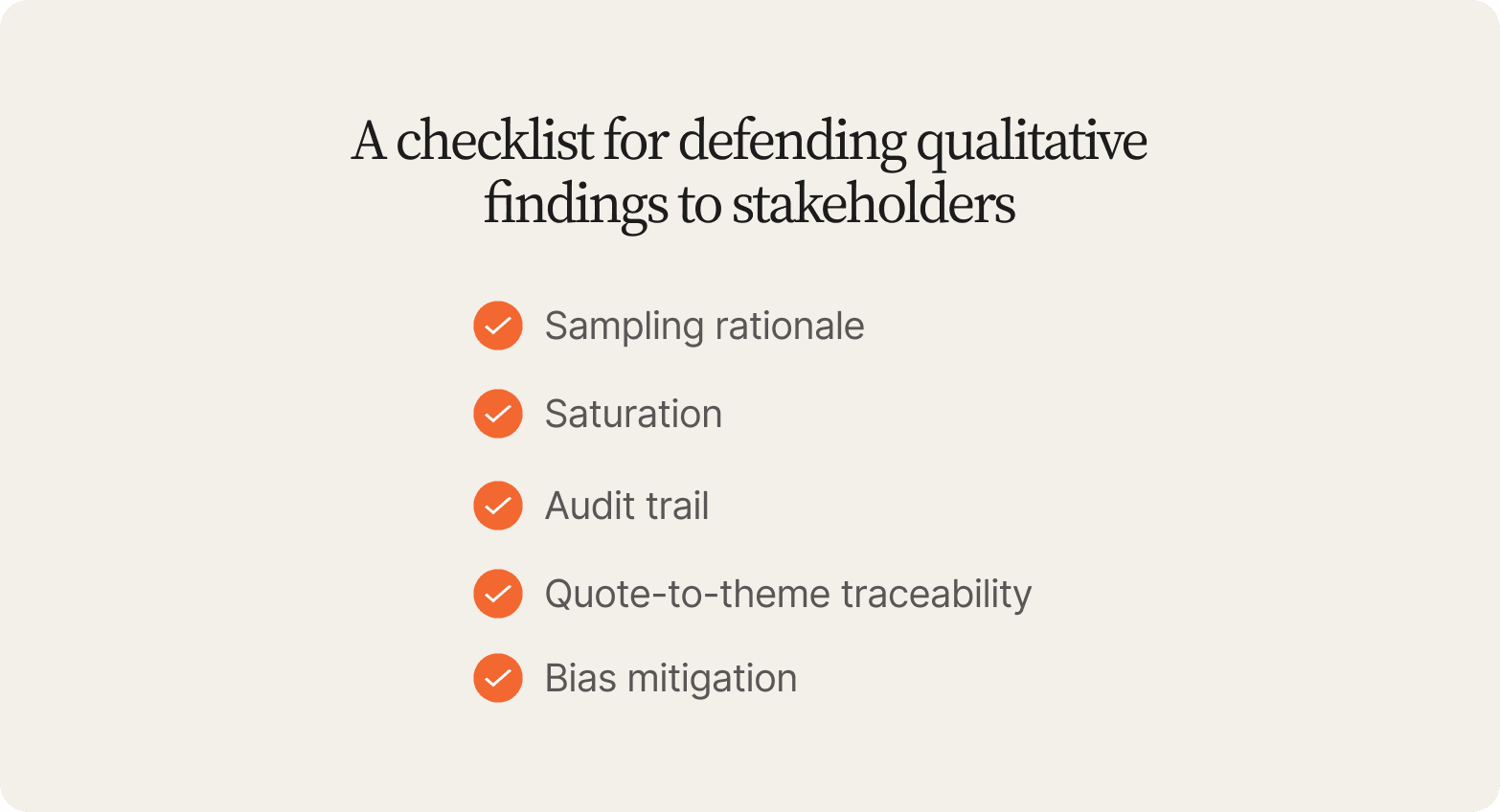
Sampling rationale. Write down who you recruited and why, including the segments you covered and how many participants were in each.
Saturation. Record the point where new interviews stopped producing new themes, which is the usual sign that you've spoken to enough people.
Audit trail. Keep a record of how your codes and themes changed during analysis, so a reviewer can see why the final themes look the way they do.
Quote-to-theme traceability. Check that every theme links to the quotes that support it, and to video clips where you have them. Transcription software makes those links easier to check if your research platform doesn't do it.
Bias mitigation. Note the steps you took to reduce bias, like neutral question wording or asking about a specific recent experience.
Some of these records are easier to keep when your qualitative research tools track them as the study runs, like automatically linking each finding to the quotes behind it.
Where Conveo fits among qualitative research methods
When research needs both individual depth and comparable responses across a larger sample, Conveo extends the one-to-one interview format. Its Consumer Understanding Infrastructure adds every study a team runs to what it already knows. Here's how:
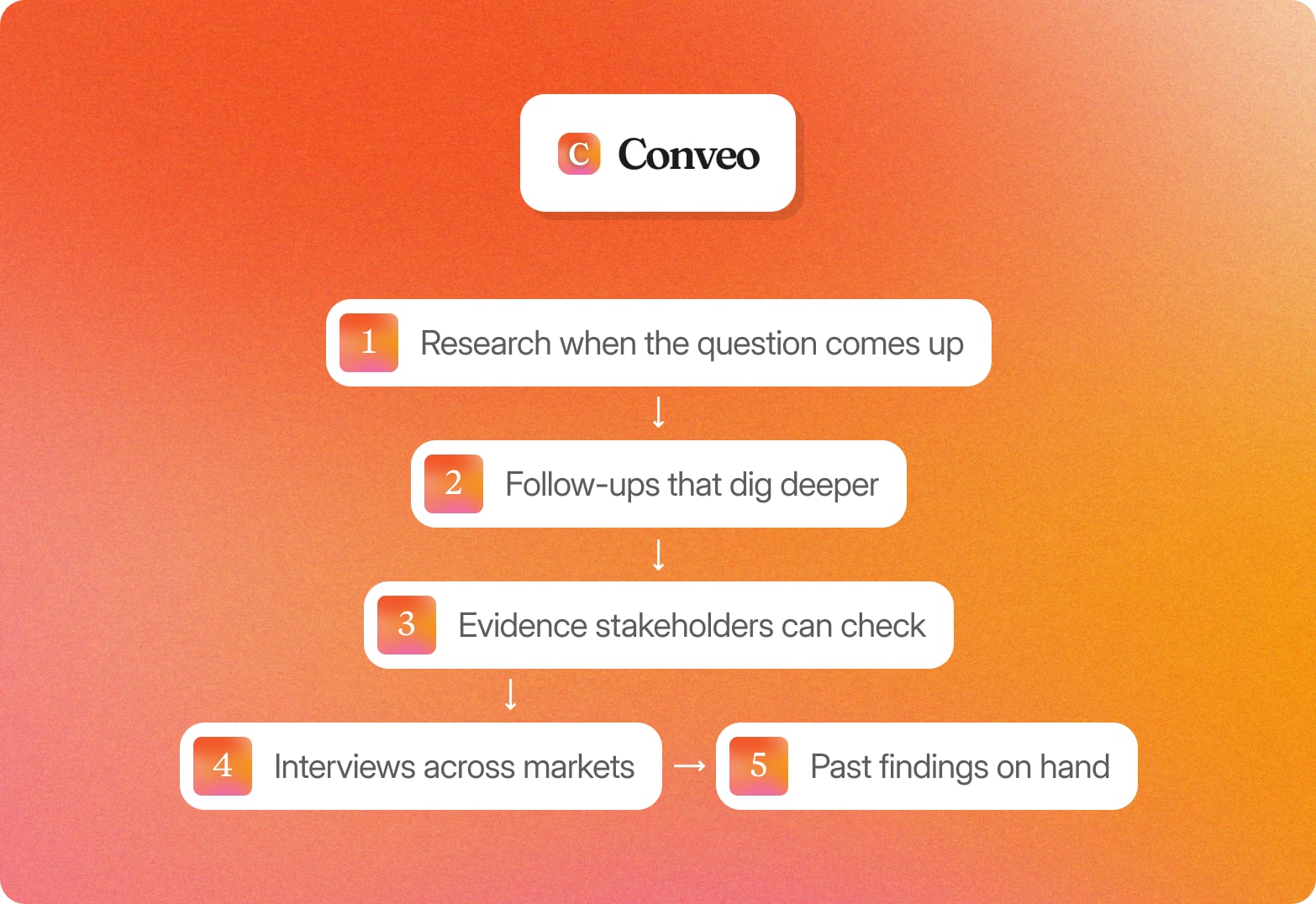
1. Research when the question comes up
New research questions come up throughout the year. Qualitative researchers can investigate each one as it arises, so findings arrive while the decision is still open.
2. Follow-ups that dig deeper
Conveo's AI research assistant asks follow-up questions when an answer is vague, building on what the participant said earlier.
3. Evidence stakeholders can check
Every theme links back to the participants behind it, with the video clip and quote, so anyone reviewing the results can check where a finding came from.
4. Interviews across markets
AI-moderated video interviews run in 50+ languages. Conveo is SOC 2 Type II and GDPR compliant, with data hosted in Europe.
5. Past findings on hand
Every study lands in Conveo's searchable insight library, so when the next study starts, the team can pull up what earlier interviews found.
Choosing the method that fits the question, and keeping the evidence traceable, is what makes qualitative findings hold up when stakeholders ask where they came from.
"The pace, responsiveness, and research expertise of the Conveo team, on top of the top AI-moderated qual platform, has been invaluable to us in scaling brand advertising internationally."
Matt Harris, Research & Insights Lead, EMEA, Canva
Frequently asked questions
What is a qualitative research method?
A qualitative research method is a way of collecting and analyzing non-numerical data to understand how people experience and make sense of something. It gives researchers a more detailed view than numerical data alone can provide.
How do you choose the right qualitative research method?
Start with what you need to learn and choose the method that can answer that question most directly. The "How to choose a qualitative research method" section in this article compares methods based on the type of insight they can provide and how the research is carried out.
What is the difference between qualitative and quantitative research methods?
Qualitative research uses non-numerical data to explore a research question in depth. Quantitative methods use numerical data to measure something and identify patterns. Mixed methods research combines both approaches when a study needs both qualitative and quantitative data.
Can AI-moderated interviews replace traditional qualitative research methods?
AI-moderated interviews can help researchers conduct interviews at greater scale while keeping the research focused on real participants. They extend the researcher's reach, and the study design, judgment and interpretation stay with the researcher.
Can you combine qualitative research methods in one study?
Yes. A study that combines qualitative methods can look at different aspects of the same question, like following interviews with a diary study to see whether what people describe holds up over several weeks. Drawing on more than one data source gives deeper insights and makes it easier to draw conclusions stakeholders will trust.
What are grounded theory and narrative research in qualitative research?
Grounded theory and narrative research are two other qualitative methods, more common in academic and social sciences research than in commercial studies. Grounded theory researchers collect and analyze data at the same time to generate hypotheses from the data itself, and keep going until new data stops adding anything, known as theoretical saturation. Narrative research focuses on the stories people tell about their lives to understand how they make sense of human experience.

About the author
Meg Gerli
Research Impact Lead
Meg is a Research Impact Lead at Conveo, working with insights and research teams on the studies they run with Conveo.
Meet Meg on film →Qualitative insights at the speed of your business.
Conveo runs AI-moderated video interviews and structures everything they say.