
TL;DR
The four core qualitative data types are text transcripts, audio recordings, video recordings, and observational field notes, each capturing a different layer of customer meaning
The real problem isn't understanding these types; it's that evidence scatters across disconnected systems and loses traceability the moment a study closes
Research credibility depends on structured systems where every finding links back to verifiable source material
Qualitative research is undergoing a structural shift. For decades, the richest customer evidence (recorded conversations, observed behaviors, in-context reactions) has been collected at enormous effort and then scattered across shared drives, email threads, and slide decks that no one can search six months later. The insight existed. It just couldn’t be retrieved.
That’s changing. Research teams are moving from fragmented file storage toward structured, auditable systems where evidence stays connected to the findings it supports. When a stakeholder asks for the evidence behind a conclusion, the answer is a clickable video clip and a verbatim quote, not a long email thread and a manual dig through folders. Teams that gather data this way, rather than letting it scatter across tools, are the ones building compounding research findings over time.
Qualitative research focuses on capturing the reasoning, emotion, and context behind behavior, and this article explains what each qualitative data type captures, why traceability matters for research credibility, and how modern research teams structure qualitative evidence into systems that compound organizational knowledge rather than letting it disappear after the debrief. Along the way, we’ll cover the qualitative research methods and qualitative data collection methods that produce this evidence, and the analysis approaches that turn raw material into meaningful insights.
What Is Qualitative Data?
Qualitative data is non-numerical information that captures the “why” and “how” behind customer behaviors, attitudes, and experiences. It’s the output of qualitative methods such as interviews, focus groups, and observation (often grouped together as interviews, focus groups, and observations- the three formats qualitative researchers rely on most), rather than of surveys or metrics. Choosing which of these to run and how to collect data at scale is one of the first decisions qualitative researchers make when scoping a study.
Quantitative data tells you what happened and how often: 60% of users abandoned the checkout flow. Qualitative data tells you what that number actually means: they abandoned because the shipping cost appeared for the first time on the final screen, after they had already committed mentally to the purchase. One number describes a pattern; the other explains it, which is how meaning gets attached to a raw statistic in the first place.
That explanatory layer is what stakeholders need to act. Frequency counts tell a team where to look. Qualitative data helps a team decide what to do next, because it surfaces the customer context, emotion, and reasoning behind any behavioral metric.
Text Transcripts and Open-Ended Survey Responses
Text transcripts are written records of spoken conversations: interview recordings converted to text, focus group session notes, and open-ended survey responses where participants describe experiences in their own words. As a form of textual data, they are among the most common qualitative data types because they’re straightforward to store, search, and share across teams, and they’re a natural fit for qualitative and document analysis alongside other written artifacts like support tickets or open-text survey fields. Most qualitative data collection tools handle this format natively, which is part of why it’s so widely used.
The operational challenge is synthesis, not access. A team sitting on 50 interview transcripts can search for keywords, but that surface-level pass misses the patterns that matter. Manually reading each transcript, applying a coding framework, reconciling codes across researchers, and drafting a thematic summary takes days of analyst time before a single stakeholder can act on the findings. This is one of the more common types of data collection in qualitative research precisely because transcripts are so easy to gather at volume, even if collecting qualitative data at this scale quickly outpaces manual review.
AI-assisted analysis changes the bottleneck. Instead of three researchers spending a week coding transcripts, thematic clusters surface across all 50 sessions within hours, with source quotes attached to each theme. Analysts spend their time interpreting and challenging the output, not producing it.
Audio Recordings
Audio recordings capture spoken conversations without accompanying visual context. As a type of data collected in qualitative research, they surface in phone-based depth interviews, remote focus groups conducted over audio-only platforms, and podcast-style customer conversations where participants describe their experiences in their own words. Many of these sessions follow a semi-structured format, where a moderator works from a discussion guide but lets the conversation follow the participant’s own reasoning.
The operational challenge is significant: raw audio cannot be analyzed directly. Before a researcher can identify patterns, map sentiment, or synthesize, every recording must be transcribed, reviewed, and coded. A researcher with 20 hours of customer interviews faces days of manual work before the analysis begins. That bottleneck compounds when studies span multiple markets or languages, where translation adds another layer before any pattern recognition is possible.
For Research Ops teams managing high study volumes, audio-heavy workflows place real pressure on infrastructure. Platforms that handle transcription, translation, and initial coding automatically as recordings arrive transform audio from an analysis bottleneck into a structured data source that feeds directly into thematic analysis. Conveo’s AI moderation captures audio and video in 50+ languages, then automatically codes and synthesizes responses, so multilingual audio data yields structured insights in days, not weeks.
Video Recordings
Video recordings capture what other qualitative formats cannot: the full human signal behind a response. Video preserves facial expressions, body language, tone shifts, and environmental context alongside spoken words, making it one of the richest sources of textual or visual data a research team can collect.
The use cases are wide: in-depth customer interviews, usability testing sessions, in-home ethnographic walkthroughs, and shopper behavior studies all depend on video to surface what participants show rather than just what they say. Many of these studies are longitudinal, in which the same participants are revisited over weeks or months to see how attitudes shift.
The operational challenge is proportional to that richness. A team with 100 recorded interviews cannot manually scrub through every session to find the moment a customer hesitated before naming a pain point, or the brief frown that preceded an otherwise positive response. That signal gets lost in the review backlog, which means decisions are made based on the sessions researchers had time to watch, rather than the full picture of all the data collected during the research project.
Conveo’s multimodal analysis addresses this directly: every session is automatically transcribed, coded, and analyzed for non-verbal cues, so a tone shift at a price point or a reaction to a product concept surfaces in the findings rather than staying buried in raw footage.
Observational Field Notes and Contextual Artifacts
Observational field notes are written records of what a researcher directly observes: behaviors, physical environments, social interactions, and the small moments that structured interview questions rarely surface. They appear most often in in-store shopper studies, workplace ethnographies, and in-home product usage documentation, where the goal is to capture what people actually do rather than what they report doing, and where contextual factors like store layout or household routine shape the findings as much as anything a participant says out loud.
The operational challenge is that field notes are inherently unstructured data. A researcher watching shoppers navigate a retail aisle might capture 20 minutes of handwritten observations about hesitation moments, abandoned products, and label-scanning behavior. Those notes carry real signal but typically stay in a personal notebook, are partially transcribed into a study debrief, and never enter a searchable system that future studies can draw on. This is one of the types of data gathering in qualitative research that gets the least infrastructure investment, even though it’s often the hardest evidence to recollect after the fact.
Without a structured way to capture, tag, and store observational data alongside interview transcripts and video recordings, field-based evidence remains the most underused asset in a research function’s knowledge base. Conveo’s knowledge library solves this by centralizing all qualitative data types, including field notes, into a single searchable system, making evidence from past studies retrievable for future research rather than starting from scratch.
Why Qualitative Data Types Matter for Research Teams
The types of data in qualitative research only create value when they can be found, traced, and built upon. Most enterprise teams are not there yet, in part because the data collection and analysis processes are treated as two disconnected phases, run by different people with different tools.
The operational reality for a typical CMI team: 30 studies run over the course of a year, each producing a slide deck that captures headline findings and little else. When a brand manager asks six months later what customers said about a specific packaging claim, no one can answer with confidence. The insight existed. It cannot be retrieved.
This is the stakeholder credibility problem that research leaders rarely name directly. Qualitative findings get discounted not because they lack rigor, but because the evidence chain breaks down at the moment of presentation. A CMO who cannot click from a conclusion back to the verbatim quote or the video moment that supports it will default to intuition. The finding becomes a talking point rather than an input to the decision, no matter how sound the underlying qualitative studies were.
The structural fix is not more headcount. It is platforms that structure qualitative data into auditable systems, where transcripts, video, and coded insights accumulate in one searchable place rather than dying in separate decks. Good data management at this stage is what separates a research function that compounds knowledge from one that starts every research project from zero.
How Modern Research Teams Structure Qualitative Data
Structuring transcripts, video recordings, coded themes, verbatim quotes, and synthesized outputs into a single connected system is what separates research that builds organizational knowledge from research that disappears after the debrief.
Three operational requirements define what a well-structured qualitative data system needs, and they should map back to a study’s original research objectives. First, traceability: every synthesized theme must link back to the source quote or video clip that supports it, so findings are verifiable rather than asserted. Second, searchability: teams must be able to retrieve insights from multiple studies, not just the most recent. Third, auditability: stakeholders outside the research team need to inspect the evidence behind a finding, not just read a summary of it. Meeting all three usually means rethinking the data collection process itself, not just the analysis step that follows it.
In practice, this changes how a researcher works. A video interview is conducted; the platform automatically transcribes and codes the conversation; and the final report includes clickable video clips and verbatim quotes so any stakeholder can verify what a participant actually said. The finding is no longer a claim. It is evidence, and research participants’ own words remain attached to it throughout.
Conveo structures all core qualitative data types, including transcripts, video, and coded insights, into a single auditable system, enabling teams to move from scattered files to traceable, stakeholder-ready evidence. Unlike transcription-only platforms, generic AI summarizers, or standalone qualitative data analysis software, Conveo ties synthesized themes directly to source video clips and verbatim quotes, making findings more credible to stakeholders who distrust outputs they cannot inspect. Research teams at Google, Reddit, and Bosch use Conveo to expand research capacity and bring qualitative research in-house without waiting on agency timelines.
Qualitative Data Analysis: From Raw Data to Actionable Insights
The types of data analysis in qualitative research include manual coding, thematic analysis, narrative analysis, discourse analysis, content analysis, and framework mapping. What they share is a common bottleneck. Raw qualitative data has to be organized, coded, and interpreted before it means anything to a stakeholder making a decision, and choosing among these evaluation methods, or the right analysis method more broadly, depends heavily on the research question a study was designed to answer.
In traditional workflows, that qualitative data analysis process is almost entirely manual. A researcher analyzing 50 customer interviews reads each transcript, applies codes to recurring phrases and ideas, groups codes into themes, extracts supporting quotes, and writes up findings in a format the business can act on. For a study of that size, the coding phase alone typically takes three to four weeks. By the time the report lands, the product decision it was meant to inform has often already been made.
"We ran a concept test for a new product line; in one night we had 200 interviews analyzed"
— CMI Lead, Edgard & Cooper
AI changes the mechanical layer of this work without replacing the judgment layer. Transcription, translation, and initial coding can now run automatically as recordings arrive, compressing what used to take weeks into days. The same 50-interview study that would have consumed a researcher’s month can produce a structured first draft of themes in days, and the underlying qualitative analysis remains iterative: researchers revisit codes as new interviews come in rather than freezing the framework on day one.
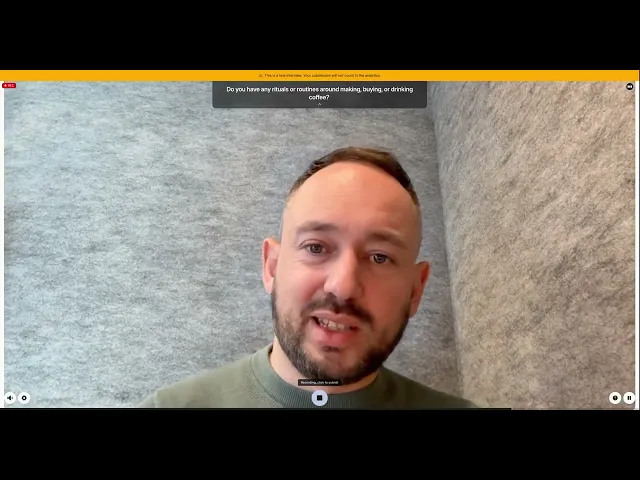
Watch the walkthrough: AI Moderation in Action →
What AI does not do is tell the researcher what those themes mean for the business. Interpreting qualitative data requires context: knowledge of the category, the stakeholder’s actual question, and the judgment to distinguish a signal from noise. The researcher’s role shifts from processing data to making sense of it, which is where the expertise actually lives, and it’s what separates a genuine qualitative data analysis approach from simply analyzing data with a keyword search. That same judgment applies on the quantitative side too. Quantitative research relies on statistical analysis and other quantitative approaches to establish what happened at scale, while qualitative analysis explains why. Most enterprise research programs need both quantitative and qualitative data collection running side by side rather than treating them as competing disciplines.
How Conveo Structures Qualitative Data for Enterprise Teams
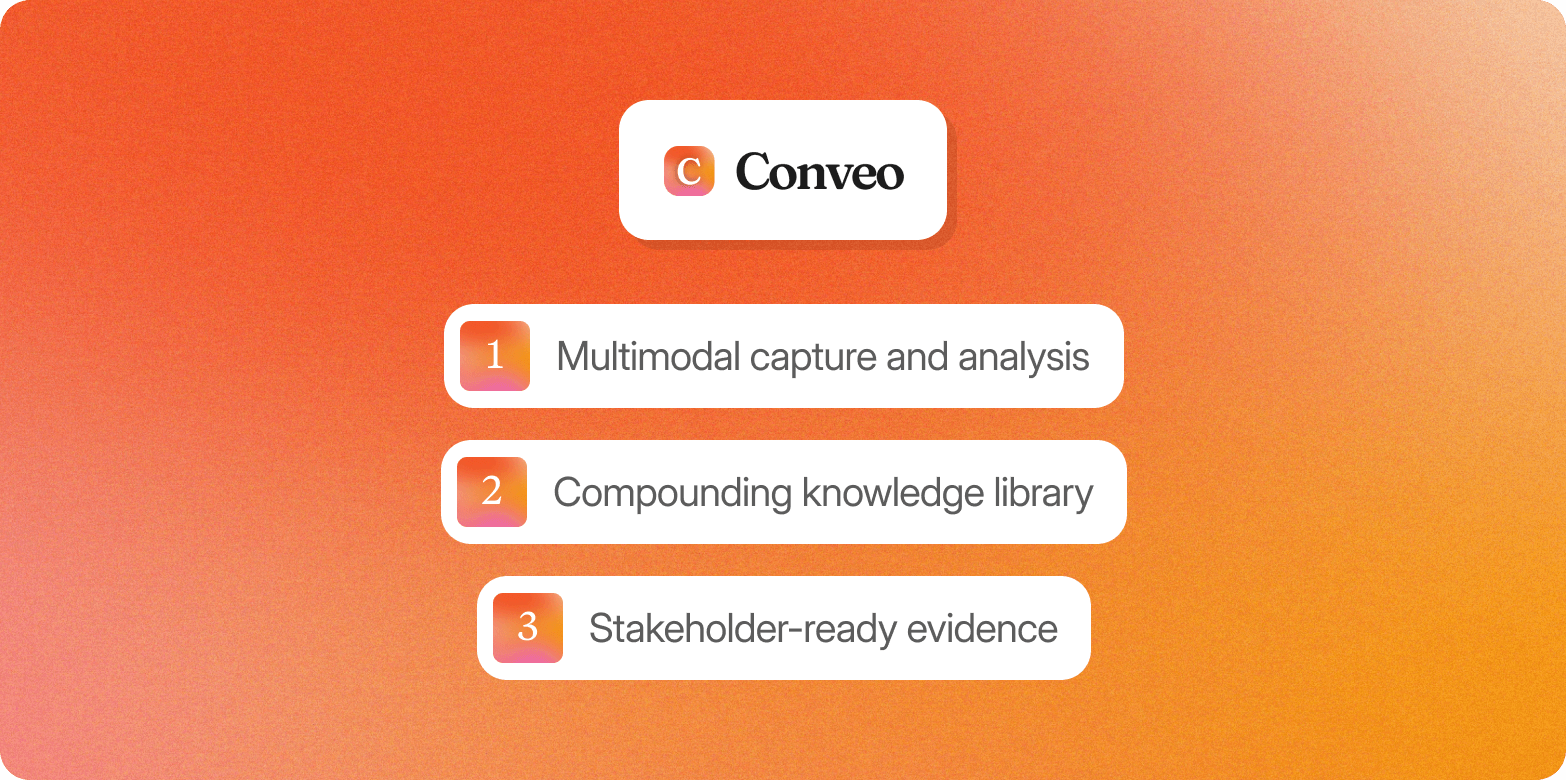
The traceability problem this article describes is exactly what Conveo was built to solve. Every qualitative data type, from video recordings and transcripts to coded themes and synthesized insights, lives in a single structured system where evidence remains connected to findings.
Three capabilities make this concrete for enterprise research teams:
Multimodal capture and analysis. Conveo’s AI moderator conducts video-first interviews in 50+ languages, then automatically transcribes, codes, and analyzes both verbal and non-verbal signals. A shift in tone on a sensitive topic, or a hesitation before naming a competitor, surfaces in the structured output, not buried in raw footage.
Compounding knowledge library. Every study feeds a searchable library where teams retrieve prior qualitative insights across projects. When a new brief arrives on a topic the team researched eight months ago, the relevant quotes, clips, and themes are already structured and retrievable rather than locked in a slide deck no one remembers, which is exactly what a compounding research process should look like across dozens of qualitative studies.
Stakeholder-ready evidence. Synthesized themes link directly to source video clips and verbatim quotes, so any stakeholder can independently verify a finding. The credibility gap closes because evidence is inspectable rather than asserted.
Frequently Asked Questions
What Are the Types of Data in Qualitative Research?
What Is the Difference Between Qualitative and Quantitative Data?
What Are Examples of Qualitative Data?
How Do Research Teams Analyze Qualitative Data?
Why Do Stakeholders Distrust Qualitative Findings?
What Is the Best Way to Store Qualitative Data?