In this article
TL;DR
Best for: UX and product research teams at enterprise companies running continuous discovery alongside sprint cycles.
The core problem: Insight that arrives after a decision is already made might as well never have happened. Product teams ship features before user research findings land, because moderation, transcription, and synthesis run sequentially and a single study can take four to six weeks.
The operational constraint: Sequential coordination across recruitment, scheduling, live moderation, manual transcription, and thematic coding caps most enterprise teams at 10 to 15 interviews per study, regardless of how many research projects sit in the backlog. Traditional research methods, and the research practices built around them, were designed for a slower cadence.
The shift: Always-on, AI-moderated discovery turns the UX research process from a per-study bottleneck into continuous infrastructure that runs alongside product development, with researcher oversight and traceable video evidence preserving methodological rigor throughout.
What compounds: Every session flows into Conveo's searchable insight library, so research insights connect across studies rather than die in a slide deck and be re-researched six months later.
The outcome: UX teams support frequent release cycles without expanding headcount, run interviews in parallel (teams report completing 100 interviews in three days), and apply research insights to product decisions instead of starting from scratch each time.
Why decisions outrun the traditional UX research process
The real cost of the traditional UX research process is timing: the lag between when a question is asked and when a defensible answer arrives. Moderated usability testing typically takes four to six weeks from recruitment brief to debrief, and that assumes the screener is approved quickly, sessions are scheduled without cancellations, and the moderator's notes make the next synthesis deck. In practice, each step slips, and the research lands after the decision it was meant to inform has already been made. At that point it functions as documentation.
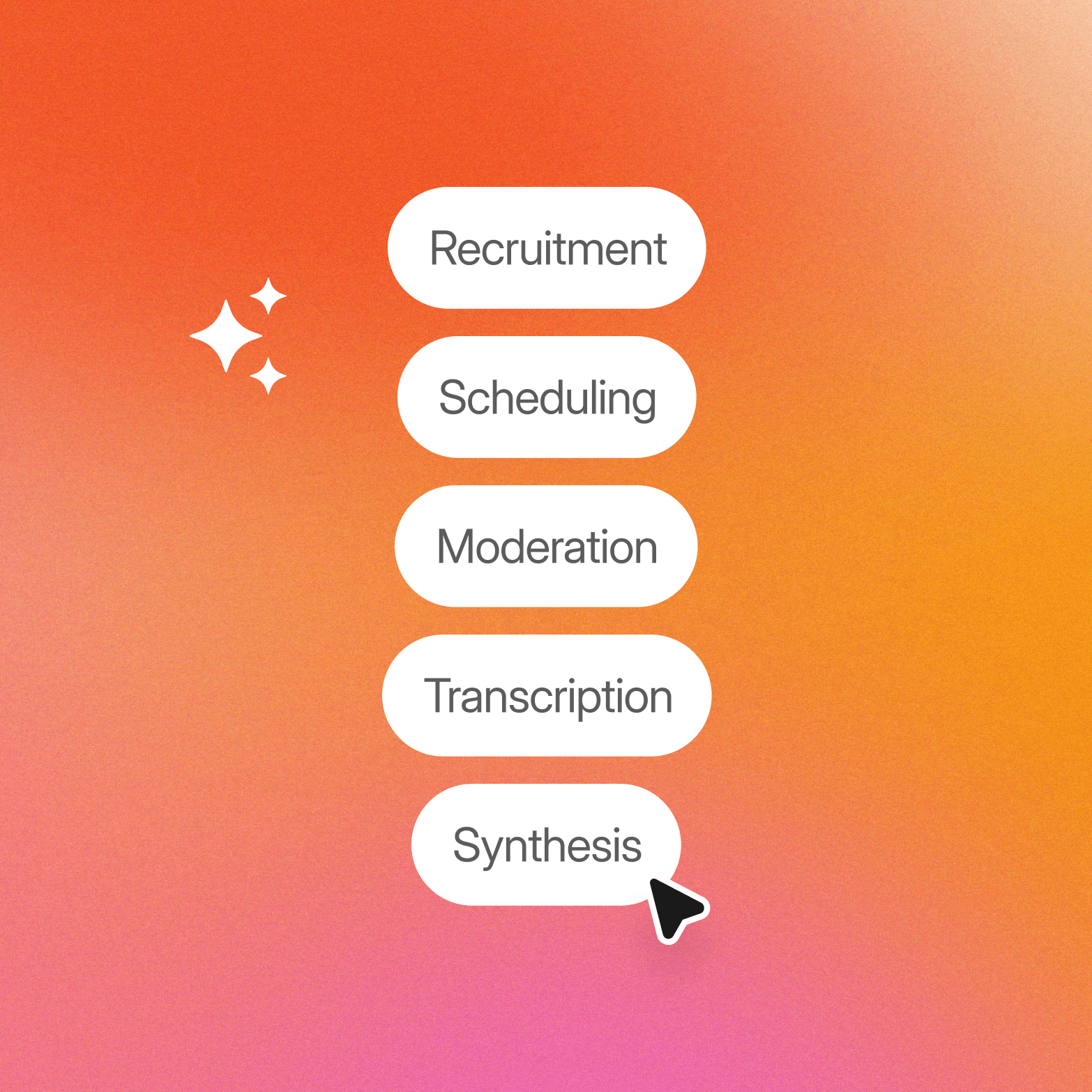
The coordination burden compounds this: a standard process runs sequentially through recruitment, screener review, scheduling, live moderation, transcription, coding, and synthesis, and each stage waits on the one before it. The throughput ceiling makes it worse: live-moderated studies cap out around 10 to 15 sessions, a limit set by calendar coordination across time zones rather than by researcher appetite. Ten sessions may suffice for a narrow usability test. They rarely suffice for the generative discovery that shapes a product direction, and individual researchers are left choosing which questions get answered this quarter and which get shelved.
Product teams running two-week sprints need research inputs before the decision window closes, and the traditional research process was built around a different cadence. Recruiting, scheduling, moderating, transcribing, coding, and synthesizing can consume 30 or more researcher-hours spread across three to five weeks, which doesn't fit inside a sprint or even between sprints. The research methods themselves remain sound. What needs to change is the operational model around them, and the research practices teams inherited along with it, both built for a pace most organizations have already outgrown.
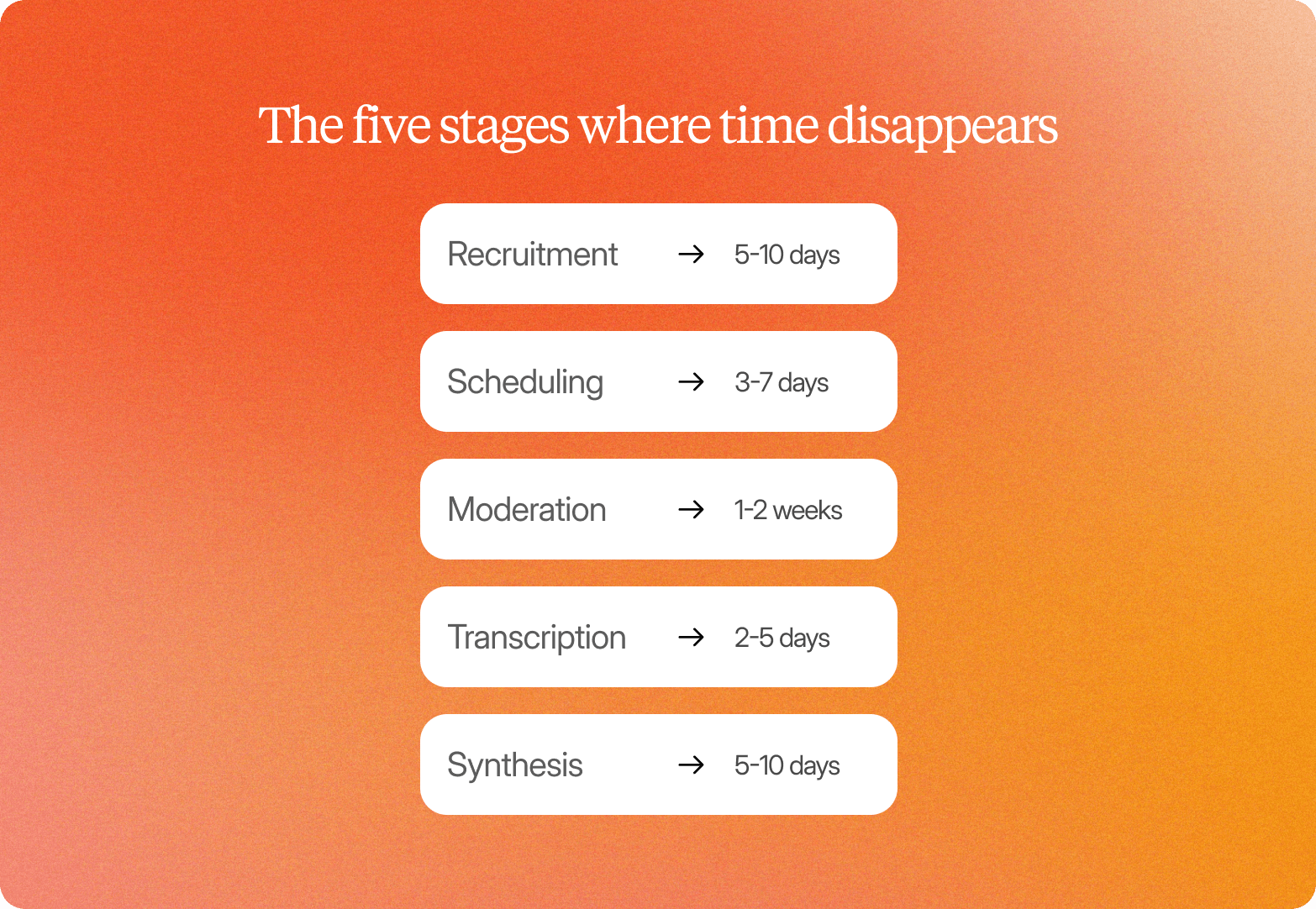
The five stages where time disappears
The clock on each stage only starts when the previous one finishes, and the dependencies are hard: scheduling can't begin until recruitment confirms attendance; moderation can't begin until scheduling completes; transcription can't begin until moderation closes; synthesis can't begin until transcription is reviewed.
Recruitment (5 to 10 days)
Writing the screener, coordinating with panel partners, reviewing applications, and handling drop-outs consumes the better part of two weeks for a specific participant profile. It's a recruitment process built for caution first, and participant recruitment is usually where a study's timeline is decided before a single interview happens.
Scheduling (3 to 7 days)
Finding time that works across a participant in Singapore, a moderator in Chicago, and a product lead in London is a genuine coordination problem that still lands in someone's inbox.
Moderation (1 to 2 weeks)
Running 10 to 15 sessions of 60 to 90 minutes each, spread across a week or more, since the moderator can't be double-booked.
Transcription (2 to 5 days)
Even automated transcription needs review for accuracy, particularly with technical terminology and accented speech.
Synthesis (5 to 10 days)
Thematic coding and building a coherent, stakeholder-ready narrative from 10 to 15 transcripts is the most intellectually demanding stage, and often the longest. It's where research efforts either turn into decisions or stall in a deck nobody revisits.
A single rescheduled participant doesn't just add one session to the calendar. Because moderation can't close until every session is complete, a single delay can push the entire study back by a week. The knock-on effects compound from there:
Moderation hours scale faster than findings. Scaling from 10 to 50 interviews results in a proportional increase in moderation hours, while insight grows far more slowly, and most teams lack the headcount to absorb the difference.
Coordination eats the budget. Budget management gets harder too: research teams end up paying for coordination overhead rather than for research activities that actually move a decision forward.
External constraints add days nobody planned for. Panel availability and holiday scheduling windows are just two examples of external constraints that routinely push a "two-week" study past a month.
Always-on discovery closes the decision-lag gap
The fix is removing the sequence itself, rather than running the same sequential process faster. AI-moderated interviews shift the UX research process from a per-study bottleneck into continuous discovery infrastructure that runs in parallel with product development, so research insights exist before the decision window closes rather than after.
Asynchronous execution removes the calendar as a constraint
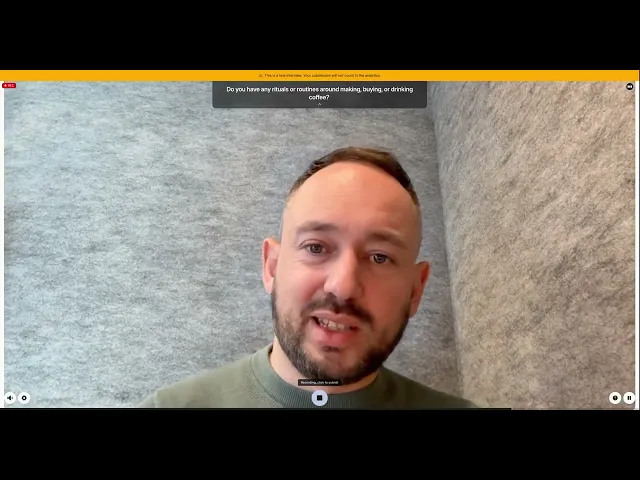
The first place time disappears in traditional research is scheduling. Coordinating 20 to 30 participants across time zones, one session at a time, routinely consumes two to three weeks before any actual research begins, and streamlining participant recruitment has historically meant little more than a faster spreadsheet. With asynchronous AI-moderated interviews, participants receive a link and complete user research sessions on their own schedule, rather than via a live call. Conveo's AI moderator doesn't wait for a calendar opening: it reviews each response, detects when an answer is thin, and probes further, the way a skilled researcher would ask "what specifically felt confusing?" The calendar bottleneck disappears. The depth stays intact, and the participant management overhead that used to eat a week of coordination time drops to near zero.
See it in action: How AI-Moderated Video Interviews Actually Work
Parallel execution removes the headcount ceiling
Traditional moderated interviews have a hard ceiling: one researcher, one conversation at a time. With Conveo, interviews run in parallel rather than one at a time, across 50+ languages, without adding researcher headcount or extending fieldwork timelines. Teams report completing 100 interviews in three days on this model. That changes which decisions can be research-informed: research studies that used to be reserved for quarterly strategy reviews now fit inside a sprint, and a small team can act as a force multiplier for research efforts across an entire product organization.
Automated analysis turns recordings into themes in hours
Fieldwork is only half the bottleneck; manual transcription, coding, and synthesis routinely consume another week after sessions close. As sessions land, Conveo transcribes and translates each recording, then clusters responses by theme, surfacing sentiment arcs, recurring friction points, and divergent minority views in hours rather than days of manual work. Researchers spend their time interpreting findings and applying quality user research to product decisions, while the platform produces the underlying materials.
Rigor is what makes always-on discovery trustworthy
Speed only matters if the findings hold up. The rigor in AI-moderated research comes from the researcher's involvement at the stages that matter most: discussion guide design, screener logic, hypothesis framing, and thematic review. Conveo's AI moderator executes the guide consistently across every session, without fatigue or social desirability bias creeping in by the fifteenth interview, and the researcher shapes what gets asked, reviews what the analysis surfaces, and decides what it means for product strategy. This is what separates quality user research from research that merely looks thorough.
Bias controls built into the method
A well-configured AI moderator follows the discussion guide without improvising leading questions, and probes are generated from what a participant actually said, rather than from assumptions about what they meant. Every participant receives the same depth of follow-up regardless of how confidently they speak or how late in the day the session runs. Because every interaction is recorded, researchers can review research sessions for leading language or missed probes, a level of review that a reconstructed set of human moderator notes doesn't offer.
Ethical considerations, including how consent is captured and how probing is bounded, are addressed at the methodological level rather than left to individual researchers to enforce on a session-by-session basis.
Traceability is the standard for defensibility
Defensible research requires every claim to connect to a specific participant moment. Concretely, that means:
A verbatim quote
A timestamped video clip
A count of how many participants expressed the same view
Every session on Conveo produces a transcript, a recording, and analysis that links themes back to the participant statements that produced them, so a stakeholder can follow the evidence from recommendation back to the exact words someone used. A workshop-generated persona that rates a user "tech-savvy 7/10" can't answer which participants said what to produce that number, because none did. AI-moderated findings can answer that question for every claim in the report, which is what good research looks like when it has to survive a skeptical roadmap meeting.
"Conveo's video-first approach is a real differentiating methodological advantage. The ability to distill insights from reactions and not just hear answers adds context you simply can't get from transcript-only tools, or any other tool in the market for that matter"
Senior Marketing Research & Insights Manager, Google
Extending capacity while expertise stays with the researcher
Scheduling, coordination, moderation, and transcription consume most of researchers' hours in a traditional workflow, while researchers' expertise creates value elsewhere. When those tasks move to the platform, researchers spend more time designing studies that test the right hypotheses and translating findings into recommendations, and more time on the professional development that gets crowded out when every week is consumed by logistics. Teams report running more studies with the same headcount, because the operational drag that limited study frequency was removed. The research itself remains just as demanding. This is what it means to support researchers and enable researchers to do the part of the job that actually requires judgment.
Compounding: Why research stops starting from zero
Most research findings have a half-life nobody talks about. A study wraps up, the synthesis deck is shared, and six months later, nobody can find the recordings. When the same question resurfaces at a roadmap meeting, the team restarts from zero, and the original investment in research activities disappears. Static decks also create a credibility problem: when a researcher presents a slide with no traceable source, a skeptical product lead can always respond, "that's your interpretation." The fix is to make the evidence inspectable in the room and to treat research insights as an asset worth managing rather than a one-time deliverable.
Conveo's searchable insight library
Conveo's searchable insight library is a compounding research repository: every study completed on the platform contributes to it, themes connect across waves, contradictions surface automatically, and nothing gets researched twice. It does two jobs at once:
Knowledge management for the research org, connecting themes and findings across every study that runs on the platform.
Asset management for the underlying evidence, the recordings, clips, and quotes that would otherwise sit in someone's local drive, feeding qualitative evidence into the same business intelligence workflows that already track quantitative metrics.
A product manager searching for "onboarding friction" can pull timestamped clips from three prior studies in minutes instead of chasing down a researcher who may have left the team. This is how the process shifts from producing deliverables to regularly sharing insights that other teams can act on without having to rerun the study.
Personas benefit from the same shift. They become actively misleading within roughly six months when they aren't refreshed, because the behavior they describe drifts even when the demographics don't. A continuously updated insight library keeps behavioral evidence current without a full persona rewrite: when new sessions land, the evidence base updates, and behavioral patterns either hold or they don't. Over time, a research repository like this drives innovation in product decisions, because teams apply current research insights rather than working off findings that have quietly expired.
Conveo StoryLines: Making always-on the default
For teams that want a continuous read rather than a one-time report, Conveo StoryLines runs research as a standing, wave-based program rather than a per-study project. Waves run bi-weekly or monthly depending on study design, giving product and brand teams a recurring, comparable read over time. That cadence is what makes a continuous discovery operating model operationally realistic: a standardized intake process and a research ops framework that scales without proportionally expanding headcount, built around defined SLAs by study type:
Generative discovery: three to five days
Concept testing: two to three days
Usability testing: three to four days
Some enterprise teams formalize this as dedicated research ops, treating it as its own research operations function: a research ops team, sometimes just one or two people acting as a reops team, owns intake triage, tooling, and the operational aspects of the practice so that user researchers and UX researchers can stay focused on study design and analysis. Intake triage is also how a lean team can set user research priorities without becoming a bottleneck for the whole roadmap.
Others fold it into an existing operations team's remit, which works fine as long as research operations holds its position when priorities shift. Either way, it's a specialized area that benefits from being named and staffed rather than absorbed informally by whichever team members have time that week. Teams that engage with the wider researchops community tend to standardize on these patterns faster than teams building a researchops practice from scratch.
Scaling qualitative research without trading off depth
A practical target for generative qual is 5-15 participants per segment, enough to reach thematic saturation without overinvesting in any one group. Most products serve two to five behaviorally distinct segments, which puts rigorous coverage at a minimum of 30 to 75 interviews. Traditional moderation, and the focus groups many teams default to for generative work, turn that into a six-week project, so teams often cut segment coverage rather than extend timelines, producing research that overgeneralizes from one or two segments to the rest of the user base. Segment coverage, alongside interview count, is what keeps user-centered approaches honest at enterprise scale.
Parallel execution resolves this: when AI-moderated interviews run asynchronously, 10 to 15 participants per segment across four or five segments can complete within the window it would previously take to finish one segment. The timeline holds steady as the scope grows, and the depth of each conversation stays intact. This is scaling research in the literal sense: broader coverage, alongside faster turnaround.
Qual-native quant closes the remaining gap
Scaling interview volume addresses breadth. Qual-native quant addresses what breadth alone can't: when participants disagree, which preference should the team act on? MaxDiff tells you what people prefer. Conveo's MaxDiff tells you why. A participant ranks speed above price in a feature prioritization exercise, and Conveo's AI moderator immediately follows up: "You put response time at the top, can you walk me through a situation where that actually mattered?" The ranking and the reasoning come from the same person in the same session, which makes it possible to analyze qualitative and quantitative signals together rather than stitching them together from two separate research studies.
Behavioral screeners raise the signal before a single question is asked
Demographic and self-reported filters introduce noise because people consistently overestimate their own engagement with a product, and because other factors like recency and category familiarity that self-reporting alone can't capture. Behavioral screening at recruitment aligns with what participants actually did: used the product in the last 30 days or purchased within a category in the last quarter, thereby selecting research participants whose experience is genuinely relevant to the research question.
This is participant management done at the recruitment stage rather than after the fact. Teams report that tightening the screener at the front end is more efficient than filtering out off-target sessions at the analysis stage, and that it keeps focus areas narrow enough that the biggest pain points surface rather than being diluted by tangential feedback.
Governance: What enterprise buyers verify before they trust the process
Consent workflows, PII handling, data residency, and vendor evaluation checkpoints sit upstream of every study. When they aren't standardized, each new project triggers its own ad hoc compliance review, adding weeks to an already tight timeline, and efforts to standardize consent early usually pay for themselves within a study or two. Teams that once tracked consent forms in spreadsheets or Google Forms, alongside a patchwork of ethical considerations handled differently by each researcher, find that user research practices and the organizational context around them shift considerably once consent and retention are standardized at the platform level rather than owned by individual researchers.
Consent, PII, and data residency
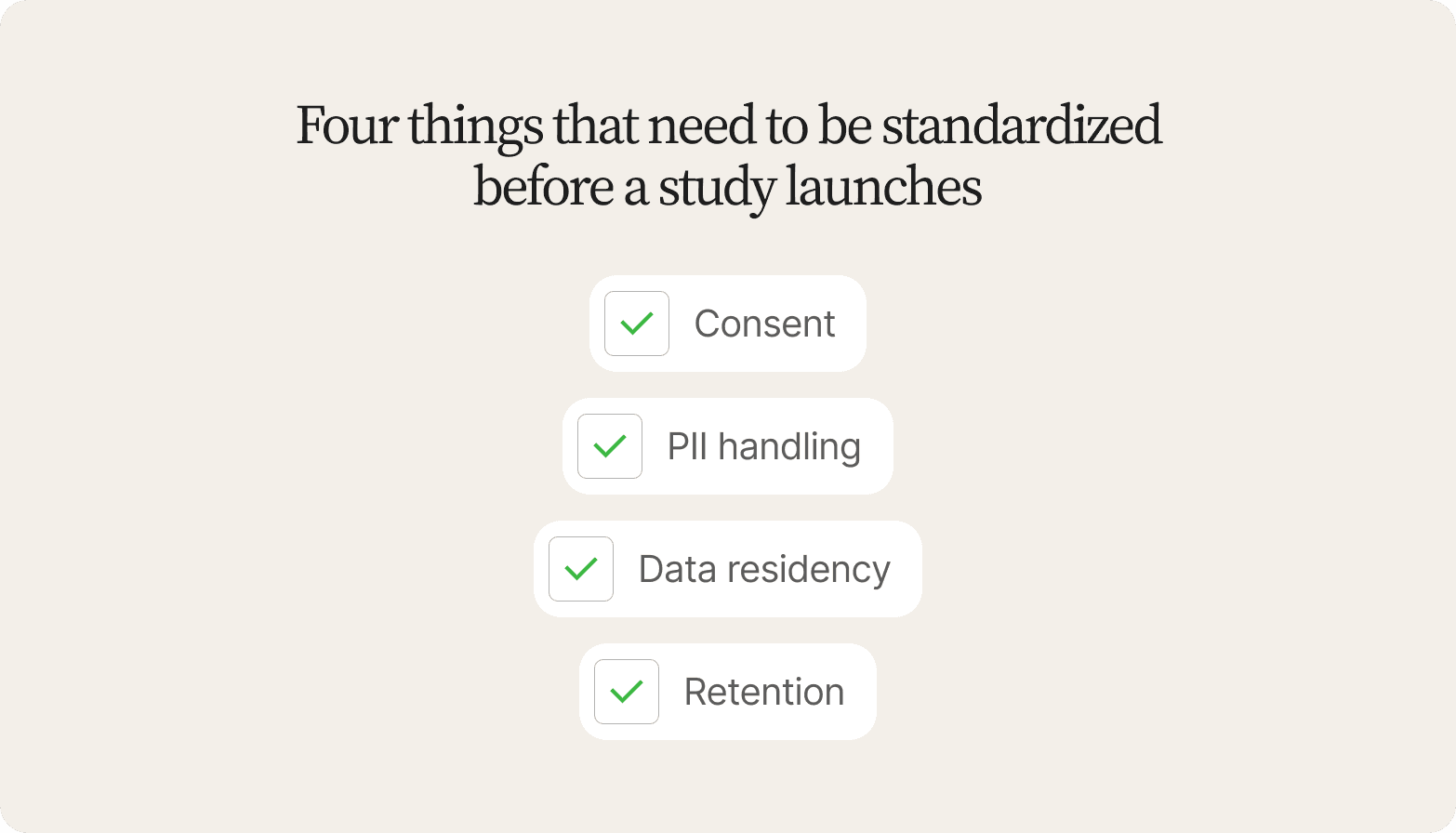
Four things need to be standardized before a study launches:
Consent. Every participant needs informed consent that specifies how recordings will be used, who has access, and how long data is retained; standardizing consent forms at the platform level removes a common source of delay.
PII handling. Personally identifiable information should be stored separately from recordings and transcripts by default.
Data residency. Enterprise buyers in regulated industries, healthcare, financial services, government need recordings stored in specific geographic regions to satisfy GDPR, HIPAA, or other data privacy regulations, so verifying data residency before a study launches avoids a scope reduction or vendor change at the worst possible moment.
Retention. Retention should default to a defined window, commonly 12 to 24 months, with automatic deletion unless a study is flagged for archival.
What to check before approving a vendor
Before approval, procurement should confirm:
Is the platform SOC 2 Type II certified?
Does it offer GDPR-ready data processing agreements?
Can it guarantee data residency in the regions your studies require?
Does it support SSO and role-based access controls?
This is also where budget management enters the conversation: a platform that removes the event management overhead of live scheduling and the recruitment process overhead of panel coordination usually offsets its own cost within a quarter or two. Conveo is SOC 2 Type II certified, GDPR compliant, and EU-hosted (Belgium), with SSO and on-demand PII deletion built into the platform rather than added after procurement, so a vendor security review runs against documented, verifiable standards.
Where Conveo fits in a continuous discovery model
If your team is choosing infrastructure for always-on discovery rather than a one-off study tool, evaluate these pieces together:
Asynchronous, AI-moderated sessions that remove the scheduling ceiling
Researcher-owned guide design and thematic review that keeps rigor intact
A searchable insight library that makes every study compound instead of expire
StoryLines for a standing, wave-based cadence instead of restarting intake every time
Compliance infrastructure a procurement review can verify directly rather than take on faith
Among research management platforms, this is the difference between a tool that helps with one study and infrastructure that supports researchers, and the other teams (product, brand, marketing) who depend on their output, across an entire strategic planning cycle. Enterprise teams use Conveo to run this as a single operating model rather than assembling it from a patchwork of research tools, a video platform, and a spreadsheet of past research insights, addressing user needs with evidence that's still current rather than research that quietly went stale months ago.
Frequently Asked Questions
What is the UX research process?
The UX research process is the end-to-end workflow for gathering, analyzing, and sharing user insights to inform product decisions: goal setting, method selection, recruitment, data collection, analysis, and stakeholder reporting. Traditional execution requires sequential coordination across every stage, which caps most enterprise teams at 10 to 15 interviews per study. AI-moderated interviews remove the scheduling and transcription bottleneck, letting interviews run in parallel, which moves the process from a per-study coordination exercise to continuous discovery infrastructure.
How long does the UX research process take?
A single moderated usability study typically runs four to six weeks from recruitment to debrief: recruitment takes five to 10 days, scheduling adds three to seven days, and live moderation runs one to two weeks for 10 to 15 sessions, followed by transcription and synthesis. Asynchronous, AI-moderated studies remove the scheduling dependency and compress the same study to a matter of days.
How many participants does a UX study need?
A practical target for generative qualitative research is five to 15 participants per segment, enough to reach thematic saturation without over-investing in any one group. Most products serve two to five behaviorally distinct segments, which puts rigorous coverage at 30 to 75 interviews across a product's real user base, a scope that's difficult to reach on a traditional timeline but realistic when segments can be recruited and moderated in parallel.
Does AI moderation replace the researcher?
No. The researcher retains discussion guide design, screener logic, segment definitions, thematic review, and stakeholder synthesis, the judgment calls that determine whether a study produces defensible findings. The AI moderator handles the operational layer: running the guide consistently, probing based on what participants actually say, and producing initial thematic clusters for the researcher to interrogate.
What's the difference between a one-off study and a continuous discovery model?
A one-off study is scoped, run, and reported as a single project, which means findings often arrive after the decision they were meant to inform has closed. A continuous discovery model, supported by intake triage, defined SLAs by study type, and a standing cadence like Conveo StoryLines, runs research as an always-on function parallel to product development, so questions get answered while decisions are still open.

About the author
Abby Euyang
Research Impact Lead
Abby studied psychology, fell for research there, and spent four years on the UX research team at PayPal. She compared the AI-moderated platforms before choosing Conveo for the researchers it had gathered, and now sits in the sessions where researcher feedback becomes product changes the same day.
Meet Abby on film →Qualitative insights at the speed of your business.
Conveo runs AI-moderated video interviews and structures everything they say.