In this article
TL;DR
When deciding how to choose a tool for customer insight discovery, start by defining what you need it to do, from running new research to organizing existing findings or supporting ongoing customer understanding.
Look beyond how quickly a tool generates themes. Check whether you can trace findings back to the original customer evidence when someone needs to verify or challenge them.
Compare shortlisted tools based on the quality of their research, how much of your workflow they cover, how well they fit your existing systems, how they handle data, and whether you can trust the participants.
The right tool should fit how your team works today while helping you build on what you learn over time.
Choosing a tool for customer insight discovery can be difficult because the category covers several different types of platforms, from tools that collect customer feedback and qualitative insights to those that help teams organize existing customer research. The right choice can give your team a deeper understanding of customer behavior and turn the data you collect into actionable insights.
This guide explains how to choose a tool for customer insight discovery, covering the different types of platforms and what to look for when comparing them. You'll get a practical framework for evaluating how well each option supports your research process, helps you analyze customer feedback, and lets you trace key insights back to the original evidence, so you can find the best customer insights tool for your needs.
What Is a Customer Insight Discovery Tool?
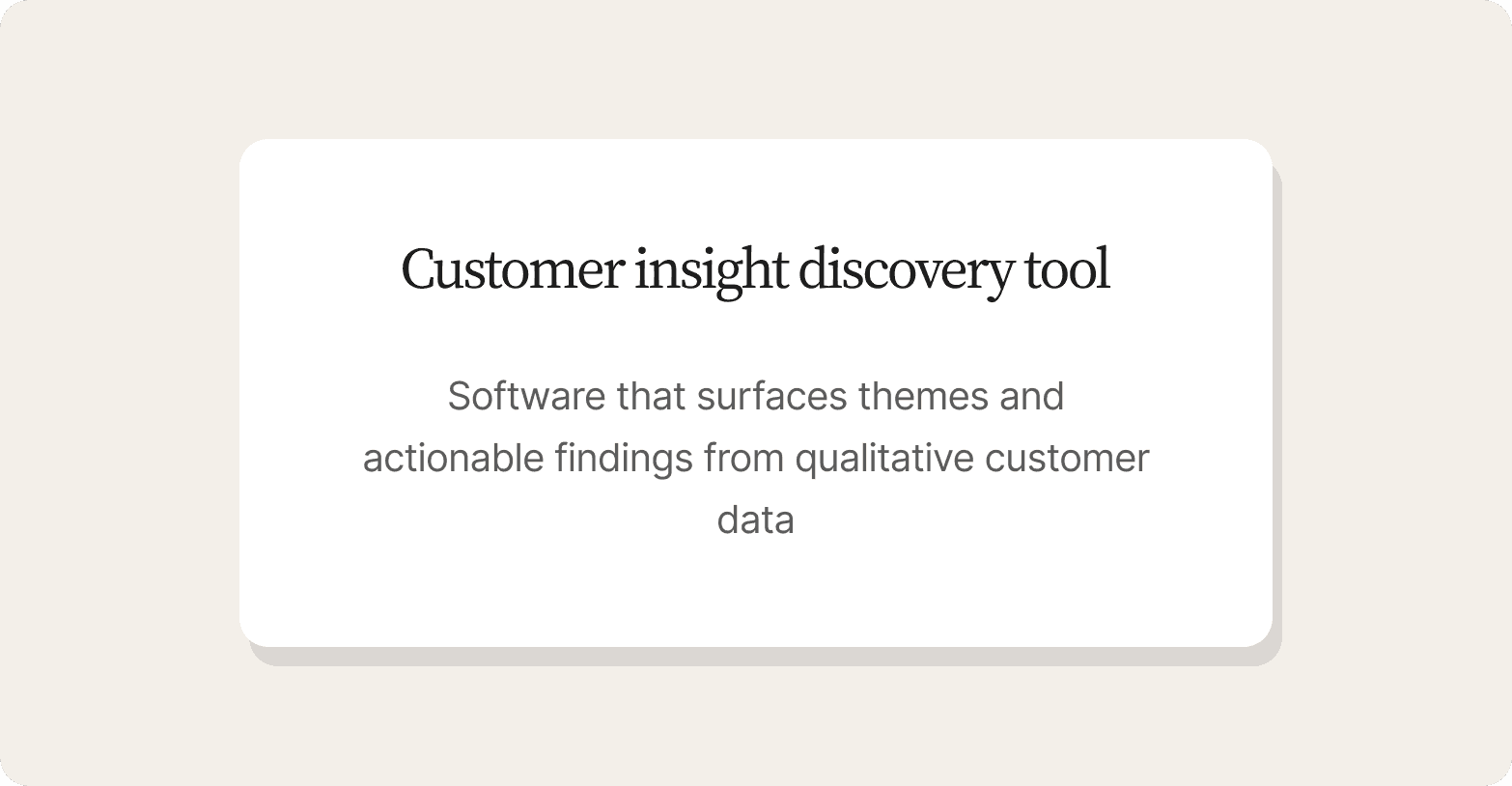
A customer insight discovery tool is software that surfaces themes and actionable findings from qualitative customer data. The goal is to better understand customer behavior so teams can make smarter decisions across different areas of the business.
Customer insight discovery tools vary in practice depending on which part of the research process they touch. They can include:
Primary research capture: Tools for collecting new qualitative data directly from customers.
Insight repositories: Platforms that organize and store research so teams can find and build on existing customer knowledge.
UX testing: Tools that help teams understand how customers interact with a product or experience and where they run into problems.
Consumer understanding infrastructure: Platforms that make customer understanding continuous and traceable, sitting alongside the CRM and ERP rather than being commissioned on a project-by-project basis.
The right category depends on what you need the tool to do, but that alone doesn’t tell you whether a platform can deliver findings you can rely on.
Why Teams Choose the Wrong Tool
Teams can choose the wrong customer insight tool when they evaluate what a platform can produce without checking how it gets there. A customer insights platform may generate useful-looking themes quickly, but that doesn’t necessarily mean those findings are backed by evidence your team can verify and defend.
When you’re under pressure to get answers quickly, it’s easy to prioritize platforms that promise fast analysis. AI tools can surface themes and produce summaries in minutes, but some do so without clearly linking each finding back to what participants actually said. If you can’t trace a theme back to the original quote, participant, or video moment, it becomes harder to check whether the finding holds up.
Research needs to arrive in time to influence the decision. But speed shouldn’t come at the cost of being able to verify the answer. Effective consumer intelligence gives teams a faster path to understanding while keeping a clear connection to the evidence behind it.
The 4 Customer Insights Tool Categories (and Which One You Need)
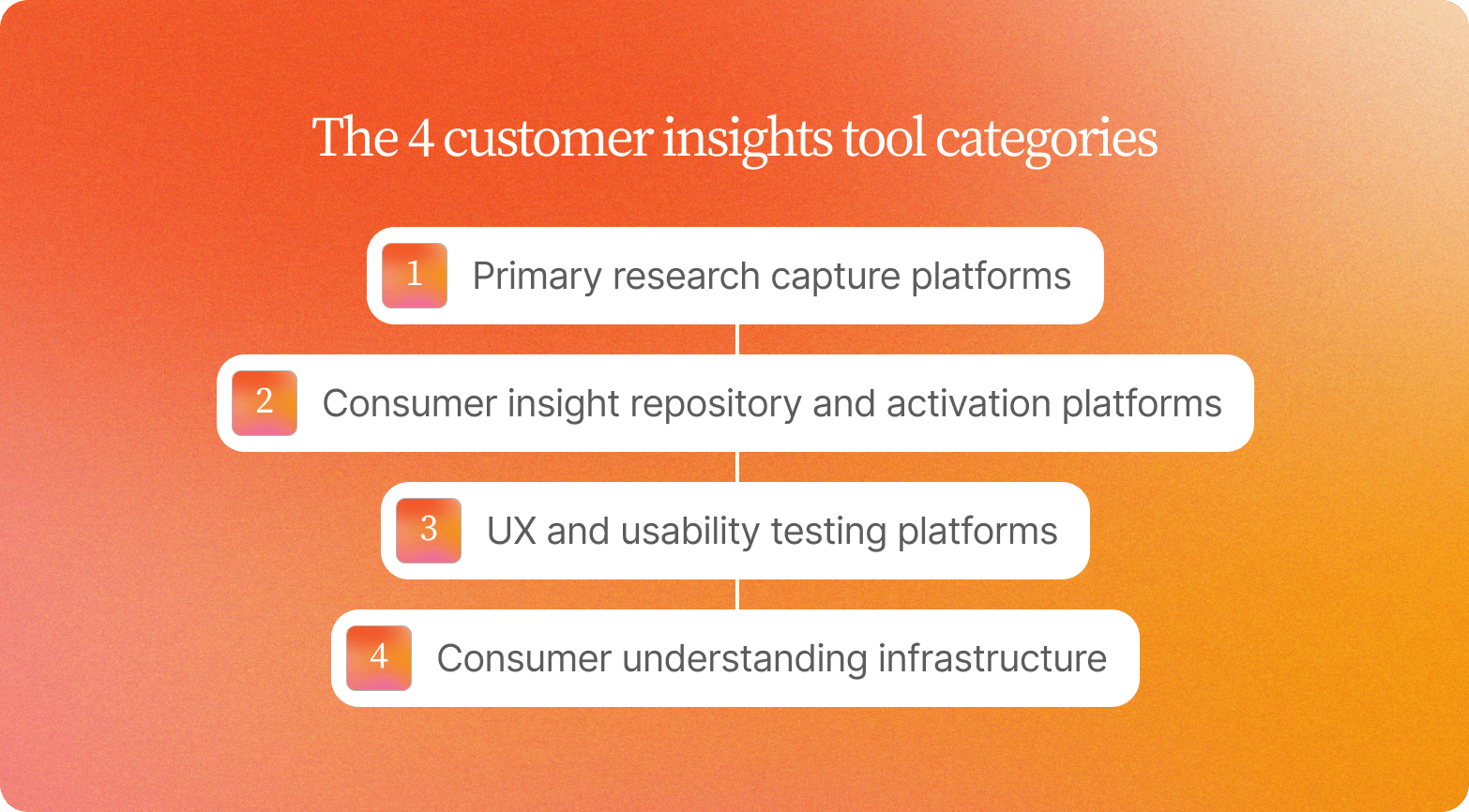
Being clear on exactly how the different types of customer insights platforms work helps you avoid comparing tools that solve different problems and focus on what your team needs.
1. Primary Research Capture Platforms
These platforms gather customer intelligence by conducting interviews and collecting open-ended responses directly from customer interactions. They fit teams running 10 or more interviews per study who need follow-up questions that adapt to what a participant just said and want video-backed findings over transcript summaries alone. If your team is still commissioning an agency for interview-based research, one project at a time, this is usually the first category to evaluate.
2. Consumer Insight Repository and Activation Platforms
These platforms organize and tag research your team already has. They fit teams sitting on a large volume of past studies who need to search across projects and want stakeholders to find existing findings themselves rather than file a new research request every time. This category solves an archiving problem, so it won't reduce the number of new studies your team commissions elsewhere.
3. UX and Usability Testing Platforms
UX research tools focus on user behavior on web or mobile apps, including task completion, prototype feedback, and clicks. They fit teams validating a specific interface decision who need structured results across a large number of participants, quickly. Because they're built around how users interact with structured tasks rather than open-ended reasoning, they're a weak substitute for understanding why customers feel a certain way about a decision.
4. Consumer Understanding Infrastructure
These platforms integrate research into a single, continuous system, so findings from one study remain available and useful when the next one begins. They fit insights teams making customer intelligence an ongoing part of how they work, rather than commissioning it for individual projects.
"The pace, responsiveness, and research expertise of the Conveo team, on top of the top AI-moderated qual platform, have been invaluable to us in scaling brand advertising internationally."
Matt Harris, Research & Insights Lead, EMEA, Canva
Along with the tool category, you should also consider the method the tool uses to collect customer insights.
When to Choose AI-Moderated Interview Platforms Over Surveys
AI-moderated interviews and surveys answer different questions, so the right choice depends on the decision you need to make. There are exceptions, but these general guidelines can help with qualitative research tool selection:
Choose a survey when you need to measure what customers think and how widely a view is held. Survey tools are useful for questions such as What percentage of customers prefer option A? or How many customers are satisfied with the new feature? If a directional percentage gives you enough evidence to make the decision, a survey is likely the better fit.
Choose AI-moderated interviews when you need to understand why customers think or behave a certain way. Interviews are better suited to questions such as Why are satisfied customers still leaving? or Why isn't a feature being adopted? They’re also the better choice when stakeholders need to see or hear customers explain their experiences in their own words, particularly when the decision is unclear or carries significant consequences.
Neither method is inherently better. The goal is to choose the one with the evidence that best suits your research objective.
Framework for Choosing the Best Customer Insight Tool for Your Team
This framework helps you compare new customer insight tool options by scoring each tool against the same five areas. For each area, give every tool a score from 1 to 5 based on how well it meets your needs. Multiply that score by the weighting shown below, then add the five weighted scores together to get an overall score.
For example, if a tool scores 4 out of 5 for research quality, that contributes 1.6 points to its total because 4 × 0.40 = 1.6.
| What to assess for all the tools | Weight | What this means in practice |
|---|---|---|
| Research quality and reliability | 40% | Can you trust the findings and check where they came from? |
| How much of your workflow it covers | 25% | Does it support the parts of the research process your team needs help with? |
| How well it works with your existing tools | 15% | Can it connect with the systems and data sources you already use? |
| Security and data controls | 15% | Does it meet your requirements for handling, storing, and accessing data? |
| Confidence in your participants | 5% | Can you be confident that the people taking part are genuine and relevant? |
Use product demos and documentation to check how the tool performs against each area. Apply the same standard to every option, and note why you gave each score so you can revisit the decision later.
Research Quality and Reliability: What to Check Before You Commit
Research quality and reliability carry the most weight because they affect the value you get from everything else in the platform. A tool can cover your whole workflow and connect to your existing systems, but those advantages matter less if the research doesn't give you clear answers you can use to move a project forward.
Use the questions below to compare insight discovery software and assess how well it supports high-quality research.
Are You Hearing From Your Target Audience?
Ask how the platform verifies participants' identities and whether the sample matches the people you want to learn from. You should be able to understand how participants are screened and how duplicates are caught.
A strong platform may connect you with an established customer research panel or let you bring your own participant lists. What matters is understanding how participants were selected, rather than treating the sample as a black box.
Does the Moderator Ask the Right Follow-Up Questions?
A good AI moderator should be able to recognize when an answer needs further explanation and ask a useful follow-up.
Ask the vendor to show you an example from a real interview. If someone says, "It wasn't what I expected," does the moderator try to find out what they expected and why the experience fell short? Or does it move straight to the next question?
Can You See How the Findings Were Reached?
Find out how much control you have over the questions and analysis. Can you review how a theme was identified? Can you change or challenge the way responses have been grouped?
This gives your team more control over interpretation, rather than treating the platform's analysis as a final answer.
Can You Go Back to the Original Evidence?
Finally, check whether you can follow a finding back to the original evidence. Depending on the research, that might mean opening the original quote or jumping to the relevant moment in a video.
This makes it easier to settle questions about a finding and keep decisions moving, without having to rerun the research or rely on someone's interpretation of what participants said.
Watch the walkthrough: AI Moderation in Action
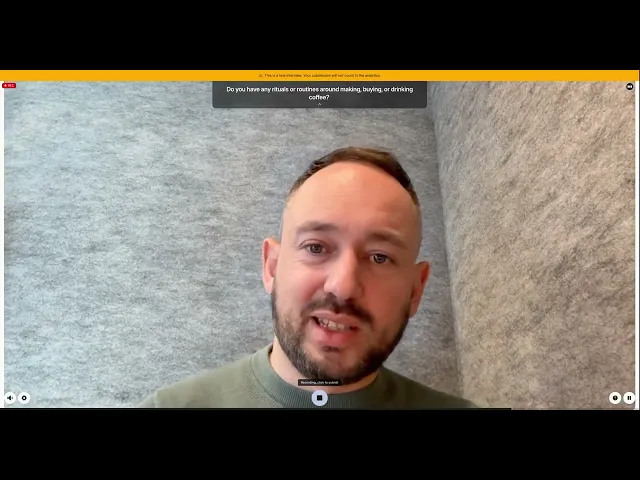
Once you've found a platform that meets the requirements above, it's time to check whether it also meets your organization's requirements before it can be approved.
Enterprise Procurement Checklist for Insight Discovery Software
Use these questions to check whether a platform meets your organization's requirements:
Can the vendor provide current SOC 2 documentation? Check what the certification covers and when the most recent report was issued.
Where will your data be stored? Confirm the vendor's GDPR approach and whether its data residency options meet your requirements.
Can you control who accesses the platform? Check for SSO and role-based access controls.
How can personal data be deleted? Ask the vendor to explain the PII deletion process and its data retention policy.
Will the platform work with your existing systems? Review the API documentation and ask about any integrations you need that are not currently available.
Ask for documentation where possible to provide your procurement and security teams with concrete evidence for assessment. Once the platform has cleared those checks, the next step is to see how it performs with your own research.
How to Run a Low-Risk Pilot
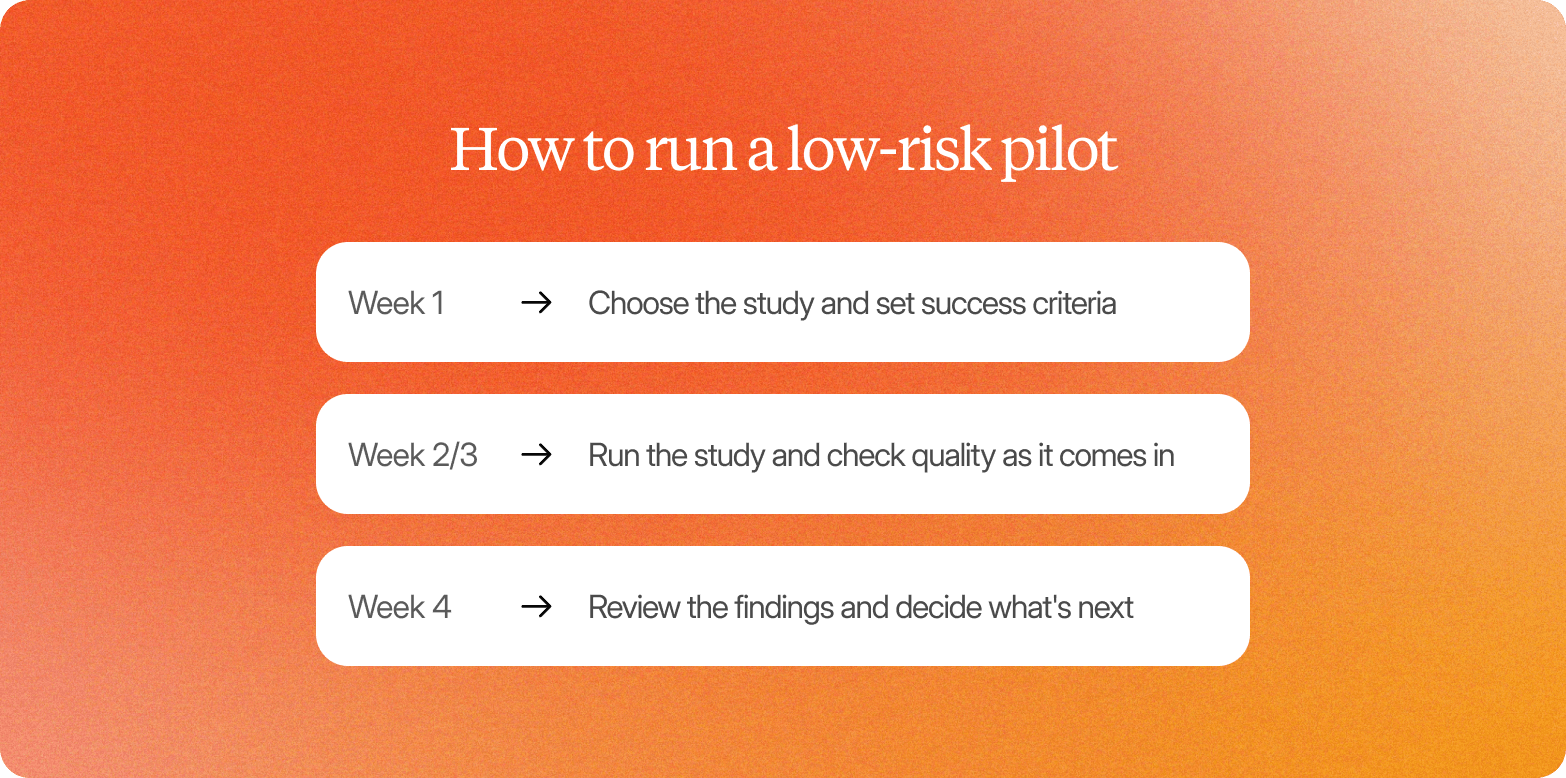
A pilot proves whether a platform holds up on your team's own research before you commit any budget. Structure it as one to two studies over three to four weeks, split into three phases.
Week 1: Choose the Study and Set Success Criteria
Pick a study stakeholders care about, but that isn't mission-critical, ideally a topic or customer segment your team has researched before. That gives you a baseline to judge the new findings against.
Agree the research question and review the discussion guide before you launch, and run a couple of test interviews to catch confusing questions early. Set your success metrics now too. These could include:
How quickly you get useful findings. Set a target for how long it should take to get answers your team can use, whether that's a few days or longer based on your research needs.
Whether stakeholders can use the findings. Check whether people reviewing the results find them clear and convincing without needing a researcher to explain or defend every conclusion. You could set a target, such as 80% of reviewers.
Whether the research is used again. Track whether other teams return to the pilot findings when working on related questions.
Whether it reduces repeated research. Look for fewer requests to investigate the same topic again because the existing findings are easier to find and use.
Weeks 2 to 3: Run the Study and Check Quality as It Comes In
Run the study using the same process you would use after buying the platform. As interviews come in, see if the process lives up to expectations. For example, review whether the moderator asks useful follow-up questions and whether the analysis accurately reflects what participants are saying.
If you spot a problem, you can see whether it can be fixed through the platform's settings or whether it reveals a limitation you would have to live with after purchase.
Week 4: Review the Findings and Decide What's Next
Bring stakeholders into the room and score the pilot against the criteria you set in Week 1. Check specifically whether the findings gave you evidence you didn't already have, and whether the team trusted them enough to act without a researcher walking through the reasoning.
Use that review to decide where this kind of research fits into your wider process. It might suit the studies you run most often, or your current approach might be the better fit for now.
Who Shouldn’t Choose Consumer Understanding Infrastructure (Yet)
Consumer understanding infrastructure isn't the right fit for every team. Skip it, at least for now, if any of the following describes where you are.
You mainly need quantitative data to measure what’s happening. If you need to know what percentage of customers prefer an option or how many people hold a particular view, a survey platform may be the better fit.
You mainly need to evaluate product usability. If your research is focused on identifying and fixing usability issues in a product or interface, a dedicated usability testing platform paired with a behavioral analytics tool is likely to give you more useful results.
You only need to organize research you’ve already completed. If your priority is making existing decks and reports easier to find, without running new research through the platform, an insight repository may be enough.
If that describes your current needs, a tool built for that specific job will probably serve you better for now. You can always move toward a more continuous research setup when your needs change.
What Conveo Does Differently as a Customer Insight Discovery Tool
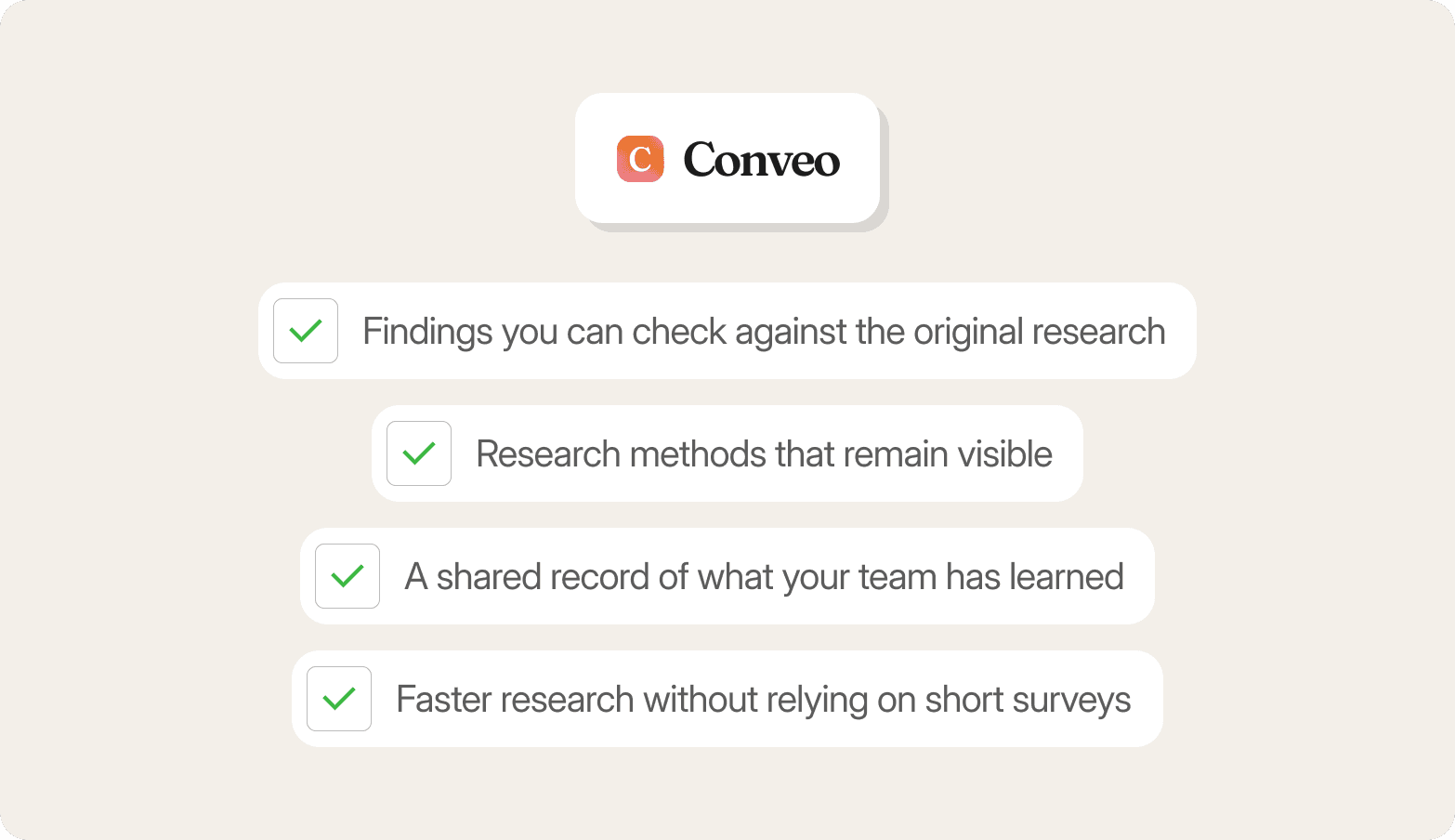
When choosing a tool for customer insight discovery, you also need to know whether you can check the evidence behind a finding and build on what you learn over time.
Conveo is designed around those needs. Used by enterprises including Google and Canva, it combines AI-moderated research with analysis and a place to keep and revisit consumer knowledge.
Here are Conveo’s key features that support this:
Findings you can check against the original research. Every theme, quote, and conclusion can be traced back to the participant and their video response, so stakeholders can see the evidence behind a finding.
Research methods that remain visible. Conveo was built by researchers, and the process behind the findings doesn’t disappear into a black box. Teams can see the source material and check how conclusions were reached.
A shared record of what your team has learned. Research doesn’t have to disappear into separate reports once a study ends. Findings from different projects stay connected, making it easier to revisit past research and spot when new evidence supports or challenges what you already know.
Faster research without relying on short surveys. AI-moderated interviews allow teams to conduct in-depth customer research and receive findings in days, rather than waiting weeks for traditional interviews.
Frequently Asked Questions
How can I tell whether this customer insights platform's themes are grounded in actual responses rather than just plausible-sounding summaries?
You should be able to trace a theme back to the raw data behind it. Ask to click from a finding to the relevant quotes, transcripts, or video clips during a live demo. If you can't see where a conclusion came from, it's harder to judge whether the evidence actually supports it.
What should I ask for in a pilot to test messy or nuanced customer feedback, such as sarcasm, mixed feelings, and contradictions?
Use a real customer research topic where the answers are genuinely difficult to interpret. Then check how the platform handles responses that don't fit neatly into one theme or sentiment. A good pilot should show you where the analysis gets things wrong, not just how well it works on easy examples.
How does the platform show its analysis of customer feedback, and can I correct mistakes?
Look for a clear way to see how customer feedback data was grouped into themes and the option to make changes when the analysis is wrong. You should not have to accept the platform's interpretation without being able to check or correct it.
Where do customer insights tools usually struggle with qualitative interpretation, and how can I test for that?
Performance can vary depending on the research topic, the customer segments involved, and the type of responses you collect. Don't assume a polished demo will reflect how the platform handles your customer research. Use your pilot to test the kinds of customer feedback and participants your team actually works with.
If stakeholders challenge a finding, what evidence should I be able to show them?
You should be able to go back to the original customer data behind the finding, whether that's a quote, transcript, or video response. The easier it is to trace a conclusion back to real customer conversations, the easier it is to defend when someone questions it.
How much researcher involvement is still needed to turn qualitative insights into actionable insights?
Automation can speed up tasks such as transcription and the identification of potential themes. Researchers still need to check whether those qualitative insights accurately reflect what participants meant and decide what the findings mean for the business. The platform should support that judgment rather than replace it.

About the author
Alex de Hemptinne
Business Impact Lead
Alex is a Business Impact Lead at Conveo, partnering with enterprise teams to embed AI-led research into their workflows. From the first study to full-scale rollout, she helps customers shift from project-based research to continuous customer intelligence.
Meet Alex on film →Qualitative insights at the speed of your business.
Conveo runs AI-moderated video interviews and structures everything they say.