In this article
TL;DR
Continuous discovery is the practice of talking to customers regularly, usually weekly or monthly, so product decisions rest on current evidence rather than periodic project findings.
Continuous discovery fails on decision lag: research findings arrive after the decision has shipped.
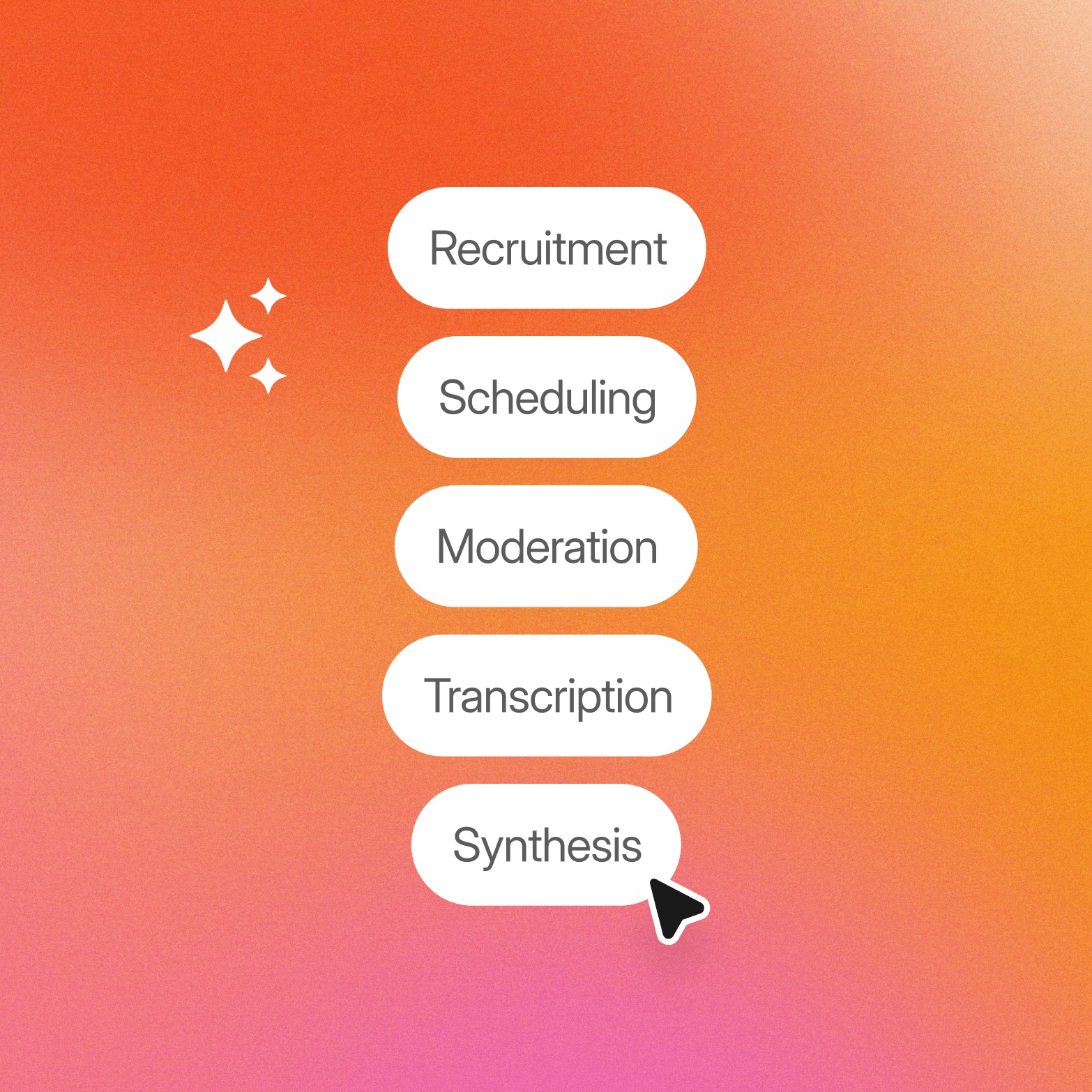
Most teams adopt continuous discovery as a principle and resource it as a research project. Recruiting, scheduling, moderating, transcribing, and synthesizing run as sequenced handoffs, so each study restarts from zero.
The cadence survives when the workflow itself carries the operational work, and findings compound in a searchable insight library that each new study builds on instead of starting over.
What continuous discovery is, and why it lapses after about a quarter
Continuous discovery is the practice of regular, ongoing customer contact, weekly or monthly, that feeds product decisions with current evidence rather than periodic project findings. Some teams call it continuous product discovery. Under either name, most teams define continuous discovery by its cadence, and that cadence breaks first.
Teresa Torres originated the weekly-touchpoint framing most teams mean when they talk about continuous discovery habits: the people making product decisions conduct small research activities with customers every week, instead of waiting for a large study. Her opportunity solution tree structures that work, mapping the opportunity space between a desired outcome and the solutions a team could build, so the team can evaluate solutions against real evidence.
Decisions ship every sprint, whether or not evidence is ready. When user research takes longer than the decision window, the team decides based on stakeholder opinion and last quarter's deck. That gap explains why most continuous discovery habits work for a few weeks and then quietly disappear.
The benefits of continuous product discovery follow from how product teams already work: decisions happen every sprint, so evidence has to arrive every sprint too. Small, frequent conversations keep the researcher close to the customer needs and pain points the team debates that week, and let the team test assumptions while changes are still cheap to reverse.
When the practice works, it looks unremarkable from the outside:
A standing cadence puts interviews on the calendar before anyone asks for them.
A shared question backlog, owned by the researcher and the product trio together, decides which research question each round explores.
Findings reach the sprint before the decision window closes, and new opportunities land on the team's opportunity solution tree while they are still current.
A new pack format or a loyalty app update ships with consumer evidence attached, and the trio keeps a shared understanding of what customers said.
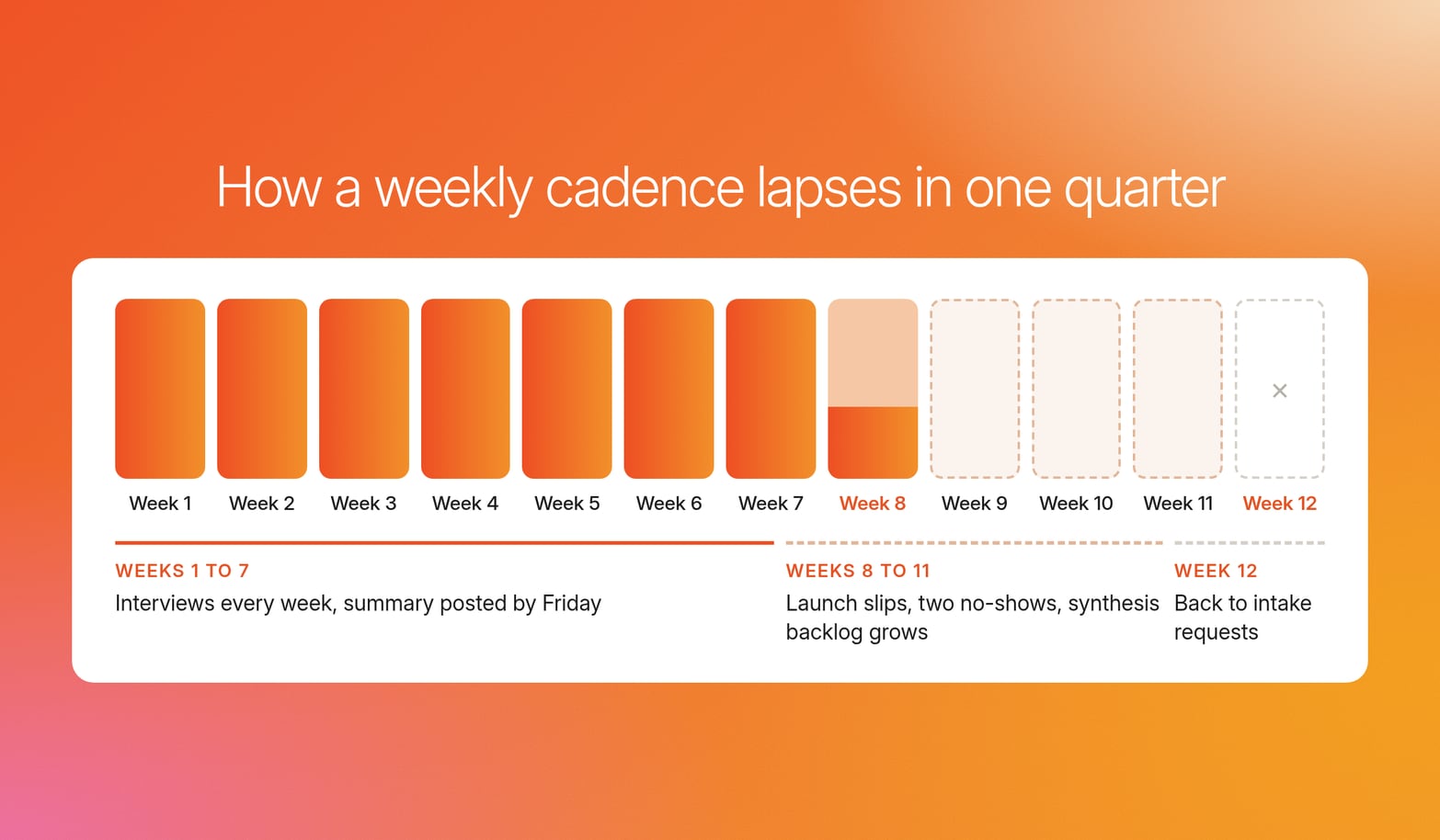
In practice, the rhythm rarely holds all year. Take a representative scenario: a consumer app team at a large retail brand commits to weekly interviews at the start of a quarter, and for the first few weeks the researcher recruits a handful of participants, conducts interviews, and posts a summary by Friday.
Around week eight, a launch slips, two participants miss their slots, and the synthesis backlog grows to three rounds. By week 12, the weekly slot is gone. The researcher is back to taking intake requests, and the features shipped that sprint rest on stakeholder opinion and last quarter's deck.
The lapse also erodes sample quality before it ends the cadence. As recruiting users for user research gets harder, teams fall back on whoever answers fastest: power users, friendly accounts, and colleagues in customer success. The user interviews continue for a few more weeks, but they describe a narrower slice of target users than the decisions they inform.
Nobody formally cancels the practice. It stops showing up on the calendar, and the team notices only when a product person asks what customers think about specific features and the most recent answer is three months old.
The root cause is consistent: the practice is adopted as a principle and resourced as a project. In most organizational contexts, teams borrow the hours each round requires from other work, and they staff each round like a one-off research project, paying the full setup cost again. The first busy sprint breaks the rhythm.
Continuous discovery lapses because of how it is resourced.
Why weekly customer contact breaks down: the handoff mechanism
Continuous discovery breaks down because recruiting, scheduling, moderating, transcribing, and synthesizing run as sequenced handoffs, so every study restarts from zero. Each step waits on the one before it, and in many embedded teams, the same researcher or product person ends up owning each one. A delay anywhere in the chain pushes findings past the decision they were meant to inform.
1. Recruiting and scheduling consume the week
The first handoff in the UX research process is recruiting. A researcher writes a screener, sends it to a customer list or recruiting partner, and waits for qualified participants. Then come slots, time zones, reminders, and confirmations. All that coordination is time-consuming for a 30-minute call, and no-shows reset the clock.
When two of six participants miss their slots, the researcher reschedules into the next sprint or presents four conversations to a team that expected six. The sample narrows from the target users the study needed to whoever was free on a Tuesday afternoon.
2. Manual transcription and coding
Once the calls end, the next handoff is turning recordings into research data. In practice, manual transcription takes several hours per recorded hour before anyone codes a single theme. A week of five 45-minute user interviews can absorb most of a researcher's remaining days, and coding across transcripts is equally time-consuming.
AI thematic analysis and automated transcription cut that time to minutes, letting the researcher focus on judgment: checking themes against verbatims, spotting contradictions, and deciding what the qualitative data means for the sprint. Without that compression, synthesis is the step teams cut first, and findings shrink to the moments someone remembers from the call.
3. Findings that sit in decks
Even when synthesis happens, research findings usually land in a slide deck, a doc, or a channel thread. Decks and other visual artifacts capture one study's answer to one question. They are hard to search, rarely tagged by theme, and cut off from the participant clips that make a finding credible to skeptical stakeholders.
So the next study starts without what the last one learned, the team loses its shared understanding of customers, and the same questions get researched twice. The cadence depends on one person's memory, and when that researcher goes on leave or gets pulled onto a launch, they take the knowledge with them.
4. Sprint and campaign calendars outrun the cycle
Product teams plan in two-week sprints, and campaign teams work to launch dates that rarely move. In practice, a sequenced research workflow, where each handoff waits on the last, often needs two to three weeks to produce one round of findings. That gap is where continuous discovery and delivery fall out of step: the sprint calendar outruns the research cycle, and the decision ships first. Findings that arrive after sprint planning and story mapping are rarely used to change what gets built.
Agency timelines of 6 to 12 weeks sit at the far end of the range. That pace fits large, methodologically complex studies, such as multi-market segmentation, where depth and broader context matter more than turnaround. For sprint-paced decisions, it is a question of fit.
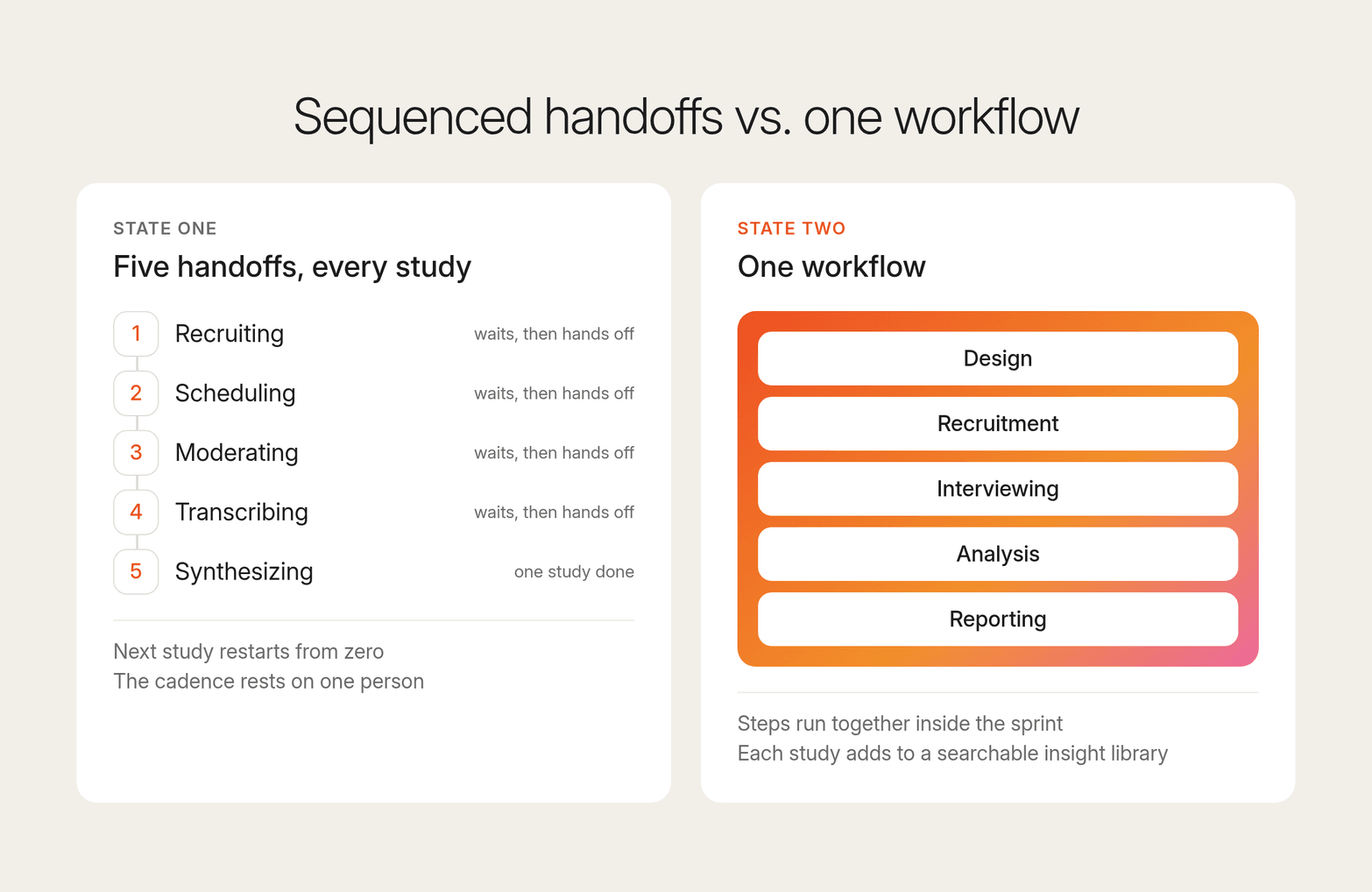
The lapse is structural, so the fix belongs in the workflow. In Conveo's view, the fix is fewer handoffs, so each round of findings fits inside the sprint it serves and a research or insights lead at a large company can sustain the cadence across several product teams.
How to evaluate approaches to continuous discovery
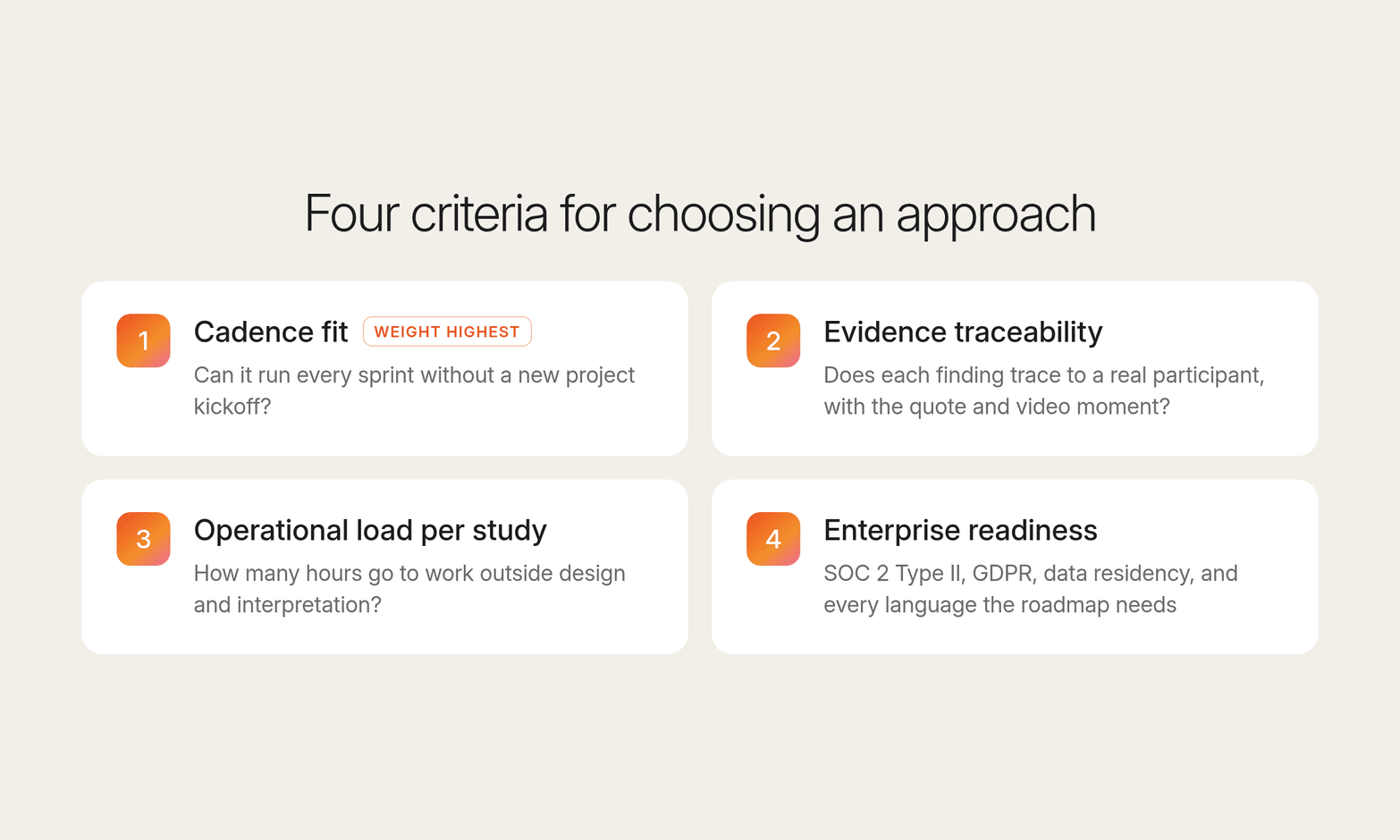
This continuous discovery framework helps UX researchers and insights leads choose an approach by four evaluation criteria: cadence fit, evidence traceability, operational load per study, and enterprise readiness.
1. Cadence fit
Weight this criterion highest, because cadence is what lapses first. The test is whether the approach can run every sprint without a new project kickoff and still return reliable feedback. A slower approach can belong in the research toolkit, but it cannot be the backbone of an always-on practice for a team that ships every two weeks.
2. Evidence traceability
Every research finding should trace back to a real participant, with the verbatim quote and video moment attached. Product, engineering, and insights stakeholders push back on summaries they cannot verify, and synthetic personas offer nothing to trace back to.
Untraceable findings can also cause harm: a confident summary can steer a roadmap toward something no participant said. Traceability is also what lets findings compound, because a tagged, sourced clip can answer next quarter's question about the same customer needs.
3. Operational load per study
Count the hours a researcher spends outside design and interpretation: recruiting, scheduling, conducting interviews, transcribing, coding, and formatting reports. Multiply that number by the cadence, and the result decides whether the practice survives.
Low per-study load lets one to three embedded user researchers support several product teams. High load caps cadence at whatever one person can sustain, which reproduces the quarterly lapse.
4. Enterprise readiness
Procurement and legal review run on their own timeline, so check requirements before a pilot. Look for SOC 2 Type II certification, GDPR compliance, data residency that matches where participant data must stay, and interview coverage in every language the roadmap needs.
Confirm whether those come standard or sit in an enterprise plan or custom plan. Missing compliance stalls procurement, and localization delay stretches multi-country programs by weeks. This criterion rarely picks the approach, but in a regulated organizational context it can block one late.
| Approach | Typical cycle | Evidence type | Operational load | Where it fits best |
|---|---|---|---|---|
| Agency-led research | 6 to 12 weeks | Expert-moderated depth, full reports | Low for the team, high per study | Large, methodologically complex studies |
| Survey tools | Days | Scaled answers, flattens hesitation and emotion | Low per study | Opportunity sizing, measuring how many, tracking change |
| DIY stitched interviewing | Varies with researcher capacity | Live interviews, manual notes | High, sequenced handoffs | Flexible, occasional deep dives |
| AI-moderated research | Within a sprint | Video, voice, and verbatim traces to participants | Low, design to reporting in one workflow | Recurring discovery at sprint cadence |
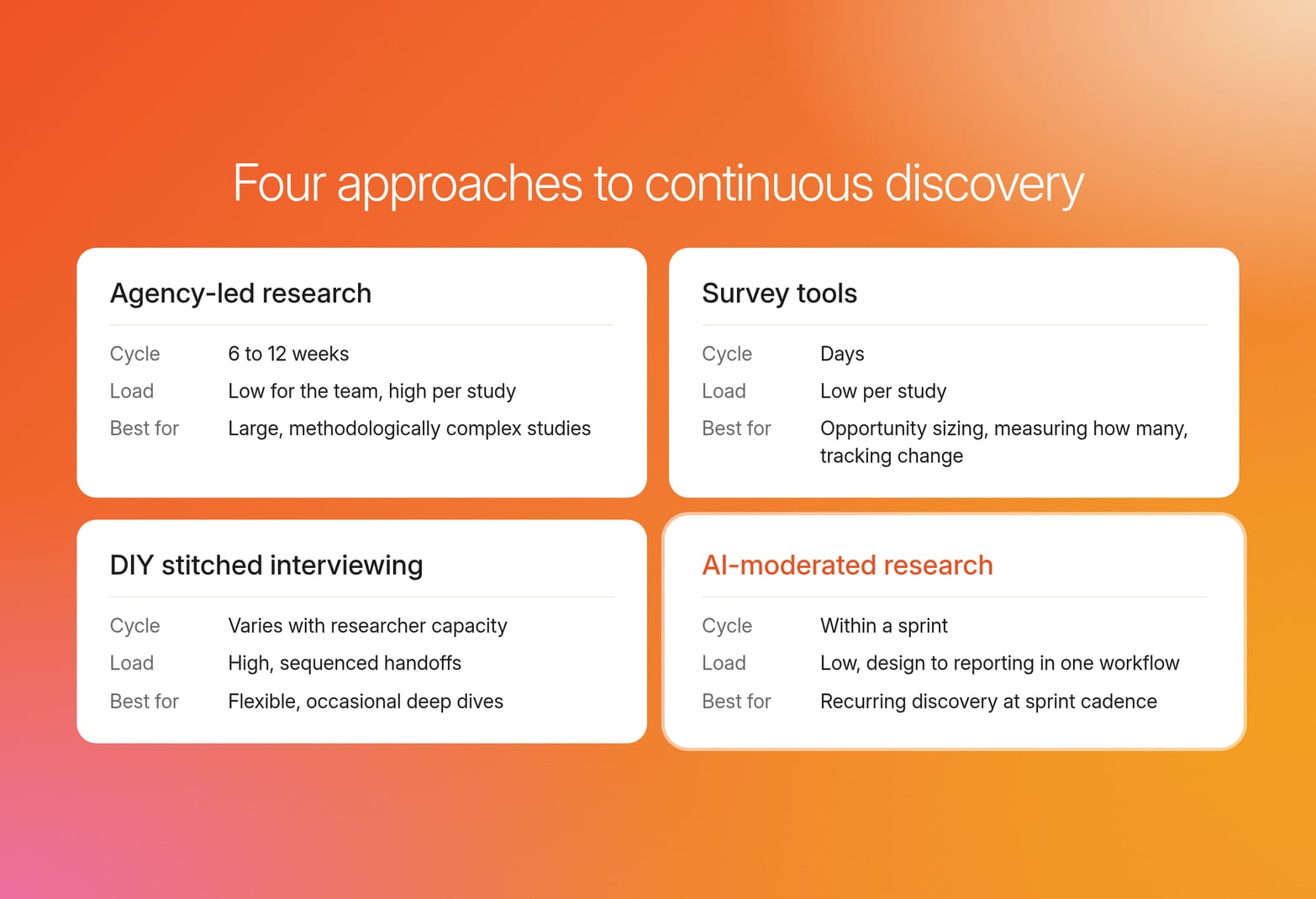
Against the four evaluation criteria, agency-led research scores well on depth, broader context, and traceability but rarely on cadence. Survey tools gather feedback quickly but give thin evidence on why. DIY stitched interviewing keeps full control, at the cost of the handoffs that cause the lapse.
Of the four approaches, AI-moderated research removes the most handoffs: study design, recruitment, interviewing, analysis, and reporting run in one place, and interviews run in parallel across markets and time zones. Teams using Conveo, for example, recruit participants through eight integrated panel providers or their own participant list, and each study adds to a searchable insight library that later studies build on.
The researcher still owns the design and the interpretation. Quality depends on a well-built guide and clear screening criteria, and writing guides for AI-moderated interviews has its own learning curve, even for experienced UX professionals.
Match the approach to the decision the research feeds. For continuous product discovery that informs sprint decisions, choose the lowest operational load per study that still traces every finding to a real participant. When the decision is large, infrequent, and methodologically complex, such as a market entry, a human-moderated agency study is still the right call.
Maze alternatives for continuous discovery: choosing by study type
Teams look for Maze alternatives when their need shifts from testing specific designs to understanding why customers behave as they do, on a recurring cadence. Usability testing shows whether people can complete a task in a design. Interviews show why they want it done, what other solutions they tried, and what would make them switch. The two rely on different research methods, and both belong in a research toolkit.
| Study type | Question it answers | Best-fit method |
|---|---|---|
| Design validation and usability | Can people complete the task in this design? | Unmoderated usability testing and tree testing |
| Why-based exploration and concept feedback | Why do customers hesitate, and what would make them switch? | AI-moderated voice and video interviews |
| Segment and persona refresh | Do segments still match actual behavior? | Behavioral interviews each quarter or after major releases |
Design validation and usability
When you're asking whether a flow, prototype, or layout works, unmoderated usability testing and tree testing are still the right fit. Task completion, misclick paths, and heatmaps on desktop or mobile devices give designers concrete evidence for the small improvements that matter late in the design process.
Keep Maze, Optimal Workshop, or one of the other established UX research tools for this work if it already fits the design workflow. The gap appears when the team needs to understand the motivation behind a test-recorded behavior. Participants share their screen while Conveo observes where they get stuck and probes on the actions it sees.
Why-based exploration and concept feedback
When the question is why customers hesitate or where a pain point sits, conversation carries the evidence, because a task metric cannot ask follow-up questions. The AI research assistant probes on video, voice, and tone, so teams see the hesitation and emotional reactions that surveys and transcripts flatten.
A vague answer about pricing gets follow-up questions and a request for specific stories about the last time the participant faced the decision. A clip of someone pausing over a price carries weight with skeptical stakeholders in a roadmap debate.
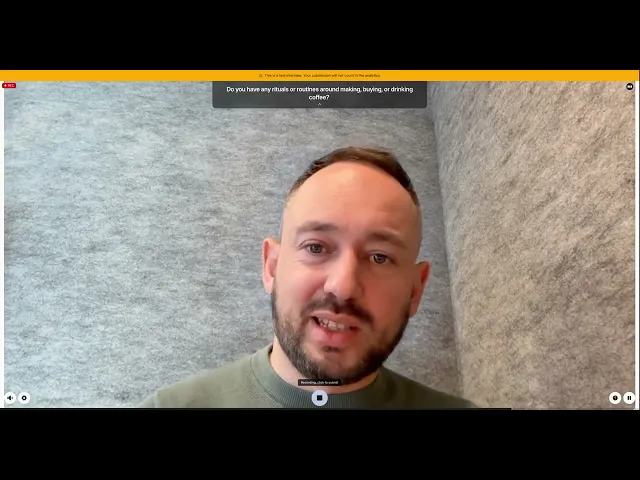
The video below shows an AI-moderated Conveo interview in action.
Segment and persona refresh
Personas built from one round of research go stale as the product, market, and opportunity space move. Behavioral interviews, run each quarter or after major releases, keep segments tied to actual behavior rather than what a workshop assumed. Each wave adds to the same searchable insight library, so the next refresh starts from what earlier waves established.
Teams that move past usability-only research keep both approaches and route each new research question to the one built for it.
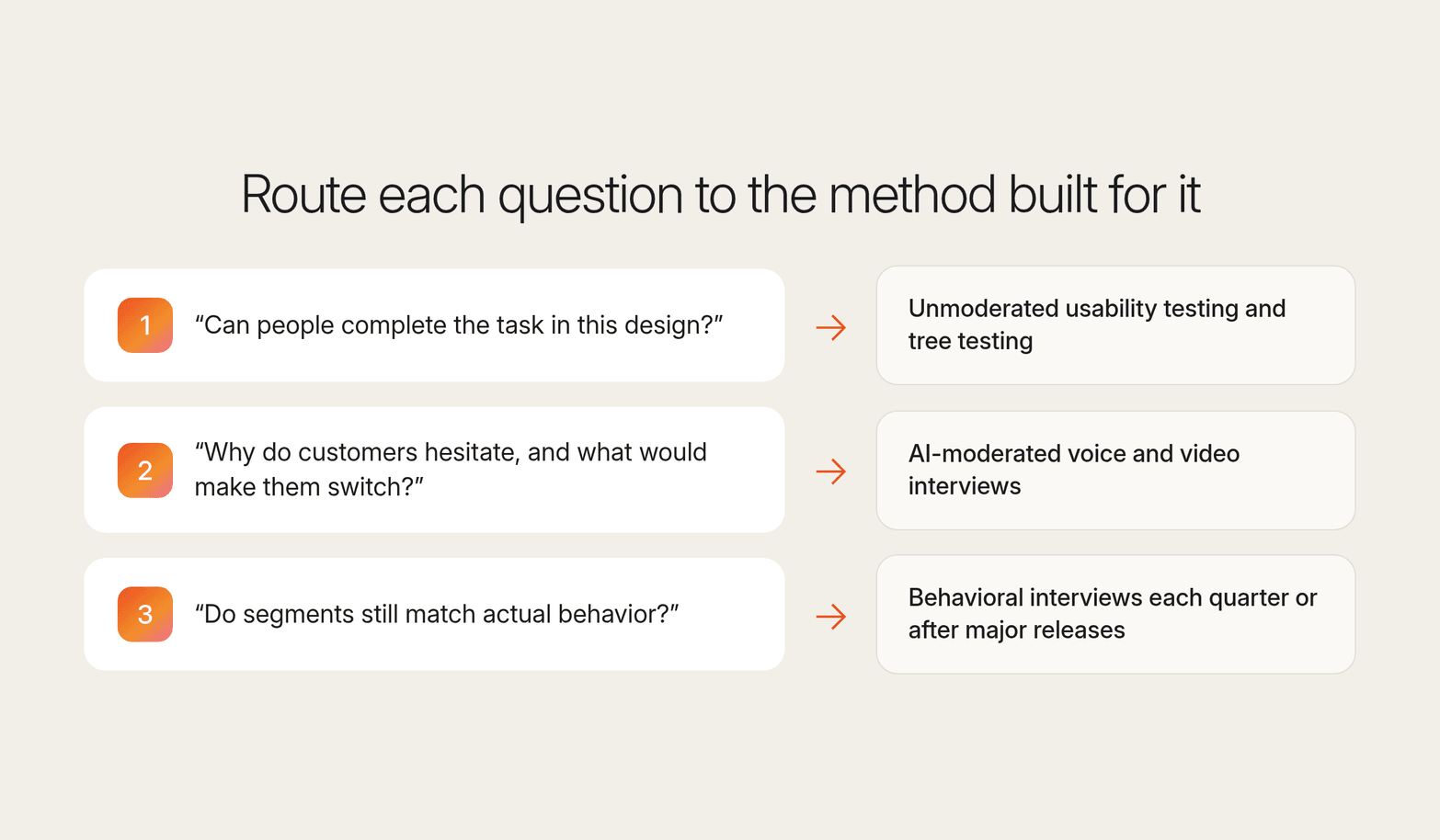
In Conveo's view, interviews work best as the always-on layer, with usability tests run as specific designs need them. Choose by the question being asked, and expect a mature UX research process to combine more than one of these UX research methods.
Where Conveo fits, and where it doesn't
Continuous discovery's hardest problem is operational: the workflow has to carry the research without resting on one person. Conveo is built for teams that need to conduct user research at that cadence, and research and insights teams at Google, AB InBev, and Canva use it. Three parts of how Conveo works carry the operational load:
One workflow. Design, recruitment, interviewing, analysis, and reporting run together instead of as five sequenced handoffs, so findings fit inside the sprint they serve.
Traceable findings. Each theme links to the participants behind it, with video clips and verbatim quotes stakeholders can audit.
Compounding knowledge. Recurring themes and facets are recognized across studies in a searchable insight library, so the next wave starts from what earlier ones established instead of a blank codebook.
Conveo StoryLines brings Continuous Consumer Understanding to this cadence: it runs research in waves, for example every two weeks or monthly, shows how themes rise, fall, or persist from wave to wave, and gets findings to the team while the decision is still open. Conveo is SOC 2 Type II and ISO 27001:2022 certified, GDPR compliant, with EU hosting in Belgium, which supports multi-market teams that need participant data to stay in Europe, and AI-moderated interviews run in 50+ languages.
"I've got no problem with stakeholders just spinning up a templatized Conveo study, getting results back and using it. I don't even have to be in the loop."
Matt Harris, Research & Insights Lead, Canva
Conveo is not the right fit for every study:
Dedicated quantitative usability benchmarks, highly facilitated prototype walkthroughs, and sessions requiring live accommodation may still call for a specialist setup.
For a single, large, methodologically complex study, such as a market entry decision, a human-moderated agency engagement is still the right call.
Conveo is built for the recurring, sprint-paced qualitative research in between: the cadence that most often lapses when it's resourced like a one-off research project.
Frequently asked questions
What is continuous discovery in UX research?
Continuous discovery is the practice of talking to customers regularly, usually weekly or monthly, so product decisions rest on current evidence rather than a quarterly study. Teresa Torres popularized the weekly-touchpoint version of the practice, in which product teams and user researchers talk to customers every week.
Why does continuous discovery usually stop after a quarter?
Most teams resource it as a project rather than a workflow. Recruiting, scheduling, moderating, transcribing, and synthesizing run as sequenced handoffs that land on one researcher, so the first busy sprint breaks the rhythm.
How is continuous discovery different from a usability testing cadence?
Usability testing answers whether people can complete a task in a specific design. Continuous discovery interviews answer why people want the task done and what would make them switch. Most mature research practices run both.
What UX research methods work best for continuous discovery?
Most teams match research methods to the question: user interviews that ask for specific stories carry the why-based work, usability and tree testing validate specific designs, and surveys handle opportunity sizing. Together, these methods let teams run user research every sprint and test assumptions before features ship.
Can continuous discovery findings compound over time?
Yes, when teams follow best practices for [storing qualitative consumer input](/insights/best-practices-for-storing-qualitative-consumer-input): searchable and tagged by theme rather than scattered across decks. A searchable insight library lets each new study build on what earlier ones established.
Does continuous discovery replace agency-led research?
No. Agency-led studies are still the right call for large, infrequent, methodologically complex work, such as market entry research. Continuous discovery and agency research answer different kinds of decisions.

About the author
Alex de Hemptinne
Business Impact Lead
Alex is a Business Impact Lead at Conveo, partnering with enterprise teams to embed AI-led research into their workflows. From the first study to full-scale rollout, she helps customers shift from project-based research to continuous customer intelligence.
Meet Alex on film →Qualitative insights at the speed of your business.
Conveo runs AI-moderated video interviews and structures everything they say.