In this article
TL;DR
Most voice of customer research reports back after the decision it was meant to inform has already closed, turning customer feedback into actionable insights too late to matter.
Velocity and hit rate on new products, campaigns, and channels, matched to shifting customer expectations, now decide which brands hold their position.
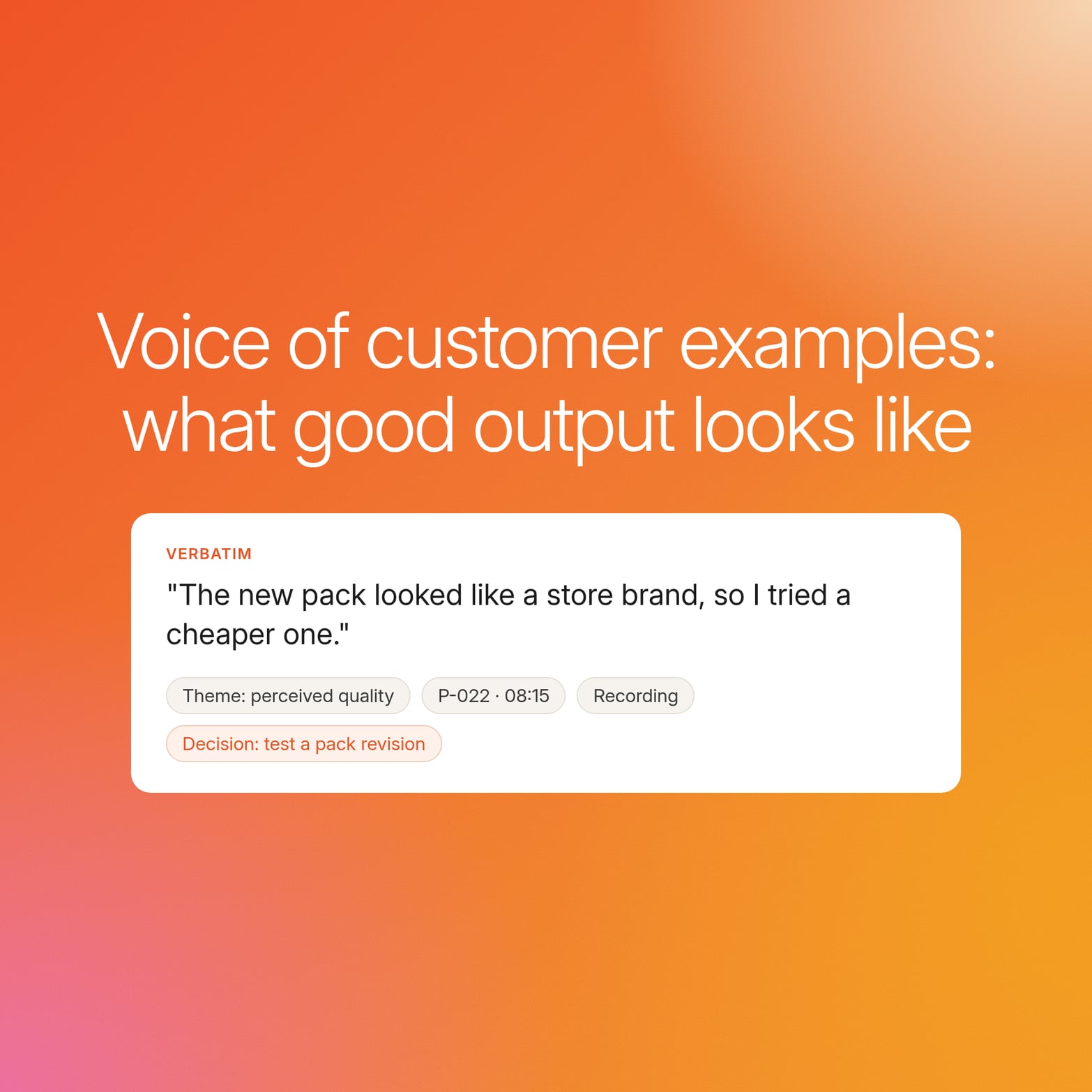
An always-on program earns trust only when every theme traces to a real participant, a recorded session, and a verbatim quote drawn from direct feedback.
A fixed interview sequence of context, experience reconstruction, evaluation, and implications produces behavioral evidence that satisfaction scores alone can't.
Recruit 5 to 15 participants per predefined segment, screen for recency, and hold core question wording stable across waves.
By the time most voice of customer research reports back, the decision it was meant to inform has closed: the roadmap is locked, the campaign brief is signed off, the pricing change is live. Collecting feedback on an annual clock means the analysis lands after the fact.
That lag has become a competitive problem. A team that keeps gathering customer feedback while the decision is open, and can spot trends before a competitor does, outperforms a team confirming last year's read.
Running a voice of customer strategy always-on only helps if stakeholders believe the resulting customer insights. Belief comes from traceability: a real participant, a recorded conversation, and a verbatim quote tied to a named theme. Raw feedback stripped of its source earns none of that trust.
Insights teams run AI-moderated video interviews on Conveo across markets without waiting for the next annual wave, collecting customer input as it happens. Conveo's AI research assistant adapts its questions to what participants actually say instead of working through a rigid script, and analysis of the VOC data starts as soon as a conversation closes.
What voice of customer research is (and what it isn't)
Voice of customer research, sometimes shortened to voice of the customer or VOC, is a structured program to surface customer needs, decision drivers, and experience gaps through direct conversation.
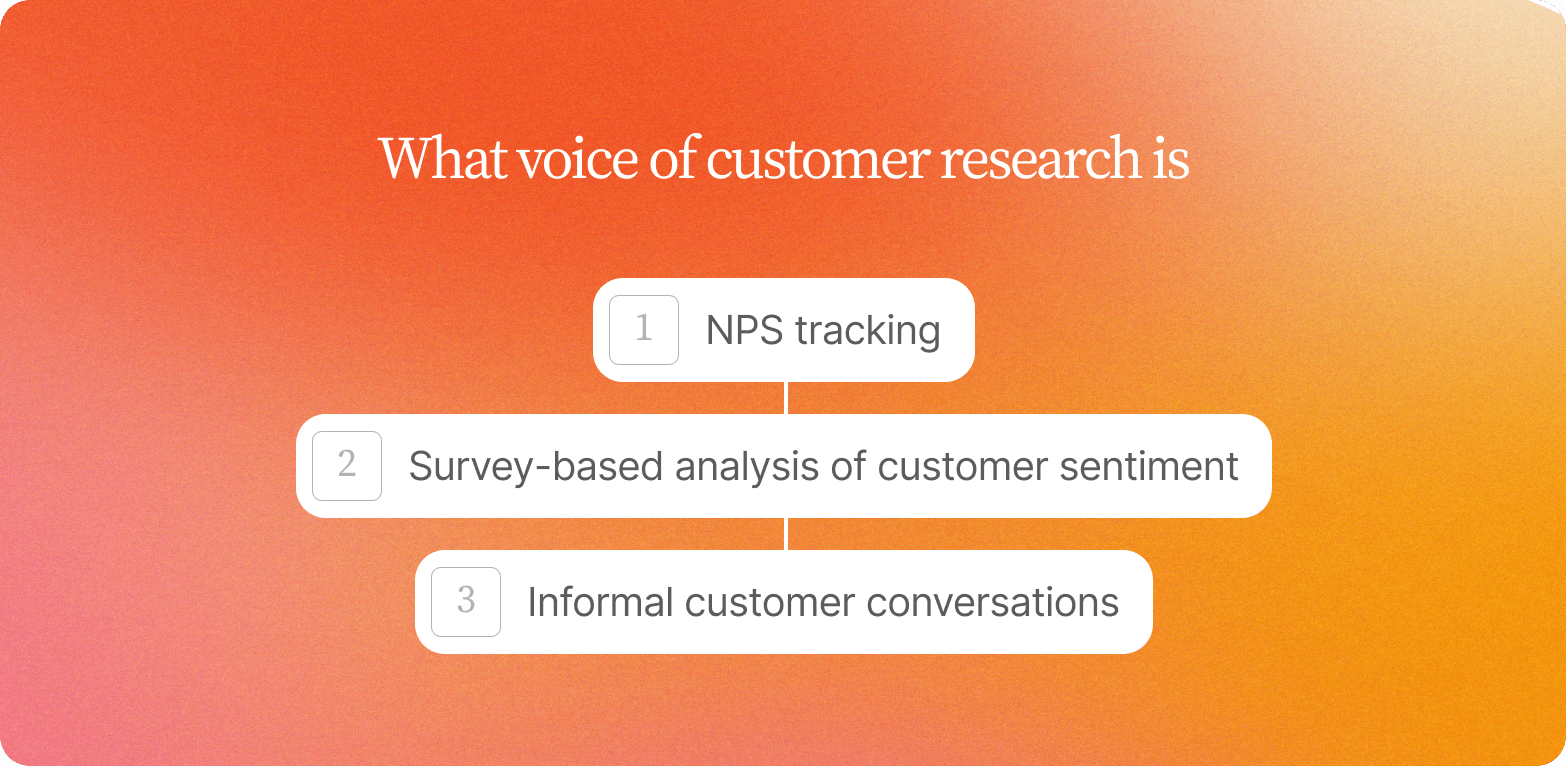
Three adjacent practices get mistaken for it:
NPS tracking tells you a number moved. It can't tell you why.
Survey-based analysis of customer sentiment tells you tone shifted, without saying what happened.
Informal customer conversations without methodology surface anecdotes, and anecdotes are not evidence.
None of the three tells you what a specific customer tried, what customer pain points frustrated them, or what they would do differently. Programs that treat those measures as voice of customer research produce findings that feel directionally true but collapse when a skeptical VP asks where the data came from.
Every theme in analysis and reporting needs to link back to source evidence: the verbatim quotes, participant IDs, timestamps, and video clips behind the customer data. An unsourced AI summary and a fabricated one are indistinguishable to enterprise stakeholders: a finding you can't trace to a real person carries no more credibility than a guess.
Picture a program that reports a handful of customer concerns, like "customers want faster onboarding," without showing who said it or what they had already tried. Programs that can't defend their findings get defunded or ignored.
Why annual VOC programs fail
Most teams schedule voice of customer research annually because fieldwork costs made it impossible to repeat quarterly: agency recruitment, moderation, and analysis priced a single study at a level that made quarterly repetition unrealistic, so customer analysis became an annual event rather than a continuous one. The structural consequence is a detection lag of a year or more: a shift in sentiment, a new friction point, or a competitor gaining ground on a specific job-to-be-done erodes competitive advantage long after the market has moved.
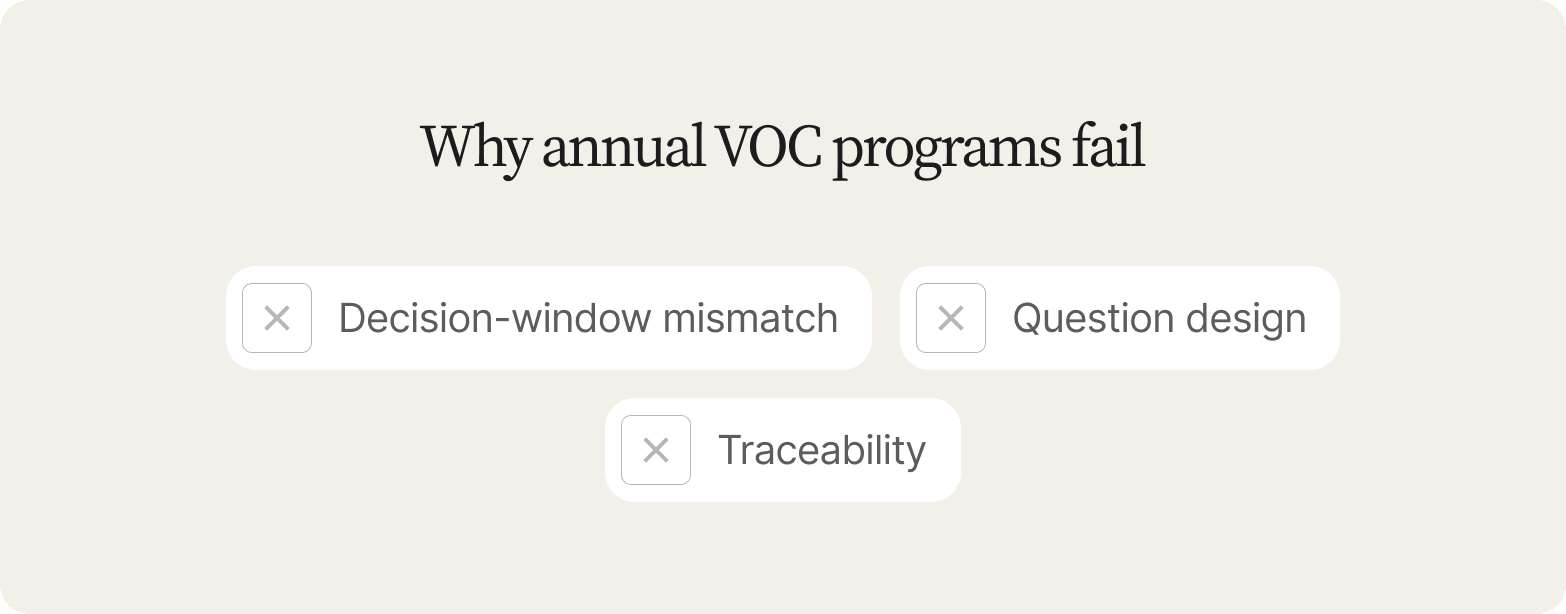
Three failure modes explain why:
Decision-window mismatch. Research that runs for weeks and repeats annually arrives as confirmation of what the business already suspected. Roadmaps close, briefs get signed off, pricing changes go live, and the findings validate a decision already made.
Question design. Annual programs chase customer satisfaction scores because scores are easy to aggregate and present. "How satisfied are you with onboarding?" produces a single number, and a chart of satisfied customers hides exactly the friction a redesign needs to fix. Survey responses compress a decision into a single number, easy to chart and easy to misread, and a single customer survey fielded once a year can't catch a shift that happens in month four.
Traceability. Summary-only outputs and unsourced synthesis are indistinguishable from fabricated findings to stakeholders who were not in the room. Researchers set aside findings they cannot source to a specific person, even when the finding is right.
The compounding cost sits underneath all three: because prior studies are not searchable, teams rerun the same foundational customer analytics questions year after year, paying for the same understanding repeatedly.
Voice of customer research methods that produce traceable findings
Voice of customer research produces defensible findings only when the method matches the question: depth interviews when the goal is understanding why customers behave as they do, surveys to confirm distribution across the customer base without explaining the qualitative data behind it. Focus groups add a middle ground for reaction and consensus, though group dynamics can mute hesitation. Online customer reviews add texture but rarely explain root cause: volume flags where to look, interviews explain why.
Structure the guide in a fixed sequence
Build every discussion guide around four fixed stages:
1. Context
Establishes the participant's situation before they formed an opinion.
2. Experience reconstruction
Surfaces what actually happened.
3. Evaluation
Captures their judgment of it.
4. Implications
Reveals what they did next and what they would do differently.
Skipping straight to evaluation before the participant has narrated results in a rationalized preference rather than an account of customer behavior.
Use experience reconstruction deliberately
Ask participants to narrate a specific recent episode in chronological detail: "Walk me through the last time you tried to solve this. Start from the moment you realized you had a problem."
That prompt surfaces what they attempted, where the process broke, and what they settled for. It signals something different from "How important is ease of use to you?" One describes customer behavior, the other aspiration.
Probe the moments that matter
Probe hesitation points, workarounds, pain points, objections, and the exact criteria that drove a decision. When a participant pauses before answering a pricing question, that pause is data.
A described workaround is the clearest signal of unmet need available. Surveys flatten the texture of a decision into a rating of customer preferences, so none of these signals survive.
Build traceability into the analysis from the start
Require every theme in your analysis to link to verbatim quotes, participant IDs, timestamps, and video clips, so teams that analyze customer feedback this way can defend it long after the study closes.
In a representative scenario, a messaging validation study produces clips showing exactly where a value proposition connected or collapsed. A summary deck stating "messaging resonated with 70% of participants" is not defensible, because no one can trace the number back to what was said. Researchers using Conveo apply that standard to every piece of customer analysis.
Preserve video, voice, and tone as primary data. Transcripts help with search, synthesis, and natural language processing that surfaces recurring themes at scale across the qualitative data. The recording carries signals a transcript cannot, like hesitation before a price point or flatness in a voice when a brand promise misses, so keep it alongside the transcript.
Continuous VOC vs annual waves: what changes
Continuous voice of customer research runs customer conversations through the year rather than in one annual burst, following the customer journey as it unfolds.
Async AI-moderated interviews remove the calendar coordination that makes traditional waves expensive. Participants join on their own schedule, and teams analyze feedback while the decision is still open instead of months later.
Conveo StoryLines is the wave-based AI-moderated research program behind that cadence. Waves run, for example, every two weeks or monthly, and Conveo runs signal detection across the wave time series to identify trends.
The rigor standard matters as much as the cadence: Conveo's AI research assistant probes on what participants actually say, so themes emerge from real participant responses.
Conveo's searchable insight library connects findings from every study inside Conveo, keeping them searchable and carrying their source evidence, so nothing gets researched twice.
Continuous VOC feedback loops mean a brand team running continuous voice of customer research can catch a shift in brand health as it happens and adjust the next campaign, instead of waiting for the next scheduled wave to confirm it.
How to design a voice of customer interview guide
Every voice of customer research guide should start with the business decision it is meant to inform. A vague topic like "what do customers think of onboarding" gives the guide nothing to aim at. Naming that decision first, then using the same four-stage sequence across every guide, separates a real VOC strategy from a checklist of questions and produces evidence that drives a specific call about that stage of the customer journey.
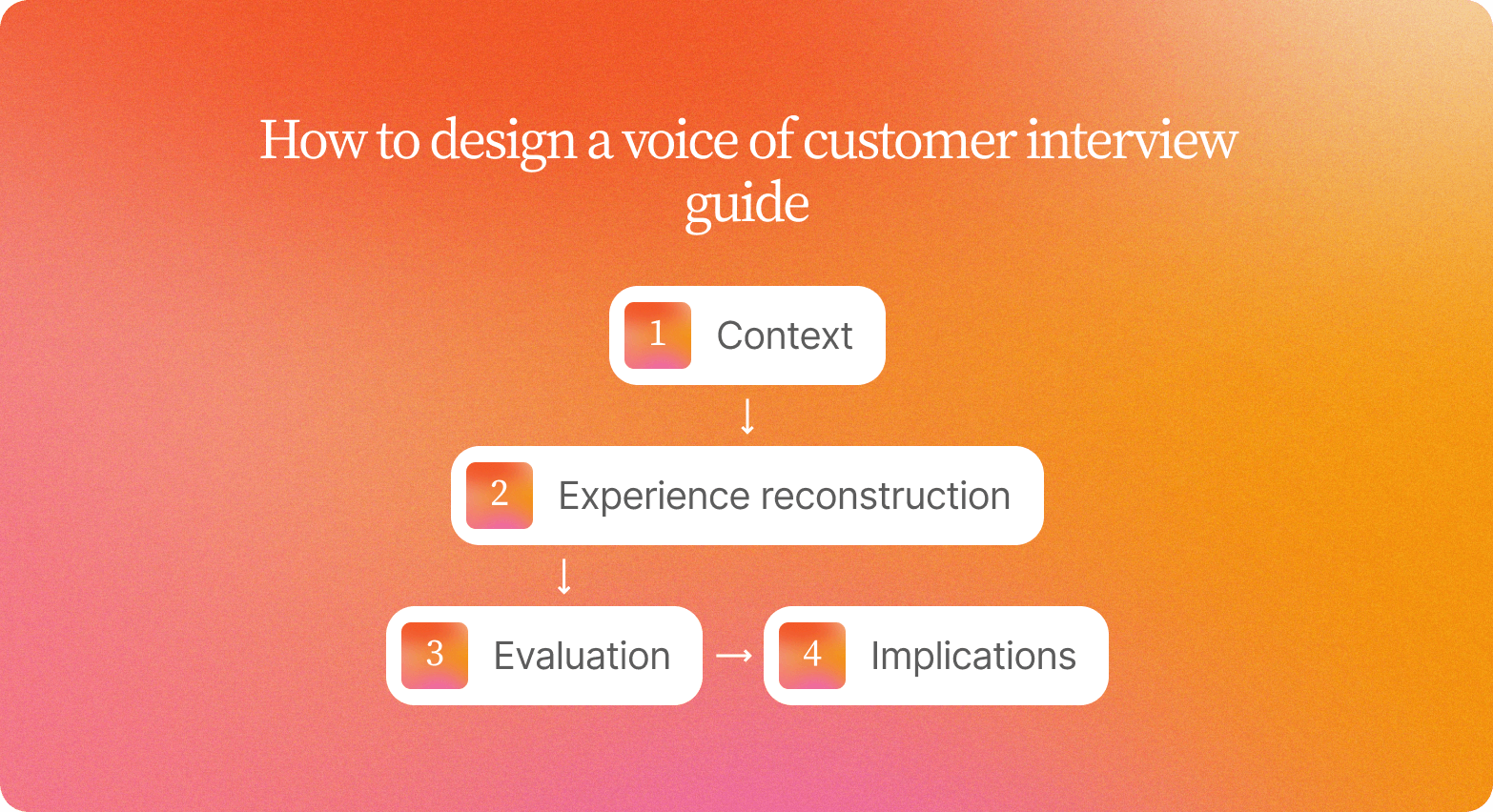
1. Context
Open by confirming the participant fits the segment you intended to recruit, and note what customer expectations they arrived with. A participant who has never experienced the problem will give you surface-level speculation instead of behavioral evidence.
2. Experience reconstruction
Ask participants to narrate a specific recent episode in chronological order: "Walk me through the last time you tried to do X, from the moment you decided to start." Chronological narration is harder to rationalize than direct questions.
3. Evaluation
Probe hesitation, workarounds, and the criteria behind the call, including how customers feel about the alternative they almost chose. This section is most often cut when guides run long, so protect it.
4. Implications
Close by asking what they would do differently or what would make them switch; this kind of customer input surfaces unmet needs.
A guide built for a brand health study, where consumer perception is on the line, makes the stakes clear: consistent wording across waves is what turns individual studies into a longitudinal read of how customer experience is changing.
Voice of customer research sampling and recruitment
In practice, effective voice of customer research recruits 5 to 15 participants per predefined segment. Pattern saturation, the point where additional interviews reinforce existing themes instead of surfacing new ones in your customer analytics, happens at the segment level.
Before recruiting a single participant, lock down four things:
Segment count first. Count your segments, then set the minimum per-segment target, instead of picking one number for the whole study.
Segment criteria, defined upfront. Segmenting after fieldwork means interviews get assigned to clusters based on whatever data surfaced.
Segment variables matched to the decision. For a brand health study: purchase frequency, category usage, retailer channel, and history of customer complaints. For a messaging validation study: role, company size, and buying stage.
A saturation point for each cell, since every segment combination needs its own evidence before you trust the theme.
Recruitment mechanism matters as much as segment design: how a team collects customer feedback shapes whether the theme can be trusted downstream. Recruit through Conveo's integrated panel network, which connects eight integrated panel providers, or bring your own list via CSV upload. Then screen for recency: a screener question such as "used the product in the last 30 days" makes sure participants can reconstruct specific episodes instead of generalizing from memory.
Screening does three things at once:
Lets teams tailor feedback requests to the exact behavior a study needs to understand, instead of sending the same generic ask to everyone on a list.
Reduces wasted outreach to people who don't fit the segment.
Separates real signal from vague impressions, the difference between an answer that holds up when a stakeholder asks who said it and one that doesn't.
Participant quality checks keep the sample defensible, protecting the customer data these programs depend on. This is a different data source from static feedback forms or scraped online reviews, both of which return raw feedback with no way to probe further.
For teams scaling voice of customer programs across markets, procurement is part of the method. Choose platforms that are SOC 2 Type II certified, GDPR compliant, and run European hosting with primary infrastructure in Belgium.
Run sessions asynchronously with AI moderation. Calendar coordination across time zones is one of the most underestimated bottlenecks in qualitative research. On Conveo, interviews run in parallel across markets and time zones, so recruitment stops being the rate-limiting step.
Comparison table: annual VOC programs vs continuous research
Annual voice of customer programs detect change roughly a year after it happens. Continuous research surfaces those shifts early enough to protect customer retention and revenue before either erodes.
| Voice of customer research | Timeline | Traceability | Decision alignment |
|---|---|---|---|
| Annual VOC programs | Weeks per wave, one or two waves per year | Summary decks, no source linking | Findings arrive after decisions close |
| Continuous AI-moderated research | Days to weeks per study, running continuously | Verbatim quotes, participant IDs, timestamps, video clips | Change visible while decisions are open |
Continuous programs shorten the gap between question and evidence and make findings auditable, so stakeholders can defend a theme instead of asserting it. The shift also changes what counts toward measurable business outcomes, a validated brand health fix or a corrected pricing narrative in place of a completed fieldwork wave, and turns scattered notes into key insights the whole company can reuse.
Voice of customer research use cases by decision type
The most common failure in voice of customer research is starting with the wrong question. "What do customers think?" produces quotes. "Should we redesign onboarding?" produces evidence that drives a decision.
Frame the business decision first, then design the research to answer it. The three examples below are representative scenarios written for illustration, without named customer results.
Brand health movement
When a brand health metric moves, the instinct is to wait for the next wave to confirm it. In a representative scenario, depth interviews surface what actually shifted: a specific claim in a new campaign, a stockout at a key retailer, or a competitor's launch landing harder than expected.
Ask participants to walk you through the last time they thought about the brand, then follow what they noticed and where it came from. That sequence surfaces the negative feedback or hesitation behind the movement more reliably than waiting for the next quarterly wave to confirm the trend.
The reconstructed moment is specific and traceable. It gives the brand team something to act on ahead of the next campaign, and acting on it tends to improve customer satisfaction faster than another broad repositioning exercise.
Messaging validation
Good messaging testing finds the exact moment a value proposition connects or collapses.
In a representative scenario, a team records participants describing what they think the product offers before they see the positioning, then shows the actual message and watches where their language shifts from what customers expect to what the product actually delivers. Clips of those connect-and-collapse moments persuade stakeholders more than a slide reporting that messaging resonated, showing the gap between the claim and what prospects need.
Pricing narrative
When an NPS score drops after a pricing change, alongside shifts in other brand health metrics, the number tells you something moved. Voice of customer interviews tell you why.
In a representative scenario, a pricing team pairs the quantitative signal with qualitative sessions that surface hesitation points, workarounds, pain points, and the criteria customers applied when they chose to stay, downgrade, or leave.
Common themes, such as friction around perceived value or confusion about tier differences, explain the score movement in terms a pricing team can act on, translating soft signals into the key performance indicators leadership already tracks, whether the goal is to increase customer satisfaction, protect customer loyalty, or defend a margin.
Use depth interviews when the goal is understanding why customers behave as they do. Use online surveys to quantify patterns once qualitative research has surfaced the themes worth measuring.
Why Conveo fits voice of customer research
Generic customer tools built for feedback collection solve one part of the cycle, a form here, a survey there. Voice of customer research at this level needs recruitment, moderation, analysis, and the insight library working as one system.
Insights and brand teams at consumer brands use Conveo for a live, continuous read on consumers. Conveo StoryLines runs research waves, for example every two weeks or monthly, and detects signal movement in how customers interact with the product across the time series, grounded in real customer interactions.
Rigor is what makes that continuous read usable. Conveo is built by researchers, and Conveo's AI research assistant follows the discussion guide's logic and adapts to what participants actually say, so a researcher can defend any finding, whether it concerns customer sentiment, a feature request, or a brand-health signal, when a stakeholder challenges it.
Findings land in Conveo's searchable insight library, where each study makes the next one faster and nothing gets researched twice, turning a single study into a durable customer strategy that compounds over time.
Procurement gets what it needs as well: SOC 2 Type II certified, GDPR compliant, EU hosting (Belgium). Recruitment runs through Conveo's panel partners or your own list, with participant quality checks keeping the sample defensible across the full customer base.
Findings arrive while the decision is still open, and the combination of always-on cadence plus traceable evidence enables continuous improvement, usually the difference between a successful VOC program and one that quietly gets deprioritized.
Frequently Asked Questions
What is voice of customer research?
Voice of customer research, also called voice of the customer, is a structured program that surfaces customer needs, decision drivers, and experience gaps through direct conversation. Where a survey tells you that 72% of customers rated checkout difficult, voice of customer research tells you why: the payment step felt unfamiliar, or the confirmation screen never arrived. Every theme that reaches a stakeholder deck should trace back to verbatim quotes, participant IDs, timestamps, and video clips, the raw material behind valuable insights leadership can act on.
How many participants does a voice of customer study need?
Plan for 5 to 15 participants per predefined segment rather than a single number for the whole study. Pattern saturation happens at the segment level, so a 20-interview study spread across four behavioral clusters usually leaves each cluster too thin to trust. Segment first around the customer preferences or behaviors the decision depends on.
How often should a voice of customer program run?
Cadence should match the decisions it informs. Annual programs detect change about a year late, so findings validate decisions already made. Wave-based programs, for example every two weeks or monthly, keep a read on customers between major studies, and steady cadence is what turns isolated studies into continuous improvement rather than an annual snapshot.
What is the difference between voice of customer research and NPS?
NPS, short for Net Promoter Score, reports that a score moved. Voice of customer research explains what happened behind the movement: what the customer tried, where it broke, and what they did next.
What makes a voice of customer finding defensible in an executive review?
Traceability. A defensible finding links to a named theme, the verbatim quotes behind it, the participant IDs, the timestamps, and the recorded clips. That specificity is what turns customer insights into something a skeptical VP will accept without a fight.
Do AI-moderated interviews replace human moderators?
No. AI moderation handles the operational work of analyzing customer feedback at volume, and human researchers still design the study, frame the hypothesis, and interpret findings in context.

About the author
Florian Hendrickx
Head of Growth
Florian is Conveo’s Chief Growth Officer, leading growth strategy and go-to-market execution as the company scales. He’s held growth leadership roles at companies like Deliverect, Robovision, and Aikido Security, and brings hands-on experience across marketing, sales, and product.
More by Florian →Qualitative insights at the speed of your business.
Conveo runs AI-moderated video interviews and structures everything they say.