In this article
TL;DR
Secondary sources, including analyst reports, review aggregators, and news monitoring, describe what competitors are doing. This kind of market intelligence cannot explain why buyers chose them or where a competitor's promise broke down in practice.
Win-loss interviews, competitor switching interviews, and buyer journey interviews surface verbatim buyer evidence precise enough to withstand stakeholder scrutiny and support strategic decisions.
Behavioral segmentation before fieldwork determines whether competitive patterns are repeatable or anecdotal. Recruit by decision context: the trigger, the constraints, and the alternatives considered.
Asynchronous AI-moderated interviews let teams run 50 to 200 competitive conversations simultaneously, across 50+ languages, with findings ready in days rather than weeks.
A searchable insight library turns one-off competitive studies into compounding infrastructure. Nothing gets researched twice, and every conclusion traces back to a real participant who said it.
Competitive intelligence that arrives after the decision has already closed might as well never have happened. The positioning is locked, the campaign brief is written, and the product roadmap is three sprints ahead of the insight. That gap between when evidence lands and when it would have mattered is where most competitive intelligence efforts fail. The research is often sound; it simply moves too slowly to inform the decision it was designed to support.
Most teams rely on secondary sources: analyst reports, news monitoring, product reviews, social media monitoring. These are useful for tracking competitors' moves and building general market intelligence, but they cannot answer the question that actually drives positioning decisions: how are competitors' products, messaging, and brands being experienced by real consumers, in their own words? When findings can't be traced back to a specific person who said something, they get dismissed as opinion in stakeholder reviews. This is a large part of why competitive intelligence is important work: teams that treat it as an extension of market research and gather intelligence continuously still need evidence specific enough to survive a stakeholder audit.
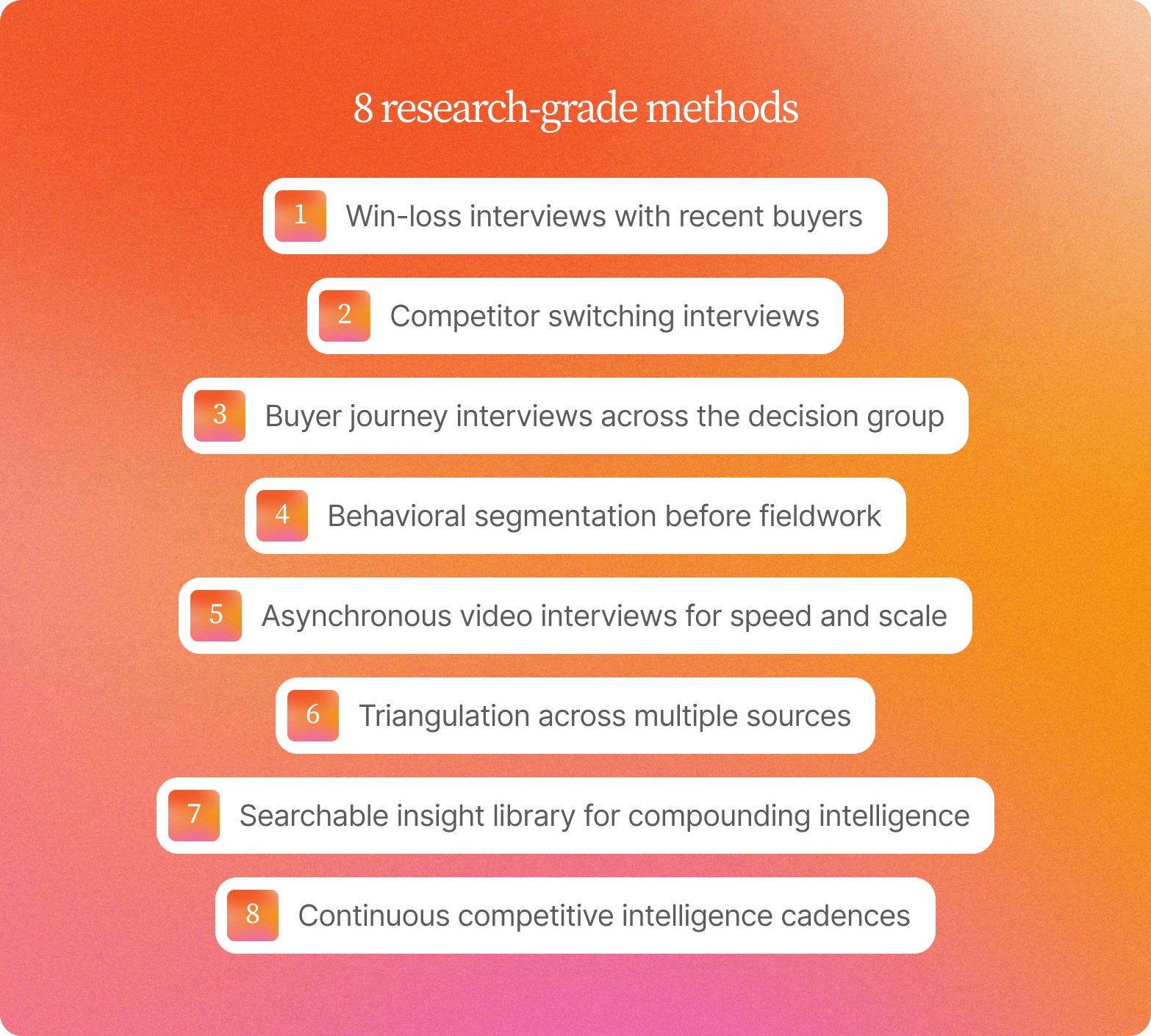
This guide covers eight research-grade methods for gathering competitive intelligence through primary qualitative research: approaches that surface verbatim consumer evidence and deliver traceable findings while decisions are still open. It also covers where secondary competitive intelligence research still earns a place, and where it falls short of the competitive intelligence data a stakeholder review actually needs.
Why secondary sources aren't enough for competitive intelligence
Most competitive intelligence programs start in the same few places: news coverage, analyst reports, and product review aggregators. Each has genuine value. News coverage and press releases capture positioning and funding signals. Analyst reports and industry reports map feature sets and category movements, while industry publications track market and category-level trends. Some programs go further: Google Alerts for competitor announcements; financial reports for public competitors; competitor and company websites for pricing changes; patent filings for emerging technologies; and trade shows or industry conferences for how a rival pitches its roadmap. Business intelligence and market intelligence teams are often already running this kind of data collection somewhere in the organization; the gap is turning it into competitive analysis that changes a decision.
Review aggregators surface star-rating and customer sentiment, the short-form verdicts buyers leave after the decision is made. What none of these sources capture is the decision behavior that actually determines competitive outcomes. They can't tell you why a buyer who shortlisted two options chose the other one, or the specific phrase a buyer used when comparing your pricing strategies to a competitor's.
That gap is significant. Gathering competitive intelligence from secondary sources alone means building a picture of your competitive environment from signals never designed to explain buyer behavior, and it tells you little about competitors' strengths relative to your own. A competitive deck built this way looks complete until someone asks why buyers are switching, or what language a competitor is using that seems to be resonating.
Those questions can't be answered from a G2 review, a press release, or a Gartner Magic Quadrant, because none of them trace back to a real conversation with a real buyer mid-decision. Primary qualitative research closes that gap. Win-loss interviews, competitor switching interviews, and buyer journey interviews capture exactly what secondary sources flatten: the sequence of the decision, the criteria that shifted weight at the final stage, and the specific language buyers use when discussing options they rejected. This is where competitive intelligence research stops describing the market and starts explaining it.
The eight methods below show how to gather competitive intelligence through structured primary research, with enough rigor that findings hold up under stakeholder scrutiny and inform strategic decisions rather than just documenting them.
Method 1: Win-loss interviews with recent buyers
Win-loss interviews are structured conversations with buyers who recently made a purchase decision, whether they chose you, a competitor, or no one. The research question is specific: what alternatives did they seriously consider, what did they hope those options would do, and what made each worth evaluating? That framing keeps the conversation off feature lists and on the decision logic that drove the outcome, and it can provide valuable insights a review site or industry report never surfaces.
Sampling matters before you field a single question. Recruit 5 to 15 participants per segment: deals won, deals lost to each named competitor, and no-decision outcomes. Defining segment criteria up front separates a repeatable competitive intelligence-gathering program from a collection of anecdotes. No-decision participants are frequently overlooked, but they reveal as much about urgency and positioning gaps as any competitive loss.
Generic questions produce polite, surface-level answers. The ones that generate useful competitive intelligence force specificity: How did you actually compare the options? What did you look at first? What would have needed to be true for the other option to win? Asking buyers to reconstruct their evaluation, rather than summarize their conclusion, surfaces decision logic that never appears in CRM notes and gives you a real competitive edge over teams relying on assumptions.
The output is a competitor narrative brief: one document per segment, pairing each conclusion with a direct quote or a timestamped video clip. Key stakeholders who weren't in the room can audit the reasoning themselves rather than take a researcher's interpretation on faith. When considering how to gather competitive intelligence examples that actually change positioning decisions, the quote-plus-clip pairing makes the findings credible enough to act on.
Teams running asynchronous, AI-moderated interviews report achieving decision-ready competitive intelligence in a fraction of the time traditional agency cycles take.
"The pace, responsiveness, and research expertise of the Conveo team, on top of the top AI-moderated qual platform, has been invaluable to us in scaling brand advertising internationally."
Matt Harris, Research & Insights Lead, EMEA, Canva
Method 2: Competitor switching interviews
To gather competitive intelligence beyond feature comparisons, competitor switching interviews focus on customers who switched from a competitor to your solution, or from your solution to a competitor. These are decision-reconstruction conversations, distinct from the direct feedback you collect through ongoing customer surveys. The research question is precise: what triggered the evaluation, what broke in the previous solution, and what resolved the uncertainty about switching?
Most teams underinvest in probing. A participant who says they switched for "better fit" has given you a label that still needs unpacking. Ask directly: when did you come closest to choosing the other option? What would have needed to change for you to stay? What did you worry would break during the switch?
Probing for what participants feared they'd lose, rather than only what they hoped to gain, surfaces the switching costs competitors can exploit, turning customer feedback into competitive intelligence rather than a satisfaction metric.
The output is a set of switching trigger patterns: the conditions under which competitors become genuinely attractive, and the conditions under which your solution loses its hold. These are more actionable than win rates or market share figures alone because they show the mechanism behind the result.
Switching interviews produce anecdotes until cross-checked against sales call recordings, CRM notes, and support tickets. When the same trigger appears across sources, it becomes a defensible pattern that strengthens your broader competitive strategy and gives you a real competitive advantage. Run this on a cadence, and it also catches market shifts early.
Method 3: Buyer journey interviews across the decision group
Buyer journey interviews map how a buying group moved from problem recognition to final selection: which stakeholders were involved at each stage, what key factors each applied, and where competitive options gained or lost ground. The output is a decision-group map showing which objections belonged to which role, and which were deal-breakers versus manageable preferences.
In B2B, this requires deliberate competitive intelligence gathering across all three stakeholder types: the decision-maker who owns the budget and rationale, the end user who evaluates workflow fit, and the gatekeeper who oversees security and data residency reviews. These priorities rarely align within a single buying group. A decision-maker may love the capability story while a gatekeeper stalls on European data hosting. Buyer journey interviews surface those conflicts in the stakeholders' own language, something no win-loss survey or industry publication can recover.
The questions that matter most: what platforms made the shortlist and why, what priorities shifted between initial research and the final decision, and where did competitive options fail specific criteria. Ask what would make the shortlist if the current solution disappeared tomorrow, including how a buyer weighed a competitor's pricing strategies against your own. That question often reveals criteria never stated during the formal evaluation.
Fixed-question scripts flatten the competitive reasons that stall deals, particularly those related to hesitation about compliance or informal workarounds. Adaptive probing follows that hesitation rather than moving on, which is where the competitive intelligence that actually explains lost deals tends to live.
Method 4: Behavioral segmentation before fieldwork
Knowing how to gather competitive intelligence in business depends on who you recruit, not just what you ask. Behavioral segmentation means recruiting by decision context: what buyers were trying to accomplish, what constraints shaped their evaluation, and which alternatives they considered. Job title and company size identify the buyer; the decision context explains the key factors behind their choice.
Demographic segmentation describes the competitor's customer while leaving the choice itself unexplained, because the segments themselves are arbitrary. The real variation lives in the situation that triggered the evaluation.
Before fieldwork, define segments by three criteria: evaluation trigger (compliance mandate, feature gap, cost pressure), competitive set considered, and decision outcome. Recruiting against those criteria ensures every interview is in a comparable context, making patterns across segments visible rather than hidden in noisy customer feedback.
The output is competitive intelligence that explains why a segment chose a competitor. Use five to fifteen participants per segment once criteria are defined upfront, enough to find repeatable patterns without over-indexing on individual variation, and it gives you a competitive edge a generic customer survey can't replicate.
Method 5: Asynchronous video interviews for speed and scale
Asynchronous video interviews let participants respond on their own schedule via video, with an artificial intelligence moderator following up with adaptive probes based on what each participant actually said. Every probe is generated from the participant's own words, so the conversation follows the real contours of their experience rather than a predetermined path.
See it in action: How AI-Moderated Video Interviews Actually Work
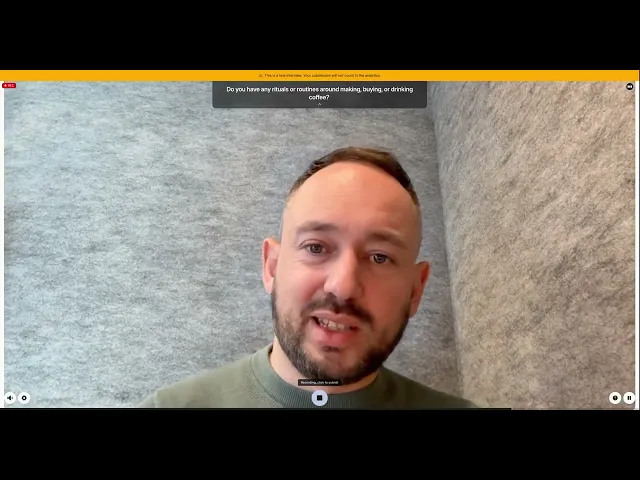
The operational advantage for competitive intelligence gathering is significant. Traditional competitive research runs sequentially and drags out across weeks, especially across time zones. Asynchronous AI-moderated interviews remove the scheduling dependency: 50 to 200 competitive conversations can run simultaneously across markets, segments, and scenarios.
This lets teams run research programs that weren't feasible at traditional agency scale. A study spanning North America, DACH, and Southeast Asia no longer needs separate waves or timelines, which matters when a single new market can shift the competitive picture entirely. Interviews run in 50+ languages, with moderation that adapts to each participant's phrasing. That capacity is what shifts competitive intelligence from a periodic exercise to a continuous read that keeps pace with market dynamics.
The credibility requirement holds regardless of scale: every conclusion needs a direct quote or timestamped video clip so key stakeholders can audit the reasoning rather than take it on faith.
Method 6: Triangulation across multiple sources
Triangulation is cross-checking competitive intelligence from interviews against every other customer-facing data source: sales call recordings, CRM notes, support tickets, and product usage data. Without it, a finding from a single win-loss conversation remains an anecdote.
Competitive intelligence fails stakeholder scrutiny when claims can't be traced to verbatim customer evidence. Triangulation moves a finding from "a participant mentioned this" to "this appears consistently across five independent sources," turning competitive intelligence data into something a business strategy conversation can rely on.
The sources worth cross-referencing: win-loss transcripts, sales call recordings, support ticket themes, product usage data, direct feedback from account teams, and CRM notes. Analyzing data from these sources side by side is what separates competitive benchmarking that holds up from a single anecdote dressed up as a trend.
Apply a simple confidence rule: treat a claim as defensible when it surfaces in at least three independent sources and traces to verbatim evidence in at least one. Everything else is single-source and held for further validation. The output is a confidence-weighted narrative that separates confirmed patterns from preliminary signals, something a competitive intelligence framework alone could never produce.
Method 7: Searchable insight library for compounding intelligence
A searchable insight library tags, timestamps, and indexes every competitive interview, quote, and finding so narratives compound across studies instead of dying in a one-off deck. Conveo's searchable insight library connects findings across projects so nothing is researched twice, one of the more durable competitive intelligence tools a team can build.
Most teams never build this. They commission a study, receive a slide deck, and file it. Six months later, the intel is stale, the market has shifted, and no one can find the verbatim that supported the original call. Slow research cycles make refreshes impractical, so teams keep using competitive intel they no longer trust.
When competitive intelligence gathering examples are structured and stored with consistent tags, each new study layers onto what already exists. Tag every interview by competitor, decision trigger, objection, and outcome- a taxonomy that helps identify areas where a competitor is quietly building an advantage before it shows up anywhere else.
Nothing gets researched twice. Contradictions surface when new findings push against older ones, and patterns that only become visible across twenty conversations start to show up, making the library a source of valuable insights rather than a filing cabinet. Querying it first, before commissioning a new study, redirects budget toward genuine gaps and turns tactical intelligence into strategic intelligence the whole organization can draw on.
Method 8: Continuous competitive intelligence cadences
One of the most underused answers to how to gather competitive intelligence is the standing cadence: a recurring program of interviews that runs bi-weekly, monthly, or on-demand when a competitor moves, rather than a project commissioned every 18 months when someone asks why win rates dropped.
Conveo StoryLines is the continuous, wave-based, AI-moderated research program built for this motion, with the tagline "Continuous Consumer Understanding," that runs recurring waves so findings arrive on a rolling basis rather than after the decision window closes.
The periodic research problem is structural: by the time traditionally commissioned competitive intelligence research arrives, the decisions it was meant to inform are already locked in, and teams end up defending stale battlecards in a competitive environment that has already shifted.
The shift is to treat competitive intelligence as a cadence: monthly win-loss interviews, quarterly switching interviews with churned customers, and event-triggered interviews whenever a competitor launches a product, enters a new market, or reprices their offer. Watching for pricing shifts and competitor announcements this way lets teams anticipate market moves rather than reacting months later and gives marketing a read on which competitors' strategies are gaining traction.
When positioning, product, and marketing teams have fresh, verbatim-backed narratives on a rolling basis, they make informed decisions grounded in what buyers are saying now, including how much market share is genuinely at risk, sharpening future strategies before the next planning cycle.
How to make competitive intelligence decision-ready
Claims fail audit questions when they can't be traced to verbatim customer evidence, which is exactly why making competitive intelligence important to leadership starts with making it auditable. Pairing each conclusion with a direct quote or a timestamped video clip lets key stakeholders quickly audit the reasoning.
Three outputs do this well: competitor narrative briefs, objection-handling evidence packs, and early warning systems that flag when a competitor is gaining ground or market share before it shows up in the numbers. Treat this as ongoing competitor research, feeding findings into marketing campaigns and sales enablement as soon as they're confirmed.
Deliver competitive intelligence in the format stakeholders already use: Slack channels for product, CRM fields for sales, and positioning briefs for marketing feeding directly into business strategy. It only changes strategic decisions if it arrives before the decision window closes, so optimize for speed and distribution over comprehensiveness.
Handled this way, decision-ready competitive intelligence shifts from a periodic project to a continuous infrastructure that supports real-time positioning, pricing, packaging, and roadmap decisions.
How Conveo delivers competitive intelligence that arrives before the decision closes
The real constraint on competitive intelligence is speed. Evidence has to land while the decision is still open, early enough to shape the outcome rather than describe it afterward.
Conveo is Consumer Understanding Infrastructure, built by researchers and designed to close the gap between when competitive evidence is needed and when it lands. Every finding traces back to a real participant, a direct quote, and a timestamped video clip stakeholders can audit in seconds, traceability gathered through a legally sound and ethical process from the start.
The value compounds through Conveo's searchable insight library, where every interview, quote, and finding is tagged, timestamped, and searchable. When a new competitive question arises, the first step is to query what past studies have already revealed.
For teams subject to compliance requirements, Conveo is SOC 2- and GDPR-compliant, with European hosting and primary infrastructure in Belgium, so procurement and data residency reviews don't become blockers.
Teams running competitive programs on Conveo report reaching decision-ready findings in a fraction of the time traditional cycles require.
Frequently Asked Questions
How do you gather competitive intelligence on Reddit?
Reddit is a useful starting point. Product subreddits, comparison threads, and complaint forums surface unfiltered buyer language that rarely appears in a formal interview. The phrasing people use when frustrated, feature comparisons run in public, and switching triggers are described unprompted. This counts as legally obtained information since the discussions are public, along with signals such as Google Alerts, competitor announcements, and industry conferences. The limitation is structural: Reddit discussions are self-selected and unstructured, with no mechanism to probe more deeply. Treat Reddit as a source of hypotheses, then validate them through structured win-loss or competitor-switching interviews.
How do you use competitive intelligence PDF frameworks?
Competitive intelligence PDFs typically organize research around an established competitive intelligence framework: SWOT analysis, Porter's Five Forces, competitive positioning maps, and feature comparison matrices. SWOT maps competitors' strengths and weaknesses against your own; Porter's Five Forces maps industry-level pressure; positioning maps show where competitors sit on price and quality; feature matrices support competitive benchmarking. What these templates can't do: surface the switching triggers that caused a buyer to leave, the hesitation moments that nearly killed a deal, or the exact language a buyer used. A PDF has no mechanism for adaptive probing. The correct sequence is to gather competitive intelligence through primary research first, then use a structured competitive intelligence framework to organize your findings.
How do you gather competitive intelligence in business?
Gathering competitive intelligence in business means understanding why buyers choose competitors, what objections stall deals, and which competitor strategies create risk or opportunity. In B2B, a single decision typically involves a procurement lead, end users, and a compliance gatekeeper, each evaluating different criteria that often conflict within a single buying group. The method that addresses this combines win-loss interviews, competitor switching interviews, and buyer journey interviews that map how a buying group moved through its evaluation, producing competitive intelligence precise enough to show which objections are hard blockers versus manageable preferences.
What is competitive intelligence gathering?
Competitive intelligence gathering, often shortened to competitive intelligence CI or competitor intelligence, is the process of collecting and analyzing information about competitors, then operationalizing it into something a business strategy team can use. Secondary competitive intelligence draws on publicly available sources like news coverage, analyst reports, and review platforms; primary competitive intelligence comes from direct conversations with buyers. Secondary sources capture what competitors say about themselves. Primary research captures what buyers actually say about competitors, including why they chose them and what almost changed the decision- the layer that provides valuable insights a spreadsheet of industry publications never will.
How do you gather competitive intelligence?
Competitor narrative brief. Built from win-loss interviews, this pairs each competitive conclusion with the participant quote and video timestamp that produced it, so the conclusion is traceable. Objection-handling evidence pack. Drawn from AI-moderated interviews, this maps common competitive objections and competitive threats to verbatim responses that already resolved them. Early-warning dashboard. Sourced from continuous tracking interviews run in waves, this signals when a competitor is gaining ground, gaining market share, or moving into a new market before it shows up in win rates, helping teams identify areas of exposure and keep pace with the latest developments while there's still time to respond.

About the author
Meg Gerli
Research Impact Lead
Meg is a Research Impact Lead at Conveo, working with insights and research teams on the studies they run with Conveo.
Meet Meg on film →Qualitative insights at the speed of your business.
Conveo runs AI-moderated video interviews and structures everything they say.