In this article
TL;DR
Market research automation can shorten parts of the research process and help teams run studies more regularly, rather than waiting until a specific question becomes urgent.
But it can mean different things depending on how you approach research, from working with an agency to building an in-house team or using an AI research platform.
This guide compares the three approaches across research quality, oversight, capacity, speed, and cost structure.
You'll also get a framework for assessing AI-moderated qualitative research and a 3-week plan for testing whether a platform works for your team.
Market research automation helps teams understand customer behavior more regularly and get findings into the hands of decision-makers sooner. But “automation” can mean anything from collecting survey responses to running qualitative interviews, and the right approach depends on the type of research your team needs to do and the business objectives it needs to support.
This guide explains the main approaches to market research automation across the factors that affect research quality. You'll also get a practical plan for testing whether a platform fits your team's research process and helps turn findings into actionable insights.
Why "Market Research Automation" Isn't One Thing
The term “market research automation” encompasses approaches that automate various kinds of research and parts of the research process. For example:
Survey automation helps teams build surveys and collect responses.
Web intelligence scans online sources to track conversations, sentiment, competitors, and market trends.
AI-moderated qualitative research runs asynchronous interviews.
Lumping these approaches into the same category can lead teams to compare them on the wrong criteria. For example, a team looking for qualitative research automation might compare an AI interview platform with a survey tool based on speed or report-generation features, without assessing whether it can pose useful follow-up questions or trace findings back to participants.
For CMI teams that need to run qualitative research more regularly, or get answers within tighter decision windows, AI-moderated qualitative research adds speed and capacity beyond structured surveys or existing online data. An AI moderator conducts interviews and asks follow-up questions that adapt to what participants say, using video to capture nonverbal cues alongside their responses.
Once you know you need interview-style depth, the next decision is how you’ll run the research.
Comparing Market Research Agency vs. AI Platforms vs. In-House Teams
There are three main ways to run qualitative research: work with an agency, use an AI research platform, or build the capability with an in-house consumer insights team.
The right choice depends on more than how quickly you need results or how much each option costs. You also need to consider how much control you have over the research method, how the work is checked, how much research your team can realistically run, and whether you can trace the findings back to the original evidence. Here’s an overview of how they compare:
| Agency | AI research platform | In-house team | |
|---|---|---|---|
| Research quality and method | Strong for fully custom studies, particularly on new or complex topics | Your researchers control the study design while the platform supports fieldwork and analysis | Full control over methods, with quality depending on the team's experience and available time |
| Oversight and QA | The agency manages the research process and quality checks | Your team retains oversight and can review the underlying evidence | Your team is responsible for oversight and quality checks |
| Research capacity | Depends on the agency's availability and the scope of each project | Can increase the number of interviews and studies you can run without adding the same level of headcount | Limited by the number of researchers and the time they have available |
| Speed | Timing depends on the project scope, methodology, and agency availability | Can shorten the time between launching a study and reviewing findings | Depends on team capacity and competing priorities |
| Cost structure | Usually priced per project | Typically based on a subscription, usage, or per-study model | Ongoing salary and operational costs |
"The pace, responsiveness, and research expertise of the Conveo team, on top of the top AI-moderated qual platform, has been invaluable to us in scaling brand advertising internationally."
Matt Harris, Research & Insights Lead, EMEA, Canva
An agency may suit individual projects, while an AI platform or an established in-house function can support research as an ongoing part of decision-making and strategic planning. When research can run regularly, the work doesn't have to start and end with each individual study.
What Changes When Research Runs Continuously
Traditional market research often happens around a specific question or decision. A team commissions a study, reviews the findings, and moves on to the next project when they need to answer a new question.
Run studies more often, and each one starts with what the last one already found. The system automatically connects related findings across studies, so any change in sentiment or new pattern surfaces as soon as it appears.
Findings stay linked to the original interviews too, down to the exact video and quote a conclusion came from. Every study adds to that record, and the next one starts smarter because of it. Over time, that makes it easier to scale qualitative insights, turning research from one-off reports into a running body of evidence you can act on as decisions come up.
How to Evaluate AI-Moderated Qualitative Research
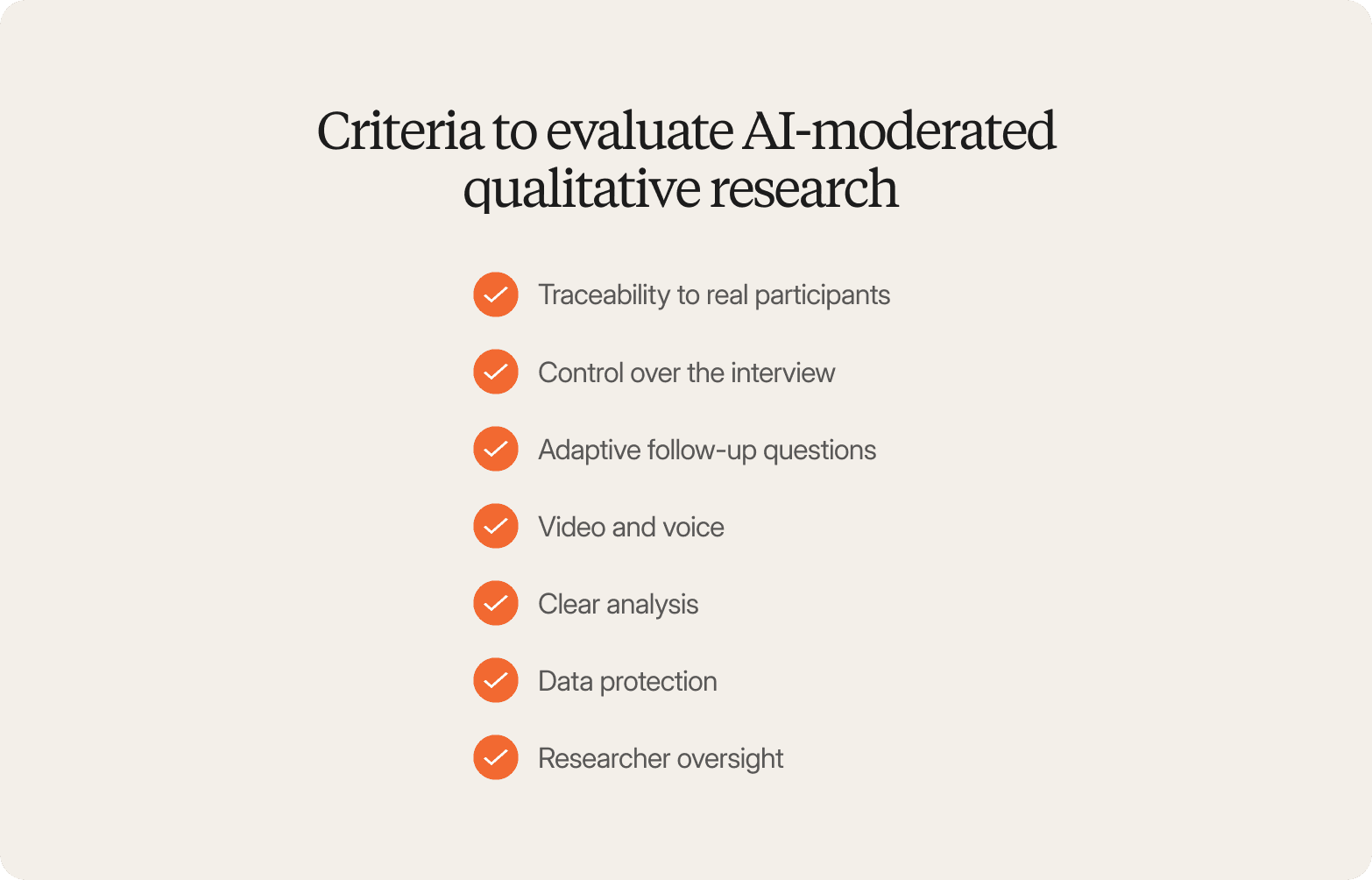
Whichever approach you use to run AI-moderated qualitative research, the core question is: can you trust the findings enough to use them in a decision? Use the following criteria to evaluate your options:
Traceability to real participants. Every finding should lead back to the person who said it, ideally through the original recording and exact quote.
Control over the interview. Researchers should be able to set and edit the discussion guide and decide what the study needs to explore, rather than handing that work entirely to the AI.
Adaptive follow-up questions. The system should respond to what participants say and ask relevant follow-up questions, rather than treating every interview like a fixed script.
Video and voice. Looking only at a transcript can remove context from what someone said. Video and audio can preserve tone of voice, pauses, facial expressions, and other cues from the interview.
Clear analysis. Researchers need to be able to check how the research reached its conclusions and review the evidence behind the themes it identifies.
Data protection. For teams handling sensitive research, the approach must use AI ethically and comply with relevant security and privacy requirements, including standards such as SOC 2 and GDPR, where applicable.
Researcher oversight: The researcher should remain responsible for the parts of the process that require professional judgment, including study design, participant screening, and the review of final findings. AI can handle work such as transcription and advanced analytics.
Video deserves closer scrutiny because it affects the information the automated research process can capture.
How Video-First Moderation Captures More Depth Than Traditional Methods
Video is the criterion that most separates AI-moderated interviews from survey automation.
A transcript only captures the words someone chose. Video and audio also capture how they said it, whether that’s a pause before answering or a facial reaction to something shown mid-interview. AI-moderated interviews pick up on these cues and can adjust the next question accordingly, just as a live interviewer would.
See it in action: How AI-Moderated Interviews Adapt in Real Time
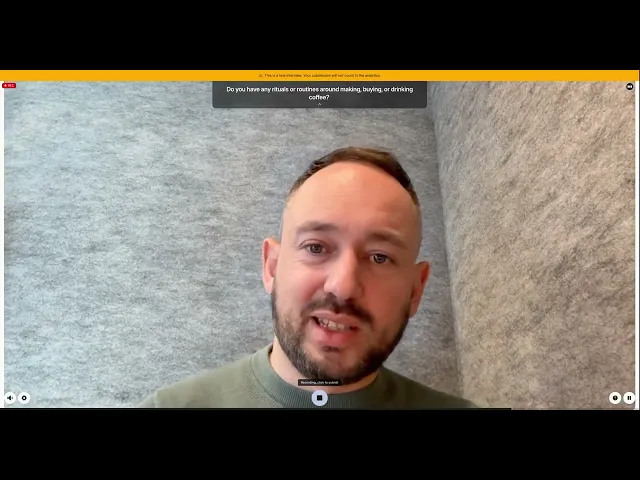
Even a dynamic survey with an open text box turns a response into words on a page. Video-first moderation captures those visual and audio signals, the behavioral depth that makes qualitative research actionable.
When to Choose an Agency, AI-Powered Market Research Tool, or In-House
When choosing how to approach market research automation, consider the kind of research you need to run and the capability you already have. Use the situations below to find the approach that best matches your team's needs:
| If this sounds like you | Best fit | Why |
|---|---|---|
| You're running a one-off, high-stakes study that needs a custom methodology or specialist expertise your team doesn't have | Agency | An agency can provide the research expertise and support needed to design and deliver a more bespoke project. |
| You need to run qualitative research regularly and want more capacity without building a larger research team | AI research platform | A platform can support recurring research while keeping the study design and review process under your team's control. |
| You already have dedicated researchers and an established process that meets your needs | In-house | Your team already has the capability to run the research, so changing the underlying model may add little value. |
| You only run one or two qualitative studies a year | Agency | Building a new process around a platform may not make sense for occasional research. |
| You run regular research but don't have the internal capacity to handle every part of the process | Platform or hybrid approach | A platform can support recurring work, while agencies can still handle projects that need specialist expertise or a more custom approach. |
This decision framework can help you narrow down AI consumer research tools vs. market research agencies vs. in-house, but it can't tell you how well a platform will work with your team's research process.
How to Run a Low-Risk Pilot for AI-Moderated Qualitative Research
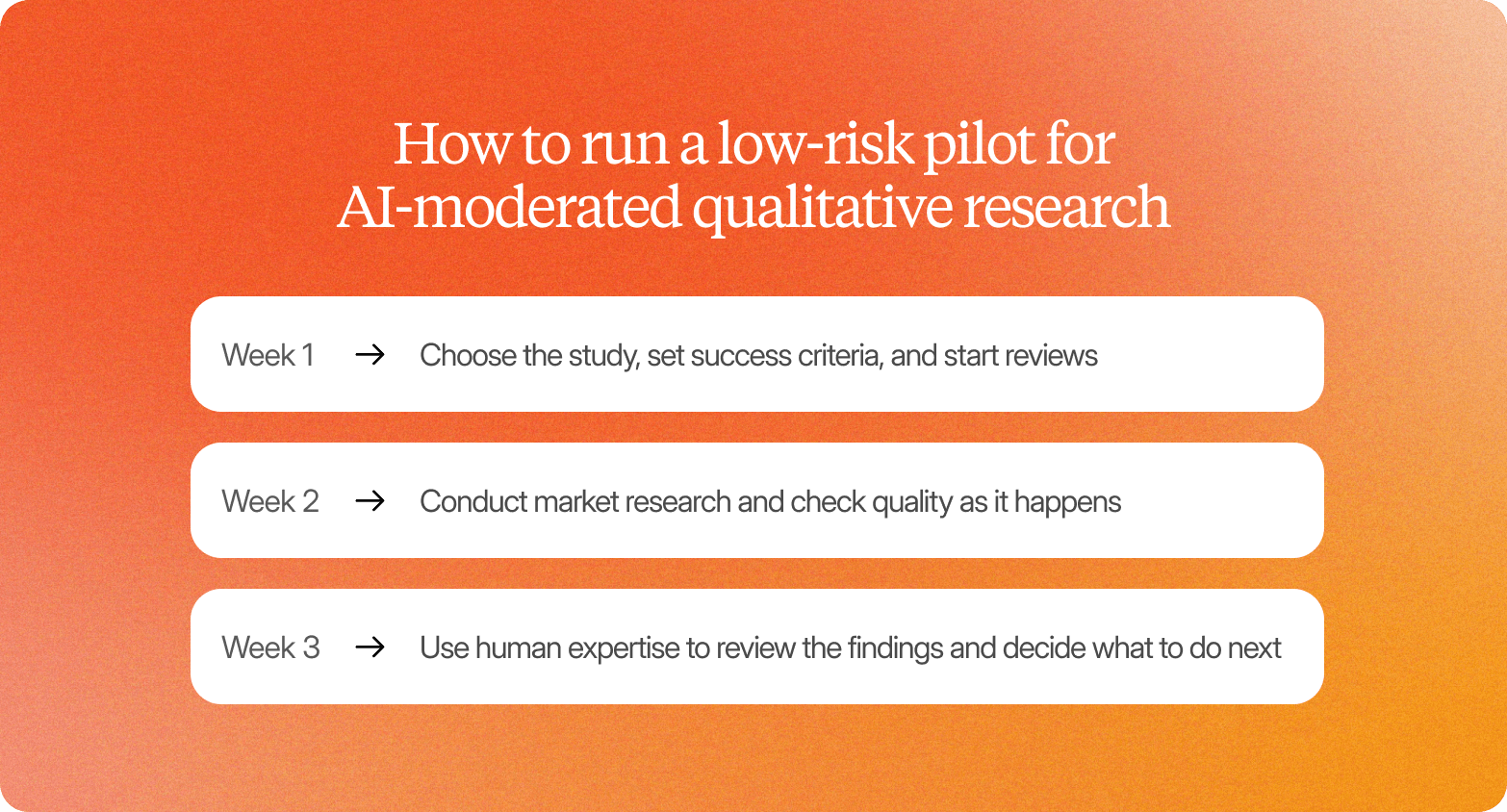
A pilot lets you test AI-moderated qualitative research on a real business question before making a wider change to your research process. Here’s how to approach it step by step.
Week 1: Choose the Study, Set Success Criteria, and Start Reviews
Choose a study that stakeholders care about, but that isn't mission-critical. Use a topic or audience you've researched before to establish a baseline for judging the quality of the findings. For example, a skincare brand that has already researched how customers respond to its product messaging in multiple markets could use the pilot to test that messaging in a new market.
Agree on the research question and review the discussion guide before launching. A few test interviews can help catch confusing questions or follow-up prompts that aren't working as intended.
Set a clear measure of success, such as whether the findings are delivered within three to five days or whether you can trace each finding back to a participant recording. Start the security and compliance review at the same time to avoid holding up the next stage of the pilot.
Week 2: Conduct Market Research and Check Quality as It Happens
Launch the study and review a sample of interviews as they come in. This lets you see whether the questions and follow-ups are producing useful responses while there is still time to adjust the study.
It also gives stakeholders a chance to see how the research works before the final review of the findings. If the process isn't producing the depth or speed you expected, record that as part of the pilot result.
Week 3: Use Human Expertise to Review the Findings and Decide What to Do Next
Review the findings with stakeholders and assess the pilot against the success criteria set in Week 1. Consider whether the research delivered proactive insights and whether the team had enough evidence to trust them.
Use that review to decide where AI-moderated research fits into your wider research process. It may be suitable for the types of studies you run regularly, or you may find that your current approach is a better fit.
How Conveo Supports Always-On Market Research
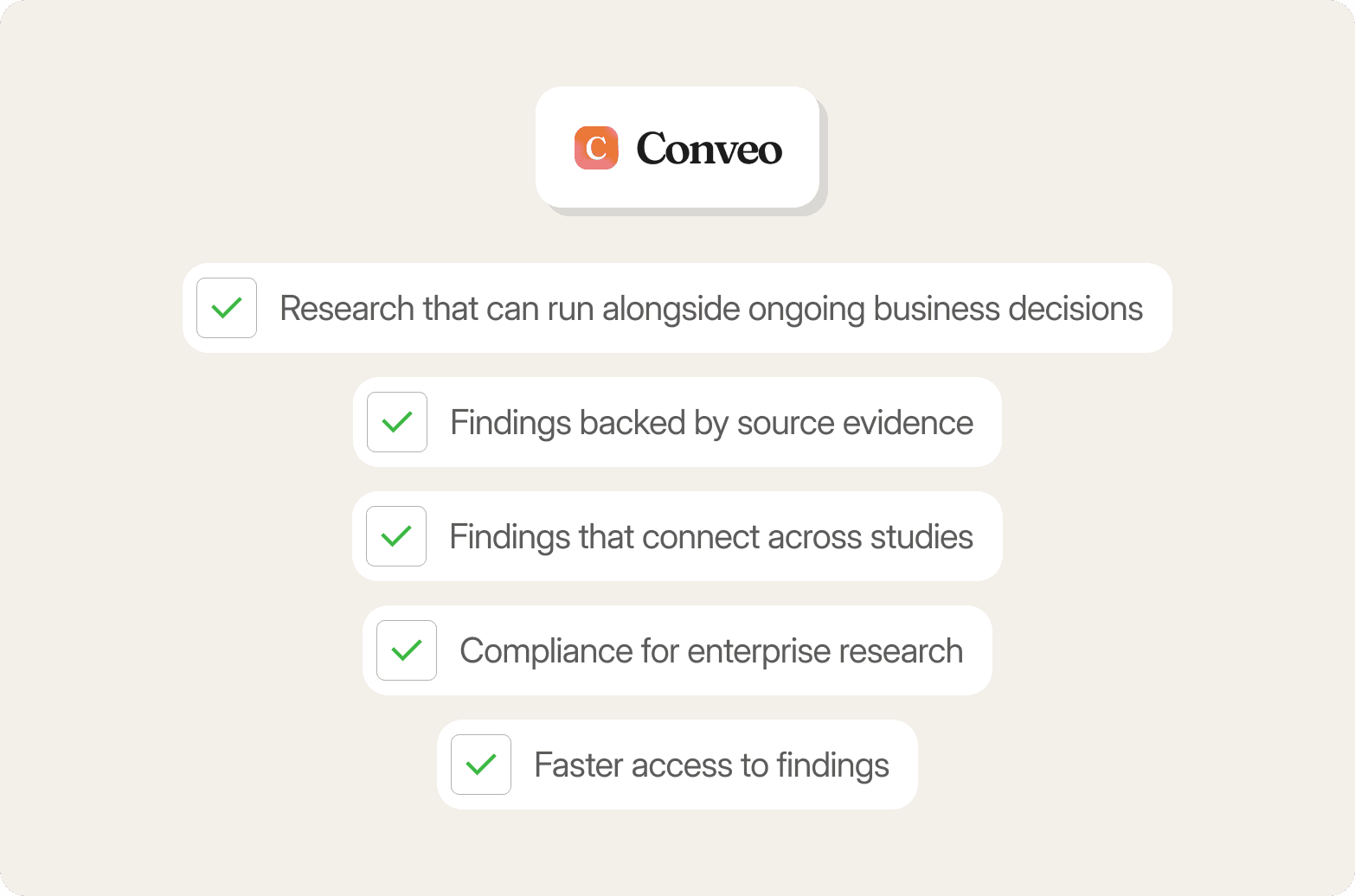
For teams that run qualitative research regularly, market research automation can support the full research process, from conducting interviews and analyzing responses to building a body of valuable insights that remain useful after each study ends.
Conveo brings those parts together through these key features:
Research that can run alongside ongoing business decisions. AI-moderated interviews allow teams to run qualitative studies without manually moderating every conversation, while researchers retain control over the study design and discussion guide.
Findings backed by source evidence. Insights stay connected to the original video, transcript, and participant, so researchers and stakeholders can check where a conclusion came from.
Findings that connect across studies. Related themes and evidence automatically link across interviews, surfacing new patterns and changes as they emerge.
Compliance for enterprise research. Conveo is SOC 2-certified and GDPR-compliant, supporting teams that need to manage participant and research data in compliance with established security and privacy requirements.
Faster access to findings. AI automates interview moderation, transcription, and analysis, helping teams move through the research process more quickly when decisions are time-sensitive.
Frequently Asked Questions
What are market research automation examples?
Market research automation includes survey automation tools such as Typeform and Qualtrics, which help with survey question design, data collection, and data analysis. Web intelligence tools such as Crayon and Brandwatch support competitive intelligence, sentiment analysis, and trend analysis across existing data sources. AI-moderated interview platforms such as Conveo automate parts of the qualitative research process and provide the deeper understanding associated with interviews and focus groups.
What is the best AI for market research?
The best AI market research tools depend on your research needs. Survey tools suit teams tracking quantitative data, while web intelligence tools support competitive intelligence and market trend analysis. AI-powered market research platforms that run interviews are better suited to qualitative research at scale. For enterprise research teams, security, GDPR compliance, and data quality matter alongside the AI features themselves.
How do you automate market research?
How you automate market research depends on the type of research you're conducting. Survey automation can handle survey creation, data collection, and parts of data analysis. For qualitative research, AI can support interviews, transcription, translation, and analyzing data. Researchers still need to set research goals, design the study, and review the findings, while automation supports the rest of the research process.
What is the difference between AI and traditional market research?
AI-powered market research can automate parts of the market research process, allowing research teams to conduct more interviews and process qualitative data more quickly. Traditional methods may involve more manual data processing and analysis. The quality of either approach still depends on the research design, participants, and human expertise behind it. For AI-moderated research, being able to trace key insights back to the original participant and video data also helps researchers check the findings.
How much does a market research agency cost?
Market research agency costs vary depending on the research method, sample, geography, and scope of the work. Agencies typically charge per project, while an AI market research platform may use an annual subscription, usage-based pricing, or per-study fees. The cost structure affects how often a team can conduct market research, so it's worth considering alongside the total price.
Can an AI platform replace a market research agency?
For recurring consumer research with a repeatable methodology, an AI qualitative research platform can serve as an alternative to a qualitative research agency. It helps internal teams stay ahead by running more of the research themselves, from conducting interviews to analyzing raw data and identifying important insights. This can reduce the manual work of conducting market research at scale, although researchers still need the technical expertise and judgment to design the study and assess the findings. Agencies may still be the better fit for highly specialized work or studies that need a fully custom approach.

About the author
Dieter De Mesmaeker
Co-Founder & CEO
Dieter is CEO and co-founder of Conveo. Before starting the company, he founded DataCamp and scaled it into one of the leading edtech platforms in the world.
More by Dieter →Qualitative insights at the speed of your business.
Conveo runs AI-moderated video interviews and structures everything they say.