In this article
TL;DR
Best for: Insights leaders who need to defend methodology choices to stakeholders and procurement, and are evaluating AI market research platforms where the question of synthetic respondents vs real participants is a live decision.
Decisions move faster than research can validate them. If a finding can't survive a stakeholder's first question, it never should have shaped the decision in the first place.
Synthetic respondents cannot produce a recording when a stakeholder asks "who said this?" Findings built on generated text collapse the moment they face an audit or a skeptical CMO.
Synthetic outputs tend to overstate purchase intent and reproduce the model's training biases rather than the real behavior consumer research is meant to capture. Variance is artificially narrow, and inconvenient minority opinions disappear.
Real-participant platforms link every theme and summary back to raw transcript text and timestamped video, converting plausible text into defensible, critical insights stakeholders can act on.
Conveo runs AI-moderated video interviews with real people, with every insight traceable to a named participant, a verbatim quote, and a video clip stakeholders can watch, and every finding compounds into a searchable library of valuable insights instead of disappearing after one project.
By the time a synthetic finding, generated by artificial intelligence with no human involved, reaches a stakeholder meeting, the decision it was meant to inform has usually already been made on instinct. That's the real cost of a research method that can't move at the speed of the business: it arrives after the decision window has closed, or carries too little trust to act on, so teams decide without it. Modern research has to clear a higher bar than mere plausibility: it has to withstand scrutiny by a skeptical stakeholder.
The debate between synthetic respondents vs real participants comes down to a single, uncomfortable moment: a stakeholder points to a finding in the deck and asks, "Who said this?" If there's no recording, no transcript, no verifiable human voice behind the claim, the finding collapses. It can't be defended in a brand review. It can't be cited in a product strategy meeting. It disappears, and the decision gets made without it, or worse, on a false premise.
With real participants, every claim traces back to a specific person who said a specific thing, captured in a specific moment. That traceability is the minimum standard of evidence required to act with confidence on brand positioning, product strategy, and concept validation. Research that can't answer "who said this?" amounts to plausible text, and plausible text makes a weak basis for a consequential call. Real research earns its name by answering that question every time.
What are synthetic respondents?
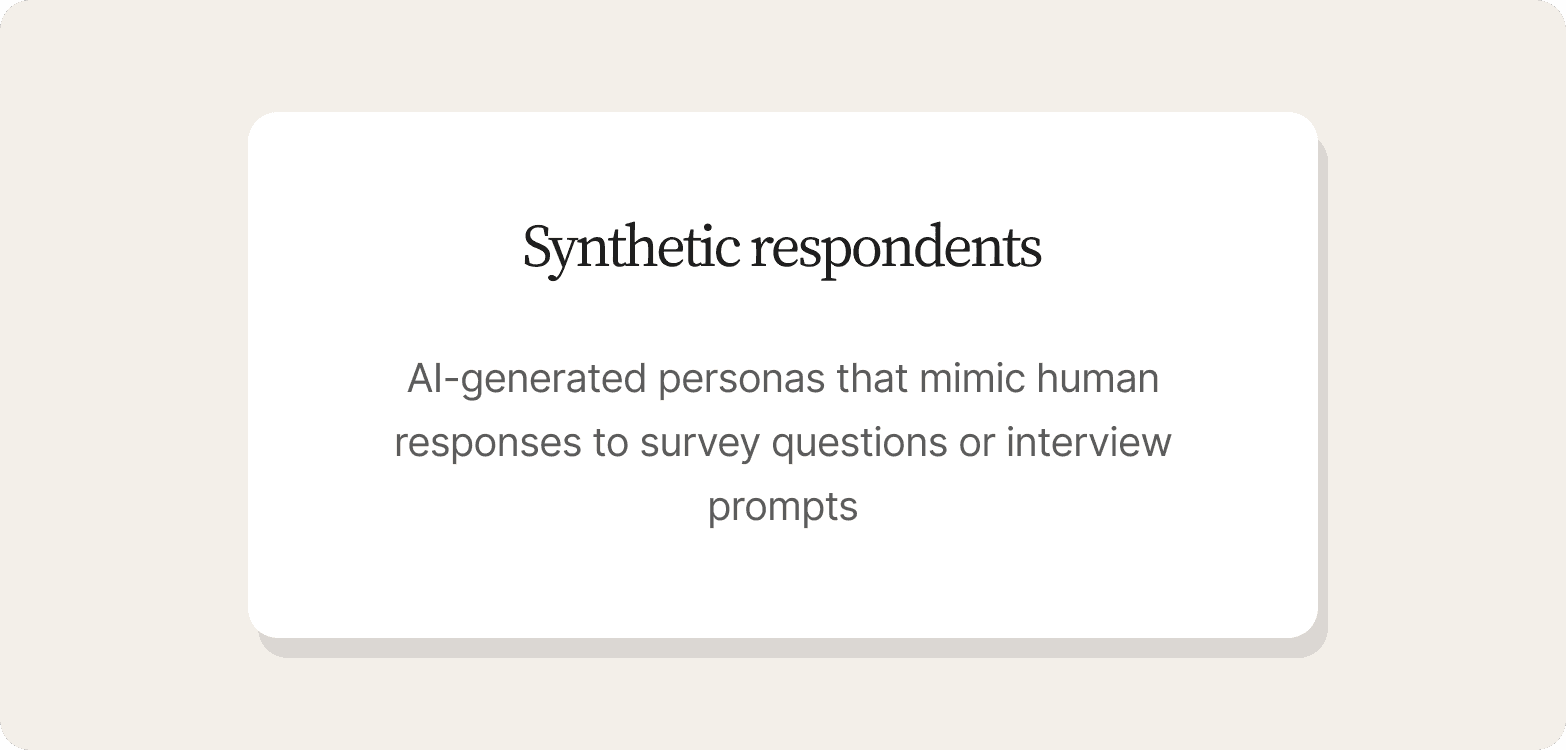
Synthetic respondents in market research have grown common as teams look for faster ways to pressure-test ideas. Synthetic respondents are AI-generated personas that mimic human responses to survey questions or interview prompts, produced by large language models rather than recruited from any real population. Sometimes called a synthetic sample, or "silicon samples" in industry shorthand, these personas generate synthetic respondents from demographic and behavioral data, statistical patterns, and predefined persona attributes rather than a live human being. No actual person participates, and no artificial intelligence system watches a real consumer react in the moment: it produces artificially generated data that reads like a genuine response at a speed and cost traditional research methods, like recruited focus groups, can't match.
The appeal can sound almost like science fiction: skip recruitment, skip scheduling, skip incentives, skip data collection altogether. Teams exploring synthetic respondents are usually under timeline pressure, working with constrained budgets, or trying to screen a large number of product concepts and concept variants before committing to full human testing.
The problem is what gets lost in the substitution. Synthetic respondents mirror the historical data used to train large language models, while the current lived experience of the people a brand needs to understand sits outside that window. They can't surprise you, contradict a long-held assumption, or show hesitation on camera when a price point lands wrong. Every response is, at its core, a probabilistic recombination of what's already been said elsewhere, an artificially generated echo of existing research rather than a new observation. For teams whose findings need to hold up in a product brief, a board presentation, or a regulatory review, that distinction is the entire question of whether the research is defensible. It's a question the entire field of AI market research is now being forced to confront. See our full definition of synthetic users for the underlying mechanics.
What are real participants?
Real participants, sometimes described as human participants to draw a sharp line against anything synthetic, are human beings who complete AI-moderated video interviews, speaking on camera in their own words, in their own environment, on their own schedule. Every session produces a verbatim transcript, a timestamped video recording, and multimodal analysis across speech, tone, and facial cues. There are no synthetic profiles and no avatars standing in for actual participants.
When a finding traces back to a real person, a researcher can show a stakeholder the clip, play the moment of hesitation, and point to the exact words used. That traceability is what separates a credible insight from an inference. Conveo's AI moderator probes based on what each participant actually says, so the verbatim and the analysis come from the same conversation, with a real person on the other end. It's the difference between a model's best guess and real-world data grounded in an actual conversation. That's what human research is built to produce, and what synthetic outputs can only approximate. This is the foundation the rest of the evidence chain depends on: timestamped video and verbatim quotes serve as the mechanism by which a finding becomes defensible when a brand director or procurement lead asks where it came from.
The defensibility problem with synthetic respondents
The speed-and-cost case for synthetic respondents is real. Generating AI personas from training data can accelerate research and shorten research cycles, while costing a fraction of recruited fieldwork and returning results in hours. Speed holds up fine. The problem surfaces when a stakeholder asks a single question the finding can't survive: who said this?
Synthetic outputs have no real recording to point to. There's no timestamped clip, no verbatim quote from a named participant, no video that proves a real person expressed that view. The finding exists as a model prediction, and that gap becomes a data integrity problem long before it becomes a communication problem. Insights teams report that the moment they can't trace a claim to a real person, the entire analysis becomes contestable. One unresolvable challenge to the evidence chain is enough to stall a decision or undermine the function's credibility with the stakeholders it depends on. The rise of synthetic respondents in market research delays this problem until the stakeholder meeting, where the question is finally asked.
Research industry data and independent validation studies consistently show that synthetic respondents tend to overstate purchase intent and reproduce the biases present in their training data. Studies such as those conducted by Kantar illustrate that synthetic data often exhibits overly positive responses and limited variability, a pattern echoed across other market research studies, raising concerns about the reliability of purely AI-generated insights.
A separate comparative analysis against public opinion data collected from real respondents shows the same pattern: synthetic outputs cluster near the mean and rarely reproduce genuine minority views. The gap persists even when synthetic panels are compared with real survey data or real-world data gathered through qualitative interviews. A positioning decision based on inflated purchase intent is a wrong one, made quickly.
Where synthetic inputs are defensible
The defensibility framework comes down to a question of stakes, rather than a blanket ruling for or against synthetic methods or traditional research. Synthetic respondents have legitimate value at two specific points in the research workflow:
Early hypothesis generation. Using synthetic personas for early-stage concept testing, pressure-testing a discussion guide, identifying which questions need probing, or stress-testing a hypothesis about target segments before fieldwork begins. Work that quietly shapes marketing strategies long before a real participant ever joins a session. This is where synthetic research earns its keep: the output shapes study design and stops short of conclusions.
Discussion guide rehearsal and survey simulation. Running a simulated session, or survey simulation, to check question flow, flag ambiguous wording, or estimate session length. The output counts as a design input rather than a finding.
At every other stage, particularly brand positioning, concept testing that will inform a launch decision, product decisions, and any research presented to leadership, real participants and full human testing are required. Synthetic data shouldn't be used for forecasting new product success, validating market demand for untested innovations, or making high-impact business decisions without input from real consumer research.
Stakeholder readout checklist: When synthetic inputs were used
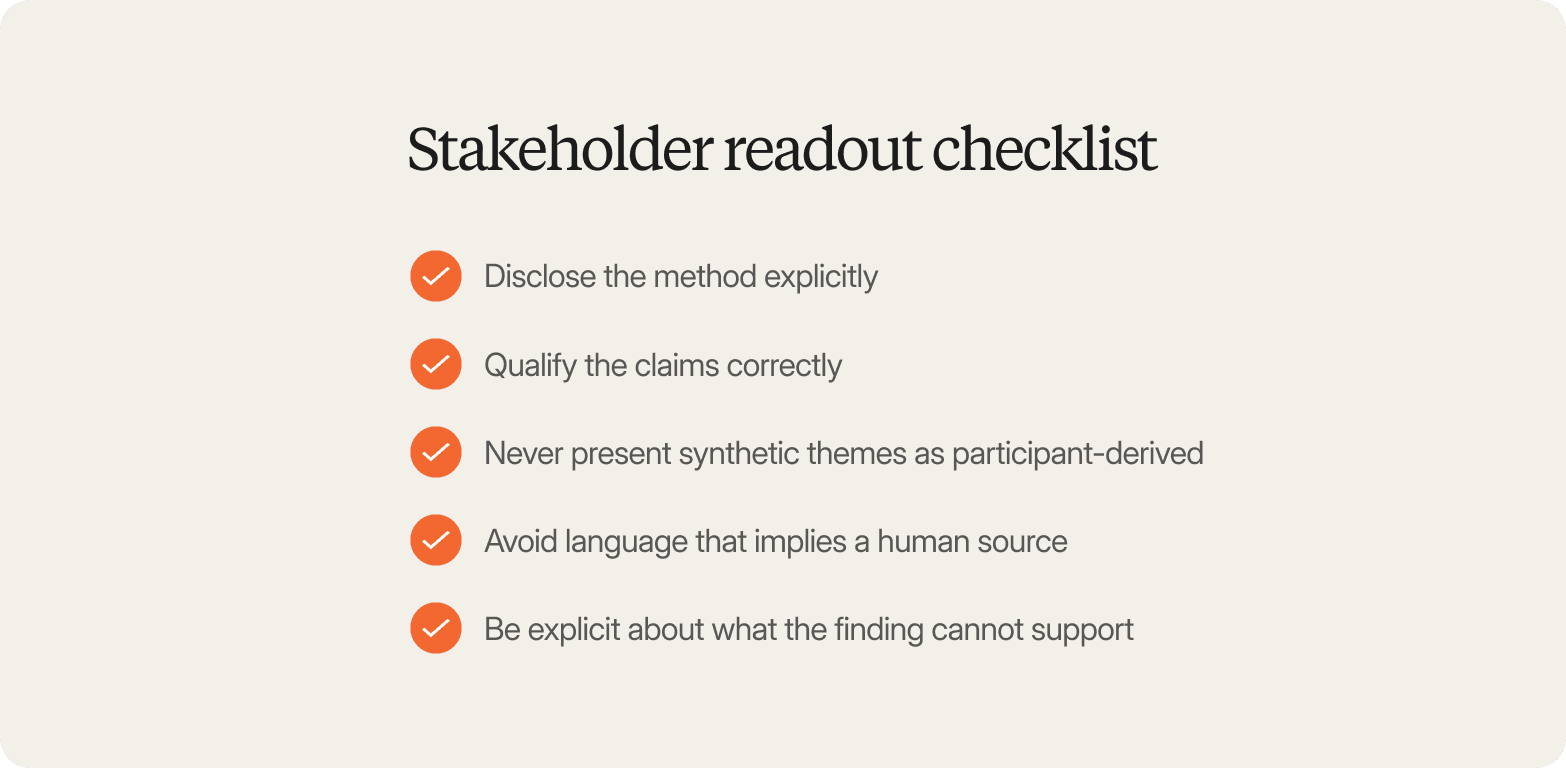
Disclosure here isn't just good practice: it raises ethical considerations about handling sensitive data and representing real people's views honestly. If synthetic outputs informed any part of the work presented, the readout requires explicit disclosure:
Disclose the method explicitly. State upfront which elements used synthetic inputs and which used real participants.
Qualify the claims correctly. Findings from synthetic inputs are hypotheses awaiting validation and should be reviewed under human oversight before informing a recommendation.
Never present synthetic themes as participant-derived. Any theme that can't be traced to a specific participant quote or timestamped clip must be labeled as an assumption.
Avoid language that implies a human source. Phrases like "customers told us" are only valid when real participants are the source.
Be explicit about what the finding cannot support. A synthetic-derived insight can't support a go/no-go launch decision, a pricing commitment, or a brand repositioning.
The teams that get into trouble are the ones who stop disclosing synthetic inputs once the work is in a slide deck and the distinction has quietly disappeared.
4 failure modes of synthetic respondents in qualitative research
Synthetic respondents tend to break down in the same few predictable ways. Four patterns show up most often, and each one erodes credibility a little differently:
1. Flat affect
Simulated respondents produce answers that read as polished and coherent, but they lack the emotional texture qualitative analysis depends on. A real participant describing a frustrating product experience will hesitate, self-correct, or say something contradictory. A synthetic participant just sounds confident, an artifact of models built to mimic human responses rather than capture them.
2. Missing edge cases
Synthetic participants can't capture genuinely novel opinions, recent events outside their training window, or the nuanced emotional responses that make qualitative research valuable. In concept testing, the edge case is often the finding: the participant who uses the product in an unanticipated way, or rejects the premise of the question entirely. Synthetic models draw only on public datasets and other existing research, rather than a brand's own proprietary data or a live conversation, so the rarest and most useful behavioral patterns across a given set of target segments are exactly what gets smoothed away, anchored to historical data instead of what's happening in a market right now.
3. Cultural drift
Pricing expectations and payment preferences exhibit strong cultural and behavioral patterns that synthetic responses can't accurately simulate outside Western contexts, patterns that are clear in public opinion data gathered from real regional samples. Controlled comparisons show these synthetic models reproduce general opinion trends but regress toward the mean, missing data on real regional variation rather than genuine consensus, a predictable result of training large language models primarily on Western-skewed text.
4. Prompt sensitivity
Minor rephrasing of a prompt can materially shift the response distribution, meaning findings are as much a function of how the question was framed as of any underlying "opinion." Verbatim that can't be traced to a real person who said it is a generated artifact.
Treating synthetic respondents as an early-stage research tool, with human oversight at every step before a finding reaches a stakeholder, keeps these failure modes contained instead of compounding into a costly wrong call.
When real participants are essential
The question that most often arises among experienced researchers is about depth rather than speed: will actual participants provide the same quality of response without a human in the room? Participants in AI-moderated video interviews are 68% more open than with a human moderator. Without the social pressure of a live audience, human participants say what they actually think rather than what they sense the researcher wants to hear. Responses also run 3 to 4 times as long as static survey answers because adaptive probing follows what each participant says rather than advancing a fixed script.
For decisions where stakeholder defensibility matters, brand positioning calls, product strategy reviews, concept decisions heading into launch, real participant research depends on one thing: every critical insight tracing back to a real person who actually said it, with verbatim quotes and video to confirm it. The depth comes from methodology rather than the medium: when the probing logic is built by researchers and every response is captured in full, real-participant research at AI-moderated scale produces findings that hold up to scrutiny, the standard real research has always been held to, just delivered faster.
Operational evaluation rubric
Use this rubric during procurement or vendor evaluation to compare synthetic respondent platforms, which rely on modeled behavioral data rather than direct data collection, against real-participant, AI-moderated approaches.
| Criterion | Weight | Synthetic respondent approach | Real-participant AI-moderated approach |
|---|---|---|---|
| Traceability: Can every insight be traced to a specific person, with verbatim and video timestamp? | High | Low: outputs are plausible but not provable | High: every finding links to a named session, transcript, and video timestamp |
| Variance: Does the platform show genuine variation across segments rather than model averaging? | High | Medium: behavioral variance often collapses to similar outputs, though useful for spotting directional gaps across target segments quickly | High: unscripted, divergent responses; variation is observable and auditable |
| Grounding disclosure: Does the vendor document what data informs the responses? | Medium | Low to medium: whether responses draw on proprietary data or public datasets is rarely disclosed in full | High: recruitment criteria, screener logic, and recordings are documentable |
| Auditability: Can procurement independently verify methodology and source? | High | Low: no participant records exist | High: recordings, transcripts, and codes are reviewable end to end |
| Best use case | n/a | Hypothesis generation, discussion guide rehearsal, early-stage concept testing | High-stakes decisions requiring defensible evidence |
Scoring key: High = meets enterprise governance standards without qualification. Medium = meets some requirements; verify with vendor. Low = requires additional validation before use in consequential decisions.
A platform that scores Low on traceability and auditability may still be appropriate for early-stage directional work or screener design. For findings presented to executive stakeholders or procurement teams, teams report that Low scores on these criteria create downstream credibility risk that outweighs any speed advantage, especially for decisions that hinge on critical insights rather than directional color.
Evidence-chain guidance
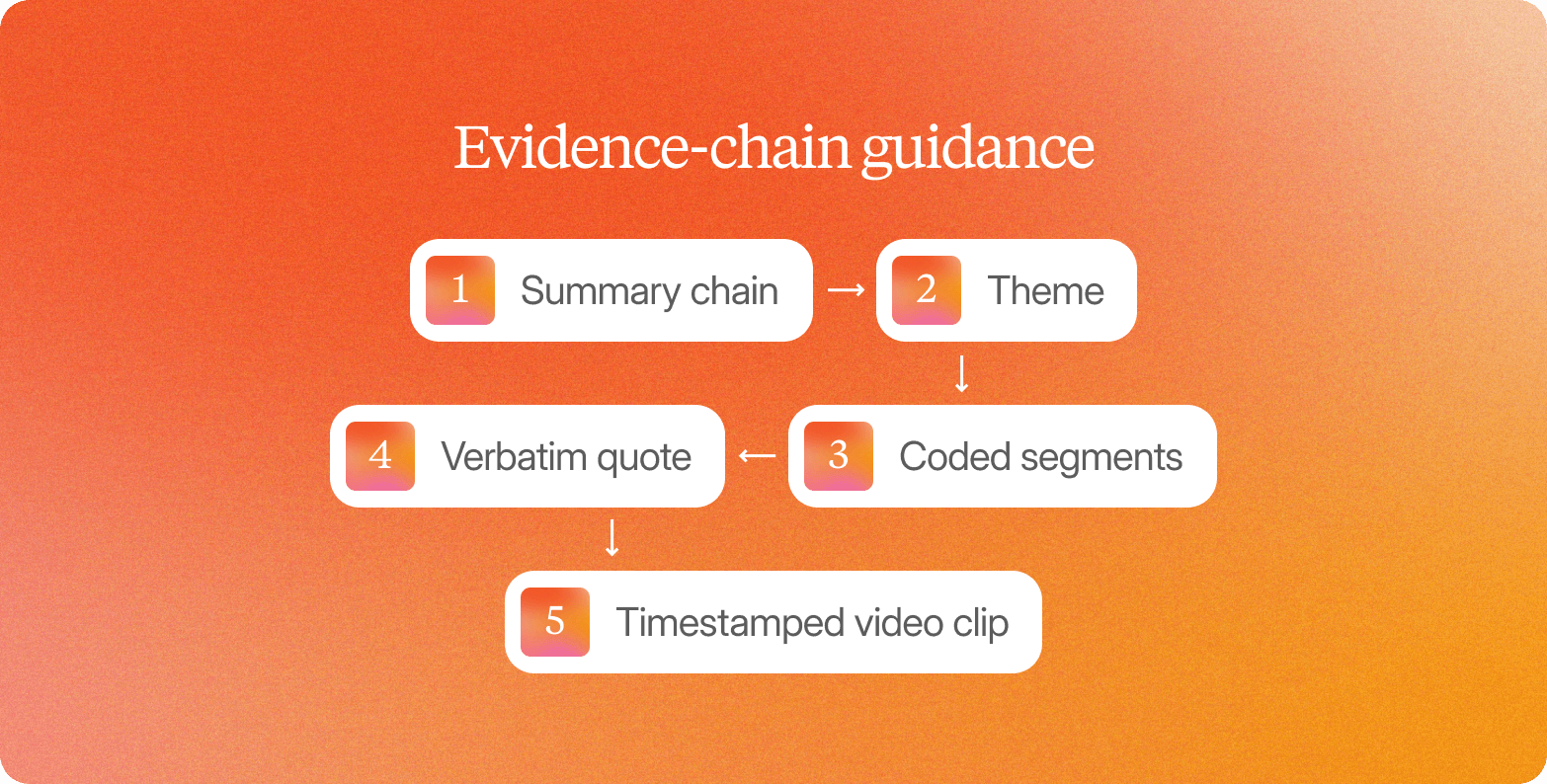
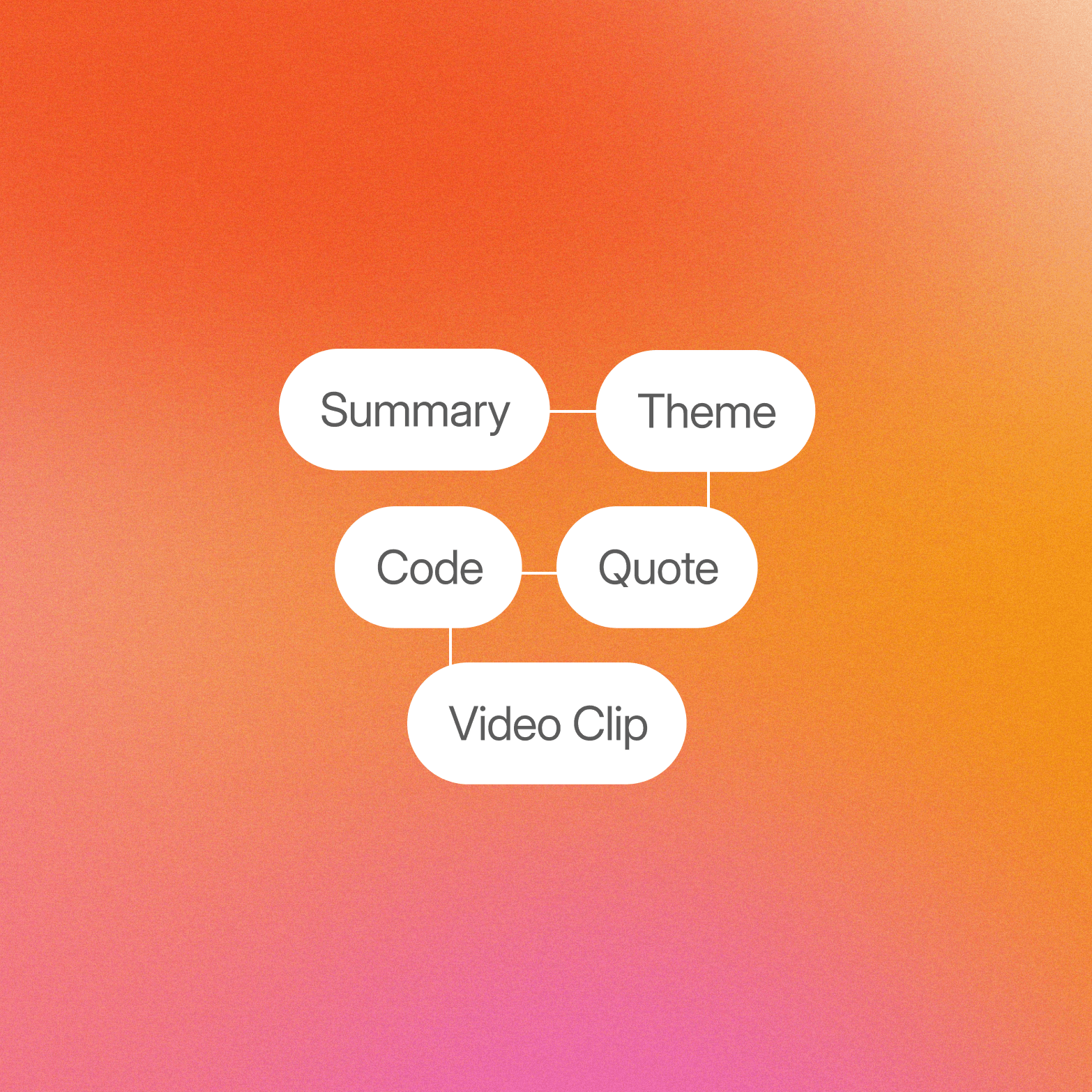
A defensible evidence chain runs in one direction, with no gaps, because data integrity depends on it: summary claim → theme → coded segments → verbatim quote → timestamped video clip. Each step is verifiable by a different stakeholder: the CMO reads the summary, the brand director checks the theme, the researcher audits the coded segments, legal or procurement clicks through to the video. That's what "traceable to a real person" means in practice, and it's a meaningfully different standard from plausible text.
Synthetic evidence can't meet this standard. Platforms generating responses from AI-trained personas can produce internally consistent themes and fluent quotes, but those outputs reflect patterns in training data rather than real data reflecting actual human behavior. There's no video to click through to, no hesitation in the audio, no expression shift at a price point. For a synthetic platform, that context counts as missing data with no way to recover it afterward. A participant who pauses before answering a question about brand trust signals something a transcript records as silence and a synthetic platform can't generate at all.
Who this isn't for
Real-participant, AI-moderated research fits some situations better than others. If a team only needs to pressure-test a discussion guide, screen concept variants at volume before any budget commitment, or explore a hypothesis space with no intent to present findings to stakeholders, synthetic AI tools remain the faster, cheaper option for that narrow lane, without replacing traditional research methods for anything that reaches a stakeholder. Teams with no requirement to defend findings to procurement, legal, or executive stakeholders, and no need for evidence that compounds across future studies, may not need the traceability infrastructure Conveo is built around.
How Conveo's AI-moderated interviews with real participants work
Unlike a model that generates synthetic respondents (or synthetic users, in some vendors' terminology) from training data, Conveo's approach starts with a real conversation. Every finding in Conveo's AI-moderated interviews traces back to a real person who said it. Participants join by video, speak freely, and Conveo's AI moderator probes based on what they actually say, following the conversation as it unfolds.
See it in action: How AI-Moderated Video Interviews Actually Work
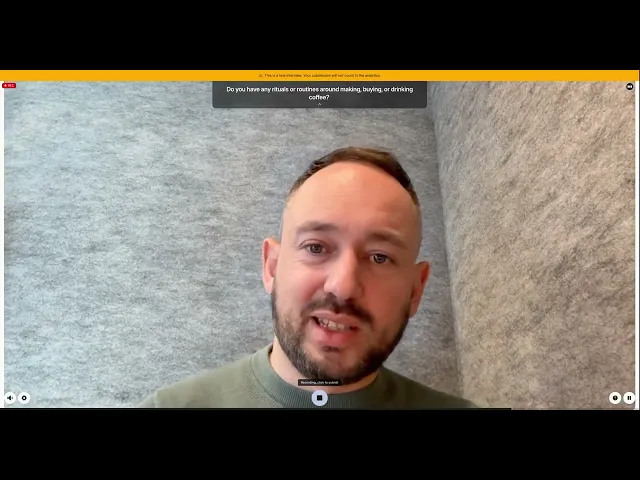
Multimodal analysis reads across speech, tone, and facial cues to surface valuable insights transcripts alone miss. Every theme links to timestamped video clips and verbatim quotes, so when a stakeholder asks "who said this?" in an executive review, the answer is a click away.
That traceability compounds over time. Every insight, and the new data behind it, flows into a searchable insight library that links findings across studies, flags when new evidence contradicts prior assumptions, and makes the full body of research searchable across the organization. Teams stop re-researching questions they answered months ago, because each study makes the next one smarter.
"Super valuable... ahead of where most of your competitors are... quite a special way to analyze this data"
Matt Harris, Research & Insights Lead, EMEA, Canva
Underpinning all of it: Conveo is SOC 2 Type II certified, GDPR compliant, EU-hosted (Belgium), and built to handle sensitive data from real conversations responsibly. For insights teams navigating security reviews, that clears governance requirements that stall adoption of platforms without confirmed compliance credentials.
Teams report findings landing while the decision window is still open, with the shift from months-long agency timelines to AI-moderated fieldwork in weeks to days compressing research cycles without sacrificing the traceability that procurement now treats as a baseline requirement. This applies whether the method is a one-off interview series or a run of focus groups: the same traceability standard holds across both.
Frequently Asked Questions
Are synthetic respondents reliable for market research decisions?
Synthetic respondents can be reliable for low-stakes, directional tasks that would otherwise require comprehensive traditional research, but reliability of synthetic methods drops significantly as decision stakes rise, unlike feedback gathered directly from real respondents. Research comparing synthetic outputs with real data from human participants, including several market research studies, consistently finds that synthetic responses cluster tightly around the mean, producing artificially narrow variance and an overly positive skew. For brand positioning, concept validation, or any finding informing marketing strategies with a significant budget or launch decision, that false precision is a liability. The defensible position is to treat synthetic data as a hypothesis-generation layer and keep decisions anchored to real participants.
What are the main limitations of synthetic respondents?
The limitations fall into three categories. First, they can't replicate lived experience: emotional nuance, hesitation, contradiction, and unprompted detail are absent, built to answer survey questions without a real human input behind them. Second, they reflect patterns in their training data, so they systematically underrepresent niche audiences, non-Western markets, and undocumented behaviors, gaps that persist however finely the demographic data inputs are tuned. Third, traceability is structurally impossible: there's no real person behind the answer, no verbatim to verify, no video to review, the very things human research is built to provide, however sophisticated the underlying silicon samples are engineered to sound human.
How is real participant research validity assessed?
Real participant research validity in qualitative work is assessed through credibility, transferability, and confirmability. Credibility asks whether findings genuinely represent what participants said and meant. Transferability asks whether the sample and context are sufficiently described for others to judge their applicability. Confirmability asks whether findings trace back to the data rather than researcher inference. Video-based AI-moderated research supports all three: every theme connects to a timestamped verbatim transcript, a real participant, and a recorded session that stakeholders can review directly.
Can synthetic respondents and real participants be used in the same project?
Yes, synthetic research and real-participant research typically coexist at different stages of a modern research workflow. Synthetic personas are well suited to pressure-testing a discussion guide or narrowing a set of concept directions before fieldwork begins, jobs traditional methods used to require weeks to complete. Once a project moves into gathering findings that will inform a decision, real participants take over, and the readout should clearly disclose which stage used which method.
What should procurement look for when evaluating an AI research vendor?
Procurement should confirm four things before a contract is signed: whether every insight is traceable to a named participant with video and transcript, whether the vendor is SOC 2 Type II certified and GDPR compliant, where data is hosted, and whether the platform's compounding library makes prior research searchable rather than starting from zero on every project. A side-by-side comparative analysis of competing AI tools against these four criteria usually settles the decision quickly.

About the author
Kahini Achrekar
Research Impact Lead
Kahini grew up in Canada, studied cognitive and behavioural science, and ran AI-moderated research client side before joining Conveo, where it let her team go deeper across more markets. She now brings that experience to clients and to the product, where what researchers ask for gets built.
Meet Kahini on film →Qualitative insights at the speed of your business.
Conveo runs AI-moderated video interviews and structures everything they say.