In this article
TL;DR
Strong in-depth interview questions live in a discussion guide with three layers: the decision it informs, the intent behind each question, and a probe ladder for weak answers. The question wording is the least important layer.
Stakeholders act on whatever a study produced. If the study produced "fine," the decision ships on the polite answer, and nobody can say later what was missed.
Guides that provide structure while allowing unexpected answers produce evidence stakeholders can verify, down to the quote and clip.
What you get: in-depth interview example questions for four research workflows, probe ladders, a time-boxed interview guide template, and a failure-mode diagnostic.
Best for: insights and CMI researchers writing or auditing discussion guides.
Why most discussion guides fail before the first session starts
The participant says her first week with a meal-kit subscription was "fine." The moderator nods, glances at the interview guide, and reads question six. She answers that one too, briefly and politely. Forty minutes later, the session ends, and the 20 minutes she spent hunting for how to skip a week never comes up.
Most examples of in-depth interview questions online stop at the wording, and the wording is rarely the problem. Guides written as fixed question lists lack probing logic tied to each question's purpose, so vague, hesitant, or unexpected answers have nowhere to go, and the moderator defaults to the next line.
An in-depth interview, covered in full in our guide to in-depth interviews in qualitative research, is a one-to-one conversation designed to surface the reasons behind a person's behavior. Most run as semi-structured interviews: a guide sets the core questions, and the moderator follows what the participant raises. Among qualitative research methods, it is the one built for the follow-up, because the first answer to almost any question is the rehearsed one.
That makes the unexpected answer the reason to run qualitative research at all. Survey questions can already show that first-week satisfaction scored poorly. They cannot show that subscribers paused by email because they couldn't find how to skip a week. A script has no slot for unexpected discoveries like that either.
In-depth interview questions only work when the moderator knows what each one is meant to uncover. The fix is attaching an intent and a probe ladder to each question before the guide reaches a single participant.
Start the interview guide from the decision it must inform
Write the decision first, then derive the guide's modules and its example questions from it. A decision like "which messaging angle leads the next campaign" sets the research focus: what evidence to collect and what to leave out. The research objectives then become the questions that decision needs answered, and guides that skip this step collect stories no one can act on.
| Decision | Evidence needed | Module that produces it |
|---|---|---|
| Which messaging angle leads the next campaign | How shoppers describe the problem in their own words | Problem narrative: the last time the problem cost them something |
| Whether to simplify onboarding before launch | Where new subscribers stall and what they do instead | First-week walkthrough: the first box, step by step |
| Which segment gets the new pack size first | Purchase occasions and quantity triggers by segment | Purchase reconstruction: the last three shopping trips |
Take the messaging decision. If the team is choosing between a saves-money angle and a saves-time angle, the guide asks about the last time participants switched brands in the category, what nearly stopped them, and which friends, family, or co-workers they asked first. The angle that answers the objections shoppers already face is the one with evidence behind it.

Teams conducting in-depth interviews for a decision like this need a second standard: traceability. Settle three things before data collection starts:
Module links: connect each module to a decision and an evidence standard.
Citation format: decide how findings will be cited with verbatim quotes and video clips.
Qualitative analysis: agree whether themes get coded against the decision's framework or built bottom-up from the interview data, grounded theory style.
See participant recruitment in qualitative research for the sampling side of this same standard.
The key components of the guide follow from there: modules, the core questions inside each, and the intent behind every one.
Write open-ended questions that pull narrative detail from a specific moment
Anchor every question in recent, specific behavior. "Walk me through the last time you did X" and "in the past 30 days" pull participants into memory and personal experiences, where the detail lives. "Generally" questions pull them into self-description, which leans on self-awareness and produces rationalizations.
Open-ended questions tied to a particular moment produce narrative responses: the sequence, the friction, and the workaround nobody planned for. Most sample interview questions fail on phrasing before they ever fail on probing. The swaps below show the pattern.
| Weak phrasing | Why it fails | Stronger phrasing |
|---|---|---|
| "Did you find setting up your subscription confusing?" | Leading: it plants the answer | "What was your experience setting up your subscription?" |
| "Do you use the delivery tracker?" | Yes/no: it ends the conversation before the why | "Walk me through the last time you checked on a delivery." |
| "How do you generally plan the week's meals?" | It invites rationalization | "Tell me about the last time you planned the week's meals." |
| "Would you pay more for faster delivery?" | Hypothetical: stated intent predicts behavior poorly | "Tell me about a time you paid extra to get something sooner." |
| "What do you like about the app?" | It asks for an opinion and assumes approval | "What did you use the app for this week, and what got in the way?" |
The same swaps apply to user interview questions in UX research.
Apply five rules before any questions go in the guide:
Remove leading language and adjectives that suggest the answer, to avoid bias at the question level.
Avoid yes/no questions unless a probe sits ready behind them.
Anchor in "the last time" or "the past 30 days," so participants answer from past experience.
Ask for sequence: what happened first, next, and after.
Ask for friction and workarounds: where it stalled and what they did instead.
If a participant can answer without recalling a specific moment, the question needs rewriting.

Example questions anchored in a real, recent moment give every follow-up something concrete to work with, and they draw more honest responses than any hypothetical.
In-depth interview example questions by research workflow
Each sequence below is complete: opening, warm-up, core module, probes, and close. A 45-minute session breaks down like this:
| Stage | Time | What happens |
|---|---|---|
| Opening and warm-up | About 5 minutes | Set expectations and build rapport |
| Core module and probes | About 30 minutes | Work through the core questions and climb the probe ladders |
| Close | 5 to 10 minutes | "What should I have asked that I didn't?" |

Every row below pairs a question with its intent and the probe to use when the answer comes back weak.
1. Discovery questions
Discovery banks serve the decision of which unmet needs to solve next. Each one starts with a broader question about the participant's world, then narrows to the process.
| Question | Intent | Probe if weak |
|---|---|---|
| Warm-up: "Tell me about your household, your current job, and what a normal week looks like." | Building rapport and context | "What took most of your time last week?" |
| "Walk me through the last time you did [process]." | Reconstruct behavior in sequence | "What happened right before that step?" |
| "What's the hardest part of that process right now?" | Locate the costliest friction and the unmet needs behind it | "What did that cost you last time?" |
| "Why that approach instead of the alternative?" | Map the decision-making process and its tradeoffs | "What would make you switch?" |
| Close: "What should I have asked that I didn't?" | Get an outside perspective on what the guide missed | "What did you expect we'd talk about?" |
2. Validation and comparison questions
Validation banks help decide whether a proposed product fits current workflows. Comparative questions expose switching thresholds and the alternatives participants actually use.
| Question | Intent | Probe if weak |
|---|---|---|
| "How does this compare to how you handle it today?" | Anchor evaluation in current behavior | "What did you do last time?" |
| "What would have to be true for this to fit your workflow?" | Surface adoption conditions | "Which of those is a dealbreaker?" |
| "What are you using now instead?" | Map real alternatives and workarounds | "How did you end up with that?" |
| "What would make you drop your current approach?" | Find the switching point | "Has that ever almost happened?" |
3. Concept and message testing questions
Concept banks help you decide which concept or message advances to the next round. Ask the comprehension check first, because it keeps reactions to confusion from being read as reactions to the idea. For a full bank of concept testing questions mapped to decision types, start there.
| Question | Intent | Probe if weak |
|---|---|---|
| "In your own words, what does this do?" | Check comprehension before reaction | "Who do you think this is for?" |
| "What stands out first?" | Capture unprompted salience | "Why that part?" |
| "Where would this fit in your week?" | Test relevance against real occasions | "When did you last need something like it?" |
| "What would stop you from trying this?" | Surface recurring objections across participants | "Have you run into that before?" |
4. Usability and think-aloud prompts
Usability banks help you decide which design issues to fix before release. Video matters here because tone and pauses carry signals that a transcript flattens. On Conveo, you can turn on screen sharing for just the task questions, so the recording shows where participants get stuck while the AI research assistant probes on what they say about it. You can also attach a clickable Figma prototype to any question, and the screen and conversation are recorded together.
| Question | Intent | Probe if weak |
|---|---|---|
| "What's going through your mind as you look at this?" | Capture first interpretation in the moment | "What are you looking for right now?" |
| "How would you expect this to work?" | Expose the mental model before the task | "What would happen if you clicked that?" |
| "Show me how you would [complete task]." | Observe the path they actually take | "What made you go there first?" |
| "You paused there. What happened?" | Catch hesitation participants rarely volunteer | "What did you expect to see?" |
The same structure carries over to questions for ad testing, packaging, brand tracking, and churn drivers. In each case, the decision sets the modules, questions anchor in recent behavior, and every question carries an intent and a probe for weak answers. Only the core module changes:
Ad testing: recall.
Packaging: shelf behavior.
Brand tracking: reasons behind metric movement.
Churn drivers: the moment of leaving.
When the guide moves between modules, a short "let's shift gears" keeps the session feeling like a natural conversation.
Build a probe ladder for every question
A probe ladder is a set of follow-ups attached to a question that tells the moderator what to ask when the answer is vague, hesitant, or unexpected.
Three signals cover most weak answers, and each one has its own rung on the ladder.
| Participant signal | Probe | What it surfaces |
|---|---|---|
| Vague ("it's fine," "pretty standard") | "Can you provide an example from the last time?" | The concrete incident behind the summary |
| Hesitant (a pause, a hedge, a shift in tone) | "You paused there. What were you thinking about?" | The reservation the participant was editing out |
| Unexpected (a workaround, a new name, a contradiction) | "Tell me more about that." | Unexpected themes the guide did not anticipate |

Within each rung, four probe types do different work, and naming the type in the guide keeps depth comparable across moderators:
Neutral probes, which delve deeper without steering: "What happened next?"
Clarification probes, the clarifying questions that pin down a word: "When you say slow, what does slow look like?"
Contrast probes: "How was that different from the time it worked?"
Tradeoff probes: "If you could fix only one of those, which would it be?"
Both versions below open with the same question.
Scripted version:
Moderator: "How was your first week with the subscription?"
Participant: "It was fine."
Moderator: "Great. How often do you cook the recipes?"
Intent-led version (intent: find where new subscribers stall):
Moderator: "How was your first week with the subscription?"
Participant: "It was fine."
Moderator: "Walk me through the first box, from ordering to the last meal."
Participant: "The food was good, but I couldn't find how to skip a week."
Moderator: "What did you do when you couldn't find it?"
Participant: "Emailed support and waited two days. I almost canceled."
The same opening question produced a polite non-answer in one version and a two-day blocker in the other. Only the second gives the product team detailed insights it can act on.

The probe follows the question's intent. That is what separates interview questions built for research from ordinary conversation: each question knows what it is looking for.
A guide without ladders cannot run consistently across dozens of sessions, no matter who moderates them. Strong communication skills help any moderator, but the ladder is what keeps depth repeatable when a different team member runs the next session. The same ladder structure carries into usability testing questions.
Screen participants and size the study before you write a word
A guide fails when non-users who cannot describe real incidents sit in the interviews. No probe ladder can draw out a "last time" that never happened. Fix the sample before writing the guide's questions, because every later step of the in-depth interview process depends on it.
Build the screener from two question types:
Four to six behavioral questions confirm the participant did the thing recently. A typical one: "How many times did you order groceries online in the past 30 days?"
One or two knowledge checks confirm they can describe it, which filters out participants who qualify on paper only.
Recruit to behavioral segments before fieldwork, then plan five to 15 interviews per segment. That range is consistent with Guest, Bunce, and Johnson (2006), who found saturation within the first 12 interviews in a fairly uniform sample, and it avoids bloating the study or the synthesis.
Segments that behave differently need their own quotas, or the differences average out across the data collected and disappear.
Treat two things as red flags: demographic-only personas and workshop "scales" such as "7/10 tech-savvy." Neither maps to an incident a participant can describe. When stakeholders ask who said it, the researcher has no evidence to point to.
Handle informed consent at the screener stage as well: what gets recorded, how clips will be cited, and who will see them. Participants who know what to expect give more honest responses once the session starts.
Teams running AI-moderated interviews on Conveo can recruit through integrated panels or bring their own customer list. Screener questions you build in Conveo, or have the AI research assistant draft, set qualifying answers once and apply them to every recruitment source. Related reading: screening survey questions that don't telegraph the answer.
Adapt the guide across markets and languages
A question that works in one market can lead, offend, or mean something different in another. A direct "What frustrated you about it?" reads as neutral in some markets. In others, it reads as an invitation to complain, and participants soften or withhold criticism. Literal translation keeps the words and loses the question.
Apply four rules when adapting the guide for multiple markets:
Localize examples and idioms for each market.
Pilot each language to test comprehension of key terms before fieldwork.
Keep the intent and the research goals constant while the wording changes.
Review translated probes for leading tone, since a neutral probe can turn suggestive in translation, especially on sensitive topics like money, health, or family.
Intent-based guides travel better than wording-based guides, because the intent is the constant. A local moderator or reviewer who knows what each question must find out can rephrase freely without drifting from the study's research goals.
Teams running AI-moderated interviews on Conveo can field the same intents in 50+ languages. Each language version still benefits from a pilot and a native-speaker review.
When findings from several markets come together in one synthesis, a constant intent keeps qualitative patterns comparable.
Write the intent once, then let the wording change market by market.
Why fixed scripts fail, whoever reads them
Fixed scripts buy consistent wording at the cost of depth. A guide listing questions without probing logic moves the participant who says "it's fine" straight to the next scripted question. Changing who reads the script, human or AI, doesn't fix it, because the gap is in the guide's logic.
Unstructured interviews fail the opposite way: they follow everything and return interview data no one can compare across sessions. Semi-structured interviews built on intents sit between the two, which is why this article's interview approach holds up at scale.
| Dimension | Static script | Intent-driven guide |
|---|---|---|
| Probing logic | Fixed follow-ups, if any | Probes tied to each question's intent |
| Handling of unexpected answers | Parked or skipped | Followed, then returned to structure |
| Consistency across moderators | Same words, uneven depth | Same intents, comparable depth |
| Traceability of findings | Notes and summaries | Verbatim quotes and video clips |
| Speed across time zones | Bound by live scheduling | Asynchronous sessions in parallel |
Researchers control the guide's design, decisions, and the intent behind every question. Conveo's AI research assistant asks follow-up questions when an answer is vague or leaves a gap, building on what the participant said earlier.
See it in action: Conveo's AI research assistant following up on vague answers.
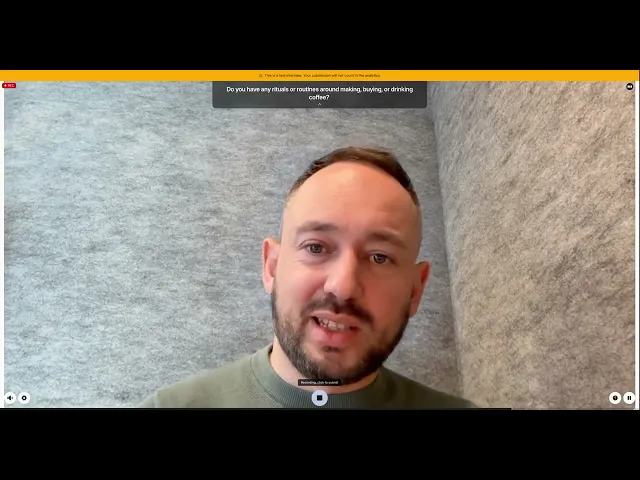
Researchers capture tone, pauses, and contradictions that transcripts and surveys miss because every session is recorded. That is valuable information a written summary drops.
Where this guide meets Conveo
A discussion guide built from a decision, modules, and probe ladders is what makes a study's findings traceable and turns hours of interviews into meaningful insights. Conveo holds research to that standard: each theme links to the participants behind it, with video clips and verbatim quotes stakeholders can audit.
That traceability compounds. A searchable insight library recognizes recurring themes and facets across studies, so the next guide starts from what earlier studies already established. Over several studies, that builds a deep understanding of the people a team researches, and each new interview process starts further ahead.
The researcher still owns the parts that need judgment:
Writing the questions and their intents.
Reviewing the evidence.
Deciding what the findings mean for the business.
Conveo's AI research assistant runs the AI-moderated interviews and a first-pass analysis, so the team can analyze interview data in qualitative research from coded themes to stakeholder-ready findings.
"You see them physically doing it. Testing the product for the first time, being probed right there. That unfiltered, in-the-moment reaction is possibly the most powerful thing you can see as a researcher."
Dafydd Jones, Associate Director, Ninth Seat
Frequently asked questions
What makes an in-depth interview question "good" versus just well-worded?
A good question is open-ended, anchored in a recent, specific behavior, and carries an intent the moderator can probe against when the first answer is vague. A well-worded question with no intent attached still fails the moment a participant says "it's fine."
How many interviews do I need per segment?
Plan five to 15 interviews per behavioral segment. For focused research questions, that range typically reaches pattern saturation without bloating the study or the synthesis. Segments that behave differently need their own quotas.
Should I translate a discussion guide literally for other markets?
No. Literal translation keeps the words but loses the question, since directness, idiom, and tone vary by market. Localize examples, keep the intent constant, and pilot each language version before data collection begins.
What's the difference between a probe and a follow-up question?
A probe is tied to a specific signal: a vague answer, a hesitation, or something unexpected. A generic follow-up without that logic just restates the original question, while a probe asks participants to provide examples or explain a pause.
Can an AI-moderated interview follow a probe ladder the way a human moderator does?
It can follow the guide's logic when the intents and research objectives are written clearly. Conveo's AI research assistant asks follow-up questions when an answer is vague or leaves a gap, building on what the participant said earlier. Whoever moderates, the guide's logic determines whether the session runs as a natural conversation that follows unexpected answers or skips past them.

About the author
Meg Gerli
Research Impact Lead
Meg is a Research Impact Lead at Conveo, working with insights and research teams on the studies they run with Conveo.
Meet Meg on film →Qualitative insights at the speed of your business.
Conveo runs AI-moderated video interviews and structures everything they say.